
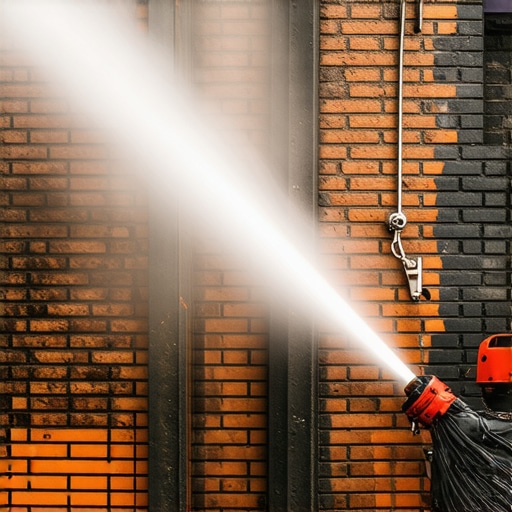
The Forensic Scene: When Carbon Masks Decay
The facility manager thought it was just a century of character—a thick, velvety black patina that gave the old textile mill its ‘historic’ look. But when I put my scope inside a hairline fracture near the lintels, I saw a nightmare. The soot wasn’t just sitting on the surface; it had fused with sulfur dioxide from decades of coal smoke to form a gypsum crust. Behind that crust, the structural clay was literally turning to powder. The homeowner or building owner sees a black wall; I see a chemical reaction that is slowly eating the building from the inside out. This is the reality of stone facade restoration in an industrial context. You aren’t just cleaning; you are performing an emergency extraction of corrosive pollutants. Before you even think about re-pointing services or aesthetic fixes, you have to understand the physics of the ‘crust’ and the ‘pore.’
“Chemical cleaning should be the gentlest method possible to achieve the desired result, as aggressive techniques often cause irreparable damage to the masonry’s protective outer skin.” – NPS Preservation Brief 1
The Chemistry of the Carbon Crust
Industrial soot is a complex beast. It’s not just ‘dirt.’ It is a microscopic jagged particle of unburned carbon, often saturated with oils and acids. On a porous substrate like red clay brick or limestone, these particles find their way into the ‘tooth’ of the material. Over decades, moisture moves through the brick via capillary action. As the water evaporates, it leaves behind dissolved salts. When these salts meet the soot layer, they crystallize, hardening the soot into a shell that is harder than the brick itself. This is why you see spalling—the brick face literally pops off because it can no longer ‘breathe’ through the black shroud. We call this a differential expansion failure. If you hit that with a 4000-PSI pressure washer, you’re not just removing soot; you’re skinning the building alive. You’ll blow out the ‘fire-skin’ of the brick, leaving the soft, inner core exposed to the next freeze-thaw cycle. In my thirty years of spreading mud, I’ve seen more buildings destroyed by ‘cleaners’ than by a century of neglect.
The Restoration Reality: Why Breathability is Life
In the world of stone facade restoration, we live by a sacred rule: the mortar must be the sacrificial lamb. In those old industrial stacks, the tuckpointing was likely done with a high-lime-content mortar. This is soft, flexible, and porous. It allows moisture to escape through the joints rather than through the brick. When a modern ‘handyman’ comes along and tries to fix a soot-stained wall by buttering the joints with hard Type S Portland cement, they’ve just signed a death warrant for the facade. The hard cement traps water. The water freezes, expands by 9%, and because the cement won’t budge, the brick shatters. This is the ‘suction’ of the system—the masonry must be allowed to transpire. If you’re dealing with stone veneer repair on a modern addition to a soot-stained industrial building, the same rules apply. You cannot trap moisture behind the stone with ‘lick-and-stick’ techniques that ignore drainage planes.
“Water penetration is the single greatest threat to masonry durability, necessitating proper joint integrity and material compatibility.” – BIA Technical Note 7
The High-Tech Forensic Toolkit
We’ve come a long way from just tapping bricks with a slicker to hear the ‘ring.’ Today, a proper forensic inspection involves drone chimney inspections to catch early signs of carbonization in the high-heat zones where soot is most acidic. We’re even using digital twin masonry projects to map every single soldier course and cold joint in a 3D model. This allows us to track crack propagation over years, distinguishing between simple thermal expansion and serious structural settlement that might require foundation slab jacking. If the building is leaning because the heavy industrial vibration has liquidated the subsoil, cleaning the soot is like putting a band-aid on a gunshot wound. You have to stabilize the base before you beautify the face. This is especially true for those massive retaining wall drainage upgrade projects often found around industrial sites, where hydrostatic pressure is trying to push a thousand tons of soot-stained earth through your wall.
The Process: How a Master Cleans the Ghost
The real secret isn’t a bigger pump; it’s a better poultice. We use an alkaline pre-wash to swell the carbon particles, followed by a micro-abrasive or a specialized chemical peel that grabs the soot and pulls it out of the pores as it dries. You have to be careful about the ‘flash setting’ of your cleaning agents in the sun, just like you have to worry about your tile grouts on masonry drying too fast. Once the soot is gone, you’ll likely find the joints are ‘honeycombing’—full of tiny voids. This is when the real re-pointing services begin. We grind out the old, decayed mud to a depth of at least twice the width of the joint, wash it to ensure good ‘suction,’ and then tightly pack in new, lime-rich mortar in ‘lifts.’ It’s slow work. It’s hard on the hawk and the wrists. But when you strike that joint with a slicker and see it compress perfectly, you know that building is good for another hundred years. Whether you’re doing a stone facade restoration or building an outdoor kitchen masonry build for the factory owner’s rooftop, the physics of the bond never change. Do it once, or do it twice—the choice is always the owner’s, but the consequence is the brick’s.