
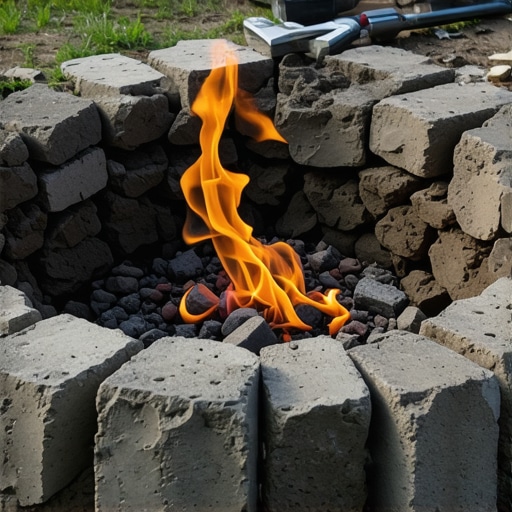
I remember the forensic scene like it was yesterday. A homeowner in a high-end suburban lot had spent nearly ten thousand dollars on a custom outdoor living space, but his centerpiece—a massive, circular masonry fire pit—was nothing more than a glorified ash tray. Every time he lit a match, the yard filled with a thick, choking grey smoke that refused to lift. When I put my inspection scope down into the base of the structure, the reality was grim. The contractor hadn’t built a fire pit; he had built a stone-lined tomb. There was no intake, no pressure differential, and the interior wall was already showing signs of thermal shock because he used standard red clay bricks instead of refractory materials. The structural steel reinforcement I saw through the lens was already starting to scale and rust from trapped moisture. It was a failure of physics, disguised as a luxury amenity.
The Thermal Dynamics of a Dying Fire
Most people think a fire pit is just a hole you put wood in. As a third-generation mason, I can tell you that’s the fastest way to waste a cord of oak. To get a clean burn, you need to understand the Venturi effect and the sheer physics of oxygen draw. When a fire burns, it consumes oxygen at a rapid rate, creating a low-pressure zone. If your masonry walls are solid, the only way for oxygen to get in is to fight its way down through the rising smoke. This turbulence creates that stinging, swirling smoke that ruins a backyard party. When we talk about commercial smokestack repair, we focus on the draft; a fire pit is simply a short-scale version of that same engineering challenge. Without a clear path for air to enter at the base, the fire suffocates on its own exhaust.
“Refractory mortars and firebrick must be utilized in any environment where temperatures exceed 500 degrees Fahrenheit to prevent catastrophic spalling and structural failure.” – ASTM C199 Standard
Selecting the Bone and Sinew: Material Science
Before you ever pick up a hawk and trowel, you have to choose your materials based on the heat. I see handymen using tile grouts on masonry fire pits all the time—it’s a death sentence for the build. Grout is too rigid; it doesn’t have the thermal expansion capacity required. For the inner core, you need high-alumina firebricks. These aren’t your standard street pavers. Firebricks are fired at much higher temperatures and possess a chemical composition that allows them to expand and contract without the crystalline structure shattering. When you’re buttering these bricks, you don’t use standard Type S mortar. You use a refractory mud that sets chemically rather than just drying out. If you’re looking for an aesthetic that matches an older home, you might use historic brick salvage for the exterior veneer, but that inner core must be modern engineering. I’ve even seen 3D printed masonry repairs used to create custom internal vents that traditional casting couldn’t achieve, allowing for precision-engineered oxygen channels within the stone walls.
The Anatomy of the Build: Birdsmouth Cuts and Airflow
To get the airflow right, you need to integrate intake vents. This is where masonry birdsmouth cuts come into play. By cutting a ‘V’ shape into the base course of the stone or brick, you create a series of triangular openings that allow cool air to be sucked into the bottom of the fire. This air then travels upward, feeding the base of the coals and pushing the smoke straight up in a columnar flow. When I’m laying the soldier course around the top, I’m looking for that ‘ring’ of the brick. If it doesn’t ring true, it has an internal fissure that will pop the moment the heat hits it. I also recommend chimney interior parging techniques on the inside of the outer stone wall. By smoothing out the interior surface with a lime-based parge coat, you eliminate the nooks and crannies where soot and creosote can build up, which also helps the air flow more smoothly—a concept we often borrow from commercial smokestack repair projects.
“Water penetration is the single greatest threat to masonry durability, especially when combined with thermal cycling which accelerates the expansion of internal fissures.” – BIA Technical Note 7
The Physics of Heat Dissipation
In hot climates like Arizona or Texas, the enemy isn’t just the fire; it’s the ambient sun hitting the stone all day combined with the internal heat. If you don’t leave a ‘dead air’ space between your firebrick liner and your exterior stone veneer, the heat transfer will crack your expensive fieldstone. This is where green roofing masonry integration logic can actually help. By creating a tiered drainage and ventilation system at the base, you allow the masonry to ‘breathe’ and dissipate heat. This prevents the ‘flash setting’ of the mortar during the build and ensures that the brick wall restoration you might be doing alongside the pit doesn’t suffer from the heat of the fire. After the build is done, a thorough masonry cleaning using a mild muriatic acid solution or a non-reactive detergent is essential to remove any excess mud from the faces of the brick, ensuring the ‘tooth’ of the stone is visible and the aesthetics are as sharp as the engineering.
The Restoration Reality: Saving a Failing Pit
If you’re dealing with an existing pit that’s falling apart, don’t just slap some mortar in the cracks. That’s a ‘handyman special’ that won’t last a season. You need to look at historic pointing styles. For older structures, using a soft lime mortar allows for movement. If the bricks are flaking off—a process we call spalling—it’s usually because someone used a mortar that was harder than the brick itself. The brick wall restoration process requires grinding out the old, dead joints to a depth of at least an inch and repointing with a mix that matches the original compressive strength. If the pit is truly far gone, I’ve found that 3D printed masonry repairs can be used to fabricate custom-fit ‘plugs’ for large voids that are then buttered into place, saving the historic look while providing modern structural integrity. Do it once, do it right, and you’ll have a fire that burns hot and clean for fifty years. Do it cheap, and you’ll be calling me back to haul away a pile of rubble in three.