
I remember my uncle, a man whose hands were so perpetually stained with red clay and lime that he looked like he was carved out of the earth itself, stopping me before I buttered a single brick on a restoration project in 1994. He didn’t look at the blueprint; he looked at the sky and then at the brick. He grabbed a handful of the sand we were using for our mud and squeezed it. If it doesn’t hold the shape of your palm, he’d say, the suction of the brick will rob the mortar of its life before the bond even begins. He knew that masonry isn’t a static wall; it is a breathing, moving lung of stone and lime. Today, I see contractors treating old facades like they are painting a piece of drywall, slapping on waterproof coatings without a second thought to the geotechnical reality or the chemistry of the substrate. It is a recipe for a structural autopsy.
The Physics of the Thirsty Brick
When we talk about preparing old masonry for a waterproof coating, we are dealing with the ‘tooth’ of the material. Old-world brick, fired in kilns that had hot and cold spots, is inherently variable. Some bricks are ‘clinkers’—over-fired and glass-like—while others are ‘salmon bricks,’ under-fired and porous enough to soak up water like a sponge. Before you even think about facade cleaning or application, you have to understand the vapor drive. Water moves from high pressure to low pressure, from warm to cold. In a Northern freeze-thaw climate, if you seal the exterior of a porous brick wall with a non-breathable coating, you are essentially building a dam. When that trapped moisture hits the freezing point, it expands by 9 percent. That expansion force is greater than the tensile strength of the brick itself. The result? The face of the brick pops off in a process we call spalling. This isn’t just an aesthetic nightmare; it’s a structural failure.
“Water penetration is the single greatest threat to masonry durability. Proper drainage and vapor permeability are essential for the longevity of any masonry assembly.” – BIA Technical Note 7
The Chemical Purge: Brick Efflorescence Removal and Cleaning
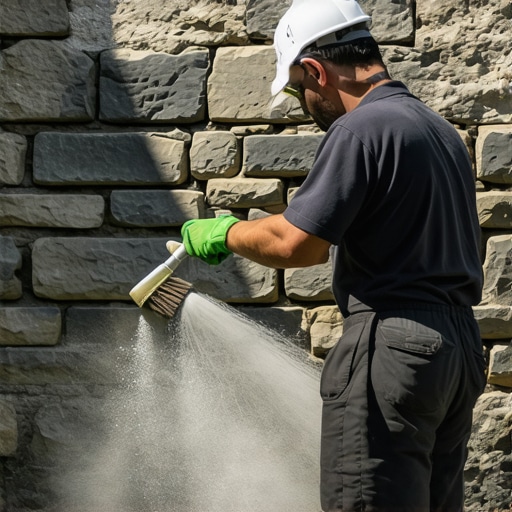
You cannot coat over salt. Brick efflorescence removal is the most ignored phase of preparation. That white, powdery ghost you see on the surface is the result of water-soluble salts traveling through the capillary network of the masonry and crystallizing on the surface as the water evaporates. If you apply a coating over these salts, the osmotic pressure will eventually push the coating right off the wall, creating unsightly blisters. We don’t just scrub it; we have to diagnose where the salt is coming from. Is it from the soil in a retaining wall installation? Or is it internal from the mortar itself? Facade cleaning for old masonry requires a surgical touch. High-pressure washing at 4000 PSI is the mark of a butcher. It destroys the ‘fire skin’ of the brick, exposing the soft inner core. We use low-pressure chemical cleaning, often with a restoration-grade detergent that neutralizes the salts without etching the surface. For commercial masonry facade maintenance, this process might take weeks of dwelling and rinsing to ensure the ‘mud’ we are about to apply actually has something to bite into.
The Sacrificial Joint: Repointing Before Coating
Before any waterproof barrier is applied, the mortar joints must be sound. In commercial smokestack repair or historic residential work, we often find that the original lime mortar has been ‘repaired’ with hard Portland cement. This is a death sentence for the wall. The mortar must be softer than the brick. It is the sacrificial lamb of the system. If the wall moves, the mortar should crack, not the brick. We grind out the joints to a depth of at least twice the width of the joint, being careful not to nick the brick edges. We then mix a Type O or Type N mortar—real ‘mud’—and butter the joints in lifts. We use a slicker to pack the mortar tight, ensuring there are no voids. Voids are where water collects, and in a retaining wall block replacement or a brick veneer installation, those voids lead to internal erosion. Only after the new mortar has cured for at least 28 days and the carbonation process is well underway can we even consider a coating.
Structural Integrity: Beyond the Surface
Sometimes the problem isn’t the surface; it’s the bones. I’ve been called to scenes where a homeowner wanted a waterproof coating to stop a basement leak, only to find the entire foundation was settling. Foundation slab jacking or the installation of helical piers might be necessary before you ever touch a paintbrush. You can’t waterproof a moving target. Similarly, if you are looking at an outdoor fireplace rebuild, the thermal expansion rates are so high that traditional waterproof coatings will simply burn off or crack within the first season. You need specialized silane-siloxane penetrating sealers that don’t form a film but rather alter the surface tension of the pores at a molecular level. This is the difference between ‘lick-and-stick’ mentalities and forensic masonry.
“The selection of mortar for repointing is dictated by the strength and porosity of the masonry units to ensure compatible movement and moisture transfer.” – ASTM C270 Standard Specification
The Trap of Modern Materials
I’ve seen too many ‘handyman specials’ where someone tried to fix tile grouts on masonry stairs by slathering them in an elastomeric paint. Within two years, the grout turned to mush because it couldn’t breathe. The ‘honeycombing’ effect inside the mortar becomes a breeding ground for mold and structural decay. When we approach commercial masonry facade maintenance, we look for the ‘cold joints’—places where new work meets old work without a proper bond. These are the entry points for the enemy. If you are doing a retaining wall block replacement, you must ensure that the hydrostatic pressure behind the wall is relieved through weep holes and gravel backfill. A waterproof coating on the front of a retaining wall without drainage on the back is just a way to make the wall fall over faster. It turns the wall into a sail, and the wind of the earth’s pressure will eventually win.
The Master’s Verdict: Do It Once
Preparing an old surface is 90% of the job. The coating is just the final 10%. It requires a deep respect for the chemistry of the past and the physics of the future. You have to feel the grit of the brick, understand the suction of the surface, and respect the power of water. Whether it’s a brick veneer installation on a new home or a commercial smokestack repair on a century-old factory, the principles remain the same: clean it, fix the structure, ensure the breathability, and never, ever trust a ‘one-size-fits-all’ solution. If you don’t hear the ‘ring’ of the brick when you tap it, you aren’t ready to coat. You’re just covering up a corpse. Real masonry isn’t about hiding flaws; it’s about making the structure’s soul resilient against the elements for another hundred years.