
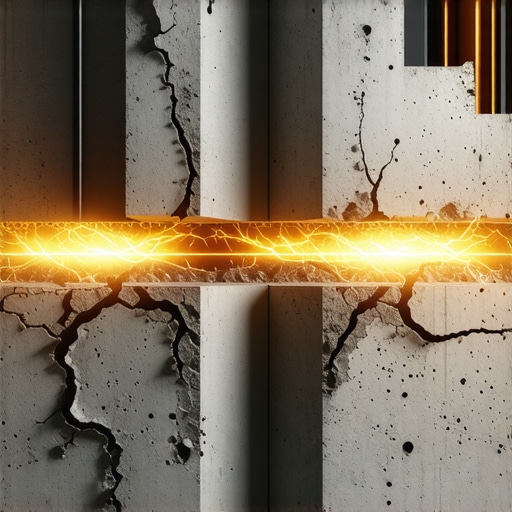
The Forensic Scene: When a Hairline Crack Becomes a Structural Grave
I was standing in a damp basement in a mid-century colonial last November, the kind of place where the air smells like wet wool and ancient limestone. The homeowner pointed to a thin, jagged line running vertically through the concrete block. She thought it was just a hairline crack, a minor blemish from the house ‘settling.’ But when I slid my fiber-optic scope into a drill-hole I’d bored through the mortar joint, the reality was grim. Behind that seemingly innocent fissure, the structural steel was rusted to dust. The horizontal reinforcement had vanished, oxidized into a reddish powder by decades of moisture infiltration. This is the reality of traditional masonry: it is a battle against the entropy of water. We spend our lives fighting the freeze-thaw cycle, applying brick spalling prevention coatings, and praying the hydrostatic pressure doesn’t win. But a new player has entered the arena: self-healing concrete. Does it mean the end of the foundation wall bowing repair industry, or is it just another ‘handyman special’ miracle cure?
The Physics of the Breach: Why Foundations Fail
Before we talk about the ‘magic’ of self-healing materials, we have to understand the enemy. In the North, we deal with the brutal 9% expansion of water as it transitions to ice. When water enters the micro-capillaries of a concrete wall or a brick face, it’s like a slow-motion explosion. This is why brick spalling prevention is so critical; if you don’t seal those pores, the face of the brick eventually pops off, leaving the soft inner core exposed to the elements. For commercial parapet wall repair, this cycle is even more vicious because the wall is exposed on both sides, subjected to extreme thermal swings.
“Water penetration is the single greatest threat to masonry durability.” – BIA Technical Note 7
When a foundation bows, it’s usually due to hydrostatic pressure—the weight of water-saturated soil pushing against the wall. Without proper retaining wall installation techniques, like a 1:6 batter correction or integrated drainage, the wall will eventually succumb to gravity. This is where fiber-reinforced mortars and carbon fiber straps come in, providing the tensile strength that concrete lacks.
The Bio-Chemical Miracle: How Concrete ‘Heals’ Itself
Self-healing concrete, or ‘bio-concrete,’ isn’t just a marketing term; it’s a micro-biological feat of engineering. The tech involves embedding dormant bacteria—typically Bacillus pseudofirmus—into the concrete mix along with calcium lactate capsules. When a crack forms, water and oxygen enter the breach and wake the bacteria up. They begin to feed on the calcium lactate, and through a chemical reaction, they secrete calcite (limestone), which effectively plugs the crack from the inside out. It’s like the concrete is growing its own scar tissue. This process addresses foundation wall bowing repair at the molecular level before the crack can expand enough to let in chloride ions that rot the rebar. However, while this works for micro-cracks, it won’t fix a retaining wall batter correction issue caused by poor soil compaction. You can’t ‘heal’ a wall that was built on a bad base.
The Hardscape Reality: From Pavers to Parapets
While we talk about high-tech foundations, the basics of brick paver driveway repair still rely on old-school physics. A ‘wavy’ driveway isn’t a failure of the brick; it’s a failure of the compaction. If you don’t have 8 inches of crushed aggregate, compacted in 2-inch ‘lifts,’ those pavers will sink. No amount of self-healing bacteria will fix a base that’s shifting like quicksand. Similarly, brick efflorescence removal is a chemical battle against salt. When water moves through masonry, it dissolves internal salts and brings them to the surface. If you see white crust, the ‘mud’—the mortar—is breathing out its minerals. To stop it, you need to break the capillary chain. This is why green roofing masonry integration is so complex; you are literally putting the source of moisture (soil and plants) on top of the structure, requiring a perfect seal and advanced drainage planes to prevent the brick from drinking the garden’s water.
Modern Aesthetics and Ancient Physics
Even when we get into the fancy stuff like metallic brick colors application, the physics of the ‘slicker’ and the ‘hawk’ don’t change. You are applying a finish that must bond with the substrate. If the substrate is ‘honeycombing’—filled with air pockets from a bad pour—the finish will fail. In commercial parapet wall repair, we often see cold joints where the concrete was poured in stages and didn’t bond correctly. These are the weak points where the ‘self-healing’ agents are most needed but often hardest to implement.
“The durability of a masonry wall is inversely proportional to the rigidity of the mortar used in its restoration.” – ASTM C270 Commentary
We have to remember that a wall needs to move. If you use a mortar that is too hard on old brick, the brick will shatter. This is why fiber-reinforced mortars are a godsend; they provide flexibility and ‘tooth’ without the brittle nature of high-Portland mixes.