
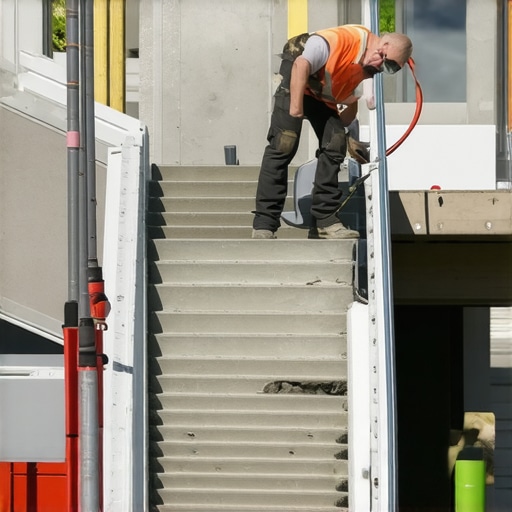
The homeowner thought it was just a hairline crack. But when I put my scope inside, I saw the structural steel was rusted to dust, and the soil beneath the front stoop had vanished into a subterranean void. This isn’t just about aesthetics; it’s about the cold, hard physics of settlement. When a three-ton slab of concrete begins to tilt, it’s a silent, slow-motion catastrophe that speaks volumes about what’s happening in the dark reaches of your subgrade. As a third-generation mason, I’ve seen people try to fix this with a bucket of premixed ‘mud’ and a prayer. It never works. You can’t fix a geological failure with a surface-level Band-Aid. You need to understand the ‘why’ before you can execute the ‘how.’
The Physics of the Void: Why Concrete Fails
Concrete steps don’t just ‘sink’ because they feel like it. In the North, we deal with the relentless brutality of the freeze-thaw cycle. Water is the great destroyer. It finds its way into the microscopic pores of the concrete and the gaps between the slab and the foundation. When that water freezes, it expands by roughly 9%, exerting thousands of pounds of pressure. This is the same force that shatters engine blocks. In the thaw, that water carries away fines—the small particles of sand and soil—creating a cavity. This is where foundation underpinning logic usually comes in, but for steps, we can often solve the problem without digging to China. If you ignore the void, you’re just waiting for the next deep freeze to turn your steps into a pile of rubble. We look for brick quoin repair needs or brick infill panel repair requirements elsewhere on the structure, as these are often the ‘canaries in the coal mine’ for wider settlement issues.
“The stability of any masonry or concrete structure is entirely dependent upon the bearing capacity of the soil beneath it and the management of hydrostatic pressure.” – ASTM D1557: Standard Test Methods for Laboratory Compaction Characteristics of Soil
Mudjacking vs. Lightweight Polymer Lifts
For decades, the standard answer was mudjacking. We’d pump a heavy slurry of cement, sand, and dirt under the slab. The problem? You’re fighting weight with weight. That slurry is heavy—sometimes 100 to 150 pounds per cubic foot. If the soil failed once under the weight of the concrete, why the hell would you add another ton of wet mud to the mix? It’s a cold joint waiting to happen. This is where the chemistry of lightweight polymer lifts—or ‘poly-jacking’—changes the game. We use a high-density, closed-cell polyurethane foam. It’s light, roughly 2 to 4 pounds per cubic foot, but it has the compressive strength to support an 18-wheeler. When the two components of the polymer mix at the tip of the injection gun, a chemical reaction occurs. It’s a rapid expansion that seeks out the path of least resistance, filling every nook, cranny, and wormhole in that soil void before it begins its vertical lift.
The Micro-Zoom: The Chemistry of Polyurethane Injection
The magic happens at the molecular level. We’re talking about an exothermic reaction between a polyol resin and an isocyanate. As these chemicals react, they create billions of tiny, gas-filled cells. This expansion isn’t just ‘puffing up’; it’s a controlled hydraulic force. As a forensic inspector, I watch the ‘tooth’ of the concrete. I’m looking for that first millimeter of movement. Unlike a heavy cement slurry, the polymer is hydrophobic. It doesn’t care if the ground is damp. It actually displaces standing water, which is a massive win when you’re dealing with the typical poor drainage that leads to sinking steps in the first place. This isn’t some modular masonry construction shortcut; it’s high-stakes material science. We use advanced masonry adhesives to seal the injection ports afterward, ensuring the finish is as clean as the structural fix.
The Forensic Inspection: Beyond the Steps
Whenever I’m called out for a concrete lift, my eyes are scanning the rest of the envelope. Sinking steps are rarely an isolated incident. I’m looking at the chimney flashing repair needs, because if the house is shifting, the chimney is often the first thing to pull away. I’m checking for brick patio restoration requirements nearby, as a sinking stoop often means the patio’s sub-base is also compromised. If I see a brick paver driveway repair that was done poorly, I know the contractor didn’t understand compaction. We often see homeowners trying to hide these structural flaws with a fresh metallic brick colors application, but you can’t paint over a structural failure. I’ve seen retaining wall geogrid installation failures that started with a simple sinking step that redirected water behind a wall, eventually blowing the whole thing out. You have to look at the site as a living, breathing hydraulic system.
“The durability of masonry and concrete systems is inextricably linked to the moisture management of the surrounding landscape.” – BIA Technical Note 7: Water Resistance of Brick Masonry
The Process: Precision over Power
We start by drilling penny-sized holes—much smaller than the massive craters required for old-school mudjacking. We then ‘butter’ the ports to ensure a tight seal. As we inject the foam, we monitor the slab with laser levels. It’s a surgical process. We aren’t just ‘jacking’ it up; we’re ‘floating’ it. We’re looking for that sweet spot where the slab returns to its original soldier course alignment with the rest of the masonry. If you over-lift, you’ve just created a new problem. This is a job for a slicker and a level, not a sledgehammer. Once the lift is complete, the foam hardens in minutes. You can walk on it almost immediately, unlike cement-based repairs that require days of ‘curing’ while you pray for no rain. The final step is a honeycombing check of the surrounding soil to ensure no other voids are lurking nearby. This is how you build a legacy, not just a ‘fix.’ It’s about doing it once, doing it right, and respecting the materials. Anything less is just a handyman special that will fail before the next season turns.