
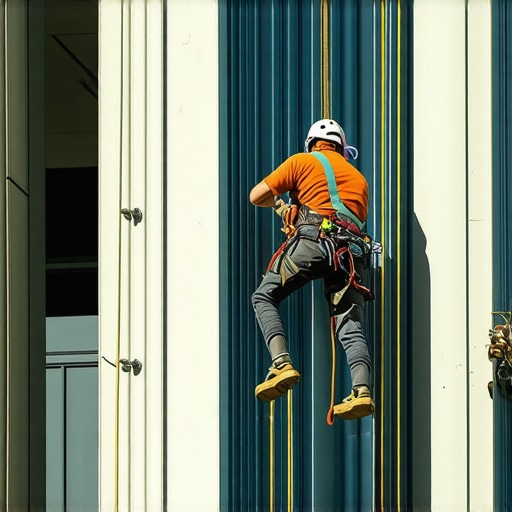
The building manager thought it was just a bit of peeling paint on the 14th-floor lintels. But when I got up there on the swing stage and put my borescope into the cavity, I saw the structural steel angle was rusted to a flakey, orange dust, expanding with enough force to heave three courses of brick out toward the sidewalk. This wasn’t a cosmetic issue; it was a structural countdown. In my forty years of swinging a hammer and peering into the guts of skyscrapers, I’ve learned that masonry doesn’t scream when it’s failing—it whispers in cracks and salt-stains until gravity finally wins the argument.
The Physics of the High-Rise Facade
High-rise masonry isn’t just a static wall; it’s a living, breathing lung that undergoes massive thermal expansion. On a 90-degree day in July, the south-facing brick on a thirty-story tower can reach 140 degrees Fahrenheit. The brick expands, but the internal steel or concrete frame doesn’t move at the same rate. This differential movement is the primary killer of modern facades. Without properly designed control joints, the wall essentially tries to tear itself apart. We see this often in professional masonry restoration: vertical cracks that align perfectly with the internal columns of the building. These aren’t just ‘settling’ cracks; they are the result of the building’s ‘skin’ being too tight for its ‘bones.’
“Water penetration is the single greatest threat to masonry durability.” – BIA Technical Note 7
When water finds its way behind the veneer, the real forensic nightmare begins. In Northern climates, the freeze-thaw cycle is a relentless jackhammer. Water enters a microscopic pore in the brick, freezes, and expands by approximately 9%. This internal pressure exceeds the tensile strength of the clay, causing the face of the brick to pop off. This is what we call spalling. While a spalled concrete steps repair might be a weekend project for a homeowner, spalling on a high-rise balcony or cornice is a liability that can lead to catastrophic failure. The fix isn’t just slapping a concrete patch over the hole; it’s about addressing the electrochemical process of carbonation that is eating the rebar from the inside out.
The Chemistry of Mortar and Historic Integrity
One of the biggest mistakes I see ‘modern’ contractors make is using a high-strength Portland cement mortar on a building that was built before 1940. I’ve seen beautiful facades ruined because someone thought ‘stronger is better.’ It’s a lie. Old bricks are soft, fired at lower temperatures, and they need to breathe. If you use a hard Type S mortar for tuckpointing brick walls on a historic structure, you have essentially created a wall where the joints are harder than the units. When the building shifts, the bricks will crack because the mortar refused to yield. This is why historic mortar analysis is the first step in any legitimate restoration. We take a sample of the original ‘mud’ to a lab to determine the sand-to-lime ratio. We want a mortar that is sacrificial—something that will absorb the stress and the moisture so the brick doesn’t have to.
“The durability of a masonry wall is as much a function of the mortar’s flexibility as its strength.” – ASTM C270 Standards
The process of professional masonry restoration involves more than just a slicker and a hawk. It requires a deep understanding of the ‘tooth’ of the material. When we are tuckpointing brick walls, we aren’t just smearing new mud over the old. We grind out the failing joints to a depth of at least twice the width of the joint, creating a clean, square shoulder. If you ‘feather-edge’ the mortar, it will peel off like a scab in three years. You have to ‘butter’ the joints properly, ensuring no ‘cold joint’ is formed where the new material meets the old. This is the difference between a repair that lasts a decade and one that lasts a generation.
Specialized High-Rise Systems: From Chimneys to Fire-Ratings
Managing a high-rise also means dealing with specialized structures that the average mason won’t touch. Take commercial smokestack repair, for instance. These structures face extreme thermal gradients—intense heat on the inside and freezing winds on the outside. The mortar in these stacks must withstand acid rain and flue gases that would turn standard mortar into sand in months. Similarly, internal safety is just as critical as the exterior facade. A fire-rated masonry installation in an elevator shaft or stairwell isn’t just about stacking blocks; it’s about ensuring every head joint is full and every penetration is sealed with fire-stop grout to prevent the chimney effect during a blaze. We don’t accept honeycombing in the grout or ‘hollow’ joints here; the margin for error is zero.
The Hardscape and Structural Support
While most of the focus is skyward, a manager’s maintenance plan must include the ground level. A failing retaining wall installation in the parking garage or a brick patio restoration in the common area are often the first signs of larger drainage issues. If your retaining wall is leaning, it’s not just ‘tired.’ It’s likely being pushed by hydrostatic pressure because the original contractor ‘forgot’ the weep holes or used the wrong aggregate for backfill. We treat these ground-level repairs with the same forensic intensity as the facade. We look for historic brick salvage to match the aesthetic of the original build, ensuring that even a concrete patch on a walkway doesn’t look like an eyesore but blends into the structural narrative of the property.
When to Act: The Forensic Checklist
If you see ‘efflorescence’—that white, powdery salt—it’s the building’s way of crying. It means water is moving through the masonry, dissolving salts, and depositing them on the surface. If you see ‘stair-step’ cracking, the building is telling you the foundation or the lintels are moving. Don’t wait for a piece of the cornice to hit the sidewalk. Real professional masonry restoration starts with an inspection, a borescope, and a healthy dose of cynicism toward anyone who says they can fix it with a tube of caulk. You do it once, or you do it twice—and doing it twice at thirty stories up is a mistake you only make once.