
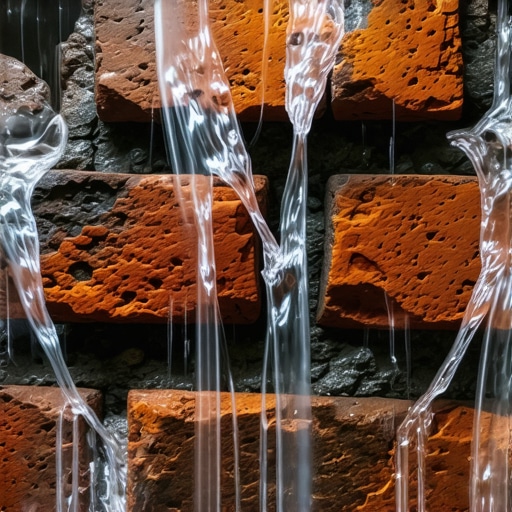
The Silent Hydraulic Ram Behind Your Walls
I’ve spent forty years listening to walls talk. Most people hear nothing until a massive foundation repair bill shouts at them. I remember a forensic scene in a 1930s estate where the homeowner thought they just had a bit of peeling paint in the cellar. I pulled out my borescope and threaded it through a hairline fracture in the mortar. What I saw on the screen looked like a cave system; the structural steel lintels were rusted to orange dust, and the interior wythe of the brick was turning back into mud. The weight of the house was resting on little more than hope and wet dust. This is the reality of hydrostatic pressure. It isn’t just ‘water’—it’s a slow-motion hydraulic ram that exerts thousands of pounds of force against your masonry every single time it rains.
The Physics of Subsurface Destruction
When soil becomes saturated, the water trapped between the dirt particles has nowhere to go but against your foundation. This is hydrostatic pressure. To understand the micro-zooming of this process, you have to look at the ‘meniscus’ of a water droplet. In a porous material like a clay brick, capillary action pulls that water deep into the substrate. If you live in a region where the thermometer dips below thirty-two degrees, that water undergoes a phase change. It expands by nine percent. That expansion doesn’t just happen on the surface; it happens inside the pore structure of the brick. This is what causes spalling—where the face of a beautiful brick simply pops off, leaving a soft, orange core exposed to the elements.
“Water penetration is the single greatest threat to masonry durability. Without proper management of moisture, the structural integrity of any masonry assembly is compromised over time.” — Brick Industry Association (BIA) Technical Note 7
The Anatomy of a Bowing Wall
I often see foundation wall bowing repair jobs that could have been avoided if the owner understood the ‘coefficient of friction’ in their soil. When water can’t drain away, the soil swells, pushing the wall inward. You’ll first notice a stair-step crack or a horizontal rift mid-way up the wall. This is a sign that the mortar joints have failed under shear stress. In these cases, we don’t just ‘slap some mud’ on it. We look at digital twin masonry projects, using LiDAR scanning to map the exact deflection of the wall down to the millimeter. This allows us to determine if we need foundation slab jacking to level the floor or if the structural repointing must be supplemented with carbon fiber straps.
Chimneys: The Vertical Aquifer
A chimney is essentially a giant straw standing in the rain. Most people ignore them until they see a brown stain on their living room ceiling. Our chimney leak detection process often reveals that the chimney interior parging—that protective layer of mortar inside the flue—has eroded. When acidic flue gases mix with moisture, they create a corrosive soup that eats through the mortar from the inside out. This is where masonry rescue after disaster becomes a necessity. If the ‘mud’ has turned to sand, the entire stack becomes a fire hazard. We use a hawk and a specialized slicker to reach deep into those joints, but if the damage is too far gone, we’re looking at a full teardown.
The Science of the Cure: Beyond the Band-Aid
Many handymen will suggest a ‘lick-and-stick’ solution using heavy-duty brickwork sealants application. Be careful. If you seal a wall that is already holding moisture, you are essentially gift-wrapping a bomb. The water gets trapped, freezes, and destroys the brick even faster. Proper tuck pointing services aren’t about aesthetics; they are about ‘breathability.’ We use a sacrificial mortar—something softer than the brick itself. In historic restoration, we often use Type O or Type N lime-based mortars. Why? Because the mortar must be the one to fail, not the brick. It’s a sacrificial lamb for the structure.
“The selection of mortar for restoration must ensure that the mortar is weaker than the masonry units so that it accommodates movement and moisture without causing the units to crack.” — ASTM C270 Standard Specification
Foundation Crack Repair and Structural Integrity
If you see a cold joint—a place where two different concrete pours didn’t bond—water will find it. If you see honeycombing in your concrete, water will inhabit it. Foundation crack repair is a surgical process. We might use high-pressure epoxy injections for narrow fissures, but for a wall that is actively moving, we look at structural repointing and soil stabilization. We have to address the root cause, which is almost always the ‘angle of repose’ of the saturated soil pressing against the basement. Foundation wall bowing repair is not a weekend DIY project; it’s a battle against gravity and fluid dynamics. Do it once, do it right, or get ready to do it again when the house starts to lean.
The Hard Truth of Masonry Maintenance
Stop looking at your brickwork as a static object. It is a living, breathing skin. When that skin gets ‘clogged’ with the wrong paint or cheap cement-heavy mortar, it suffocates. Check your downspouts. Look for efflorescence—that white, salty powder that looks like frost. That’s the wall’s way of crying. It means water is moving through the masonry and pulling minerals to the surface. If you ignore those cries, you’ll eventually need a full-scale masonry rescue after disaster. Keep the water moving away from the house, keep your joints tight with professional tuck pointing services, and never trust a contractor who doesn’t own a level and a proper set of slickers. In this trade, the details aren’t just details; they’re the only thing keeping the roof over your head.