
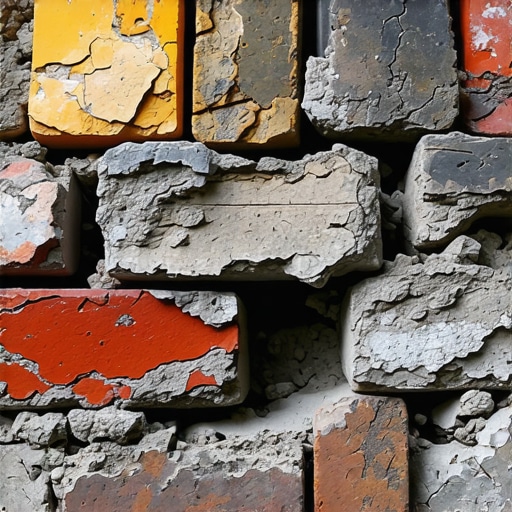
The Forensic Scene: The Borescope Doesn’t Lie
The property manager told me it was just a cosmetic blemish, a thin line running through a soldier course on the third floor of the office complex. He wanted a quick tuck pointing services quote to ‘make it pretty’ before the board meeting. I didn’t reach for my slicker; I reached for the borescope. When I slid that optical fiber into the 1/8th-inch gap, the screen didn’t show solid masonry. It showed a graveyard. The structural steel backup was so badly oxidized it looked like a stack of rusted potato chips. The brick lintel replacement that should have happened a decade ago was now a looming catastrophic failure. That single cracked block wasn’t a blemish; it was a scream for help. In this business, if you don’t listen to the individual units, the entire building will eventually speak for itself in the language of gravity.
The Physics of the Single Unit Failure
Masonry is a game of compression. Every block, every brick, and every stone is a soldier in a heavy-duty army. But when one soldier deserts, the load redistribution starts a slow-motion riot. We are talking about commercial masonry facade maintenance where the physics of the North’s freeze-thaw cycle are the primary antagonist. When water finds its way into a micro-fissure, it isn’t just ‘wet.’ It is a ticking bomb. As temperatures drop, that liquid undergoes a phase change, expanding by exactly 9%. This expansion creates internal tensile stresses that clay and concrete were never designed to handle. This is where spalling begins, often seen in high-exposure areas like chimneys where chimney interior parging has failed, allowing moisture to migrate from the inside out.
“Water penetration is the single greatest threat to masonry durability. Moisture can cause efflorescence, freeze-thaw damage, and corrosion of embedded metals.” – BIA Technical Note 7
When you spot a block that looks slightly out of plane—maybe it’s protruding by a fraction of an inch—you are witnessing hydrostatic pressure or thermal jacking. In the heat of the summer, a long expanse of wall without proper control joints can expand significantly. If the brick veneer installation was done without a ‘soft’ joint, that expansion has nowhere to go but out. This results in ‘bowing’ or ‘bellying’ of the wall. If you’re managing a site, you should be looking for the ‘ring’ of the brick. My mentor always said that if you tap a unit with your trowel handle and it sounds like a dull thud instead of a clear bell-tone, the bond is dead. The mud has failed.
The Anatomy of Structural Distress
Identifying the single failing block requires understanding the ‘Crack Language.’ A stair-step crack follows the tuck pointing services joints and usually signals a foundation settlement. But a crack that shears directly through the block? That is a sign of massive localized pressure or a failing brick lintel. When a lintel—the steel beam over a window or door—starts to rust, it undergoes ‘expansive’ corrosion. It grows in size, lifting the masonry above it and crushing the blocks at the corners. This is why brick lintel replacement is a surgical procedure; you have to support the entire load of the building above while you swap out the rotted heart of the opening.
In the world of commercial smokestack repair, the stakes are even higher. These structures endure extreme thermal gradients. The inside might be 400 degrees while the outside is sub-zero. This creates a shearing force within the masonry itself. We often see honeycombing in the mortar or blocks that have literally turned to dust because the chemicals in the exhaust gases have reacted with the lime in the mortar. For these high-consequence environments, we are now utilizing digital twin masonry projects. By creating a 3D digital replica of the stack, we can track the movement of a single block over years, predicting failure before a 20-pound chunk of masonry falls 200 feet to the ground.
The Modern Mason’s Arsenal: From Hawks to Robots
While I still value the feel of buttering a brick by hand, the industry is shifting. For large-scale commercial masonry facade maintenance, robotic masonry repair is no longer science fiction. These systems can strip out old mortar joints with a precision that no human with a grinder could ever match, ensuring that we don’t damage the ‘skin’ of the brick during the process. This is critical when dealing with historic facades where the brick is softer than the modern cement a handyman might try to use. You have to use a sacrificial mortar—something with a high lime content—so that the mortar wears out before the brick does.
“Masonry units must be laid with full mortar joints to ensure load distribution and water resistance. Voids in the mortar bedding lead to localized stress concentrations.” – ASTM C270 Standard Specification
Take outdoor masonry fountain restoration as an example. These are the most difficult environments because the masonry is constantly saturated. If you use the wrong mud, the minerals in the water will cause a chemical reaction that expands the mortar, blowing the stones apart from the inside out. It’s a slow-motion explosion. You need a cold joint strategy and specialized waterproofing parging to keep the structure sound. When we repair a brick column, we aren’t just replacing bricks; we are analyzing the load-path. Is the column sinking? Is it twisting? Brick column repair often requires temporary shoring that would make a bridge engineer nervous.
The High Cost of the ‘Band-Aid’ Fix
I see it every week: a homeowner or facility manager hires a guy with a bucket of premixed concrete from a big-box store. They ‘smear’ some mud over a crack and call it a day. That is a death sentence for the wall. By sealing the surface with a non-breathable material, you trap moisture behind the patch. The next time it freezes, the pressure has nowhere to go, and instead of a hairline crack, you lose the entire face of the block. This is especially true in brick veneer installation, where the air gap behind the brick is the only thing keeping the house from rotting. If you plug the weep holes or the cracks with the wrong material, you’ve just built a vertical swimming pool against your structural framing.
True tuck pointing services involve grinding out the joint to a depth of at least twice the width of the joint, cleaning the dust, and then ‘pointing’ in new mortar in ‘lifts’ or layers. It is tedious. It is expensive. And it is the only way to ensure the wall lasts another fifty years. Whether you are looking at a commercial smokestack repair or a simple backyard wall, the rules of the Master Mason apply: respect the moisture, understand the load, and never trust a crack that you haven’t seen the back of. If you spot that one block that looks just a little bit ‘tired,’ don’t wait. By the time it falls, it’s usually taking its friends with it.
“, “image”: {“imagePrompt”: “A macro close-up of a weathered, cracked red brick in a commercial wall showing spalling and rusted steel lintel visible through the fissure, gritty texture, professional forensic photography style.”, “imageTitle”: “Signs of Structural Masonry Failure”, “imageAlt”: “A close-up view of a failing brick block with visible structural damage and moisture intrusion.”}, “categoryId”: 0, “postTime”: “”}