
The Forensic Scene: The Slab That Lied
The facility manager thought it was just a hairline crack, a minor blemish on a 20,000-square-foot shop floor. But when I brought in the forensic scope and started looking at the substrate density, the truth was far uglier. Beneath a thin, brittle layer of ‘lick-and-stick’ sealer, the structural concrete was essentially returning to dust. When I put my scope into a bored hole, I saw that the reinforcing steel was rusted to nothing, expanding in volume and forcing the concrete to delaminate from the inside out. This isn’t just a flooring issue; it’s a chemical civil war. If you think you can just pour a gallon of epoxy over a slab like this and call it a day, you’re not a craftsman—you’re a con artist. Preparing a damaged concrete surface for high-traffic epoxy coatings is about understanding the physics of the bond, the chemistry of the cure, and the brutal reality of hydrostatic pressure.
The Physics of the Matrix: Why Surfaces Fail
Concrete is not a solid mass; it is a porous, breathing lung of stone and chemical gels. At the microscopic level, we are looking at Calcium Silicate Hydrate (C-S-H), the glue that holds the aggregate together. In a high-traffic environment, especially in the North where the freeze-thaw cycle is a seasonal executioner, water enters the pores, expands by 9% upon freezing, and shatters those C-S-H bonds. This leads to honeycombing and spalling. If you apply epoxy over a slab that hasn’t been properly profiled, you are essentially ‘buttering’ a piece of toast that is already molding. The coating will look ‘slick’ for a month, and then it will peel up in sheets because you failed to address the laitance—that weak, milky layer of cement and sand that rises to the top during a wet pour. To get a real bond, you need to expose the ‘tooth’ of the concrete.
“Surface preparation is the most critical step in the application of any coating system. The majority of coating failures are attributed to inadequate surface preparation.” – ASTM D4258 – Standard Practice for Surface Cleaning Concrete for Coating
Step 1: Forensic Diagnosis and Moisture Testing
Before you even touch a tuckpointing machine or a grinder, you have to talk to the water. In my decades of emergency masonry repair, the culprit is almost always moisture vapor transmission (MVT). Water moves from areas of high concentration (the wet soil under your slab) to low concentration (your climate-controlled shop). If your sub-base didn’t have a 15-mil vapor barrier, that moisture is pushing upward. When you seal the top with epoxy, that water gets trapped, builds hydrostatic pressure, and causes ‘osmotic blistering.’ I’ve seen foundation wall bowing repair projects where the floor was actually heaving because the retaining wall drainage upgrade was ignored outside, forcing all the groundwater under the building. You must perform a Calcium Chloride test or use an in-situ RH probe. If the slab is ‘sweating,’ no epoxy on earth will stay stuck.
Step 2: Mechanical Profiling (Beyond the Handyman Special)
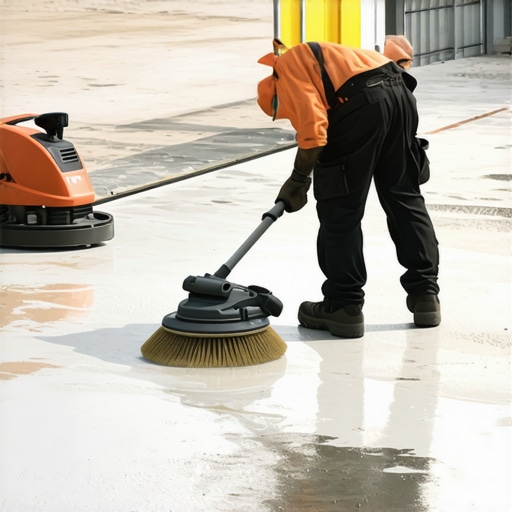
Forget about acid etching. That’s for amateurs who like the smell of burning lungs and don’t care about the long-term pH of the slab. For high-traffic epoxy, we talk in terms of Concrete Surface Profile (CSP) levels. For a heavy-duty coating, you need at least a CSP 3 to CSP 5. This requires diamond grinding or shot blasting. You are looking to create a surface texture that feels like 40-grit sandpaper. This mechanical ‘key’ is what allows the resin to ‘bite’ into the slab. Think of it like tuckpointing curved walls; the geometry of the joint is what gives the mortar its structural staying power. If the surface is too smooth, the epoxy is just sitting on top, waiting for a forklift to tear it off. We use BIM masonry projects data to map out the high-stress zones of a floor before we ever start the machines, ensuring that heavy-load paths get a deeper profile and more aggressive ‘buttering’ of the primer.
Step 3: Repairing the Structural Scars
You cannot coat over a moving crack. If you have a ‘cold joint’ that is shifting, or a crack caused by soil heaving, you need to treat it like a surgical incision. We use mortar matching services logic even in concrete repair—ensuring the repair filament has a similar modulus of elasticity to the host slab. For deep gouges, we use a fire-rated masonry installation mindset: the repair material must be tougher than the original. If you have a foundation wall bowing repair issue, you fix the structure first. You don’t put a tuxedo on a man with a broken spine. Cracks must be ‘veed’ out, cleaned of all ‘mud’ and dust, and filled with a high-modulus structural epoxy paste. If you’re dealing with exterior edges, you might even look at retaining wall weep hole cleaning to ensure that water isn’t being channeled back toward your repair zone.
“The concrete surface must be free of all laitance, oil, grease, and other contaminants that may inhibit the bond of the coating system.” – ICRI Technical Guideline No. 310.2R
Step 4: The Chemical Bond and the Finish
Once the slab is profiled and the ‘honeycombing’ is repaired, we move to the chemical phase. In the North, where road salts are tracked in, we have to worry about chlorides. Chlorides are the ‘cancer’ of concrete. We use brickwork sealants application techniques to ensure the edges are protected, but for the main slab, we want a deep-penetrating primer that can combat high pH levels. If the concrete is ‘green’ (less than 28 days old), it’s still hydrating—the chemistry hasn’t finished. Applying epoxy too early is a death sentence for the project. We wait for that ‘ring’ my grandfather used to talk about. When you strike a properly cured and prepared slab, it doesn’t ‘thud’; it ‘pings.’ That’s the sound of structural integrity. Only then do you apply your base coat, your broadcast media, and your topcoat.
The Truth About Longevity
A properly prepared slab will outlast the building it supports. A ‘handyman special’ will be peeling before the first snow. It comes down to respect for the material. Whether you are doing tuckpointing machine services on a historic facade or prepping a 50-year-old industrial floor, the physics are the same. You are fighting gravity, you are fighting moisture, and you are fighting the inherent entropy of man-made stone. Do it once, do it right, or get off the job site. The ‘mud’ never lies, and the floor will eventually tell the truth about what you did—or didn’t do—to prepare it.