
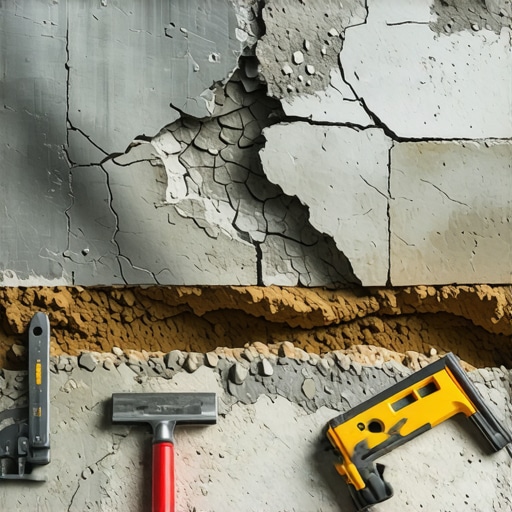
The Anatomy of a Failing Wall
The homeowner stood there, pointing a trembling finger at a hairline fracture that looked like a jagged lightning bolt running through his basement wall. He thought it was just a cosmetic nuisance, a bit of ‘settlement’ that a tube of hardware-store caulk could fix. But I’ve spent forty years reading the language of concrete masonry units (CMU), and this crack wasn’t whispering; it was screaming. When I pulled out my borescope and slipped it into one of the hollow cores of the block, the reality hit home. The vertical rebar was a ghost, rusted down to a red dust that stained the bottom of the cell, and the horizontal wire reinforcement had snapped like dry spaghetti. This wasn’t a job for a handyman with a putty knife; this was a structural emergency.
Understanding the Physics of CMU Failure
Concrete blocks, or CMU, are incredible in compression. You can stack them a hundred feet high and they will hold the weight. But they are notoriously weak in tension. When the soil beneath a footing begins to shift—a process we call differential settlement—the wall is forced to bridge a gap it wasn’t designed for. This is where the stair-step crack comes into play. It follows the path of least resistance: the mortar joints. The ‘mud,’ or mortar, acts as the sacrificial bond, but when the soil subsides, the tensile stress exceeds the bond strength of the Portland cement and lime mixture. You’ll see the crack start at the corner of a window or door and work its way down to the footing. This is the house telling you that the earth is winning.
“Structural cracks in masonry are often the result of differential settlement, where one part of the foundation moves more than the others.” – BIA Technical Note 18
The Chemistry of the Foundation: Why Walls Give Up
In the North, we deal with the brutal reality of the freeze-thaw cycle. If you haven’t invested in proper tuckpointing weatherproofing, water enters the microscopic pores of the CMU and the mortar. When that water freezes, it expands by approximately 9%. This expansion generates thousands of pounds of internal pressure, leading to spalling, where the face of the block literally pops off. But in settlement cases, the enemy is often hydrostatic pressure combined with soil shrinkage. If you have expansive clay soil, it acts like a sponge. It swells when wet and shrinks when dry, leaving the foundation hanging in mid-air. This lack of support leads to cracked brick wall repair needs on the exterior and structural failure on the interior. The hydration of the cement in those blocks is a process that takes decades to fully stabilize, and if the environment is too acidic, the very matrix of the concrete begins to dissolve, leading to honeycombing and structural rot.
The Solution: Foundation Helical Pier Installation
When the soil is the problem, you can’t just fix the wall; you have to fix the earth. This is where foundation helical pier installation comes into play. Think of these as giant screws for your house. We excavate down to the footing, notch the concrete, and drive these high-strength steel shafts deep into the earth until they hit competent load-bearing strata or reach a specific torque value. This isn’t guesswork. We monitor the pressure gauges to ensure each pier can support the calculated load of the structure. Once the piers are set, we use hydraulic jacks to slowly—and I mean slowly—transfer the weight of the house from the failing soil to the steel piers. Sometimes, if the gods of masonry are smiling, we can even close those stair-step cracks back up. But don’t expect a miracle; the primary goal is stabilization, not a time machine.
The Art of the Repair: Mud, Hawks, and Slickers
Once the foundation is stabilized, we turn our attention to the masonry itself. For a proper brick wall restoration, you can’t just slap any mortar into the gaps. If the home is older, using a modern high-strength Type S mortar is a death sentence for the surrounding units. The mortar must be softer than the block or brick it holds. We use a ‘hawk’ to hold our mud and a ‘slicker’ to pack the joints tight. This is tuckpointing at its most critical. We grind out the failed joints to a depth of at least twice the width of the joint, ensuring we have a clean surface for the new mortar to ‘bite’ into. We ‘butter’ the edges of the units carefully, avoiding any cold joints where new mud fails to bond with the old. For those dealing with exterior aesthetics, historic brick salvage might be necessary to replace units that have been crushed by the settlement forces.
“The compressive strength of a CMU wall is significantly reduced when horizontal cracking indicates a failure in the bond between the unit and the mortar.” – ASTM C270 Standard Specification
The Forensic Checklist for Homeowners
Before you call a contractor, do your own inspection. Look at your chimney; chimney leak detection is often the first sign of settlement, as the heavy masonry stack will pull away from the house first. Check your interior finishes; are tile grouts on masonry backings cracking in the bathroom? This indicates the substrate is moving. If you have stone elements, are you using porous stone sealers to prevent water ingress that exacerbates settlement through weight and erosion? Even your cutting methods matter; if you’re doing renovations, sustainable block cutting with water-cooled saws prevents the micro-fracturing of the CMU cells that can lead to future failures. If you see a horizontal crack mid-way up the wall, stop everything. That’s not settlement; that’s hydrostatic pressure pushing the wall inward, and it’s a precursor to a total collapse.
Final Thoughts from the Trowel
Masonry is a living thing. It breathes, it moves, and it reacts to the world around it. Fixing CMU cracks caused by settlement requires more than just a bucket of cement; it requires an understanding of the soil, the chemistry of the binders, and the physics of the load. Don’t let a ‘handyman’ hide a structural failure behind a coat of paint. If the ‘ring’ of the block sounds dull when you hit it with a hammer, you’ve got a problem. Do it right once, or you’ll be doing it again when the wall is in your lap. Invest in the steel, respect the lime, and always, always watch the water.