
The Forensic Scene: When the Lintel Screams
I recall a call out to a 1920s textile mill that had been converted into high-end lofts. The owner was complaining about a ‘sticky door’ on the third floor. Most inspectors would have looked at the hinges. I looked at the brickwork three stories up. Above the window, the soldier course—those bricks standing on end like loyal guards—was beginning to lean outward, creating a subtle ‘smile’ in the masonry. When I inserted my fiber-optic scope into the head joint, I didn’t see structural steel; I saw a weeping mass of iron oxide. The brick lintel replacement should have happened twenty years ago. Instead, the steel had expanded through a process called ‘rust jacking,’ exerting thousands of pounds of upward pressure, effectively detonating the surrounding masonry from the inside out. This wasn’t just a repair; it was a race against gravity. The historic mortar analysis later proved that a previous contractor had used modern Portland cement to ‘patch’ the joints, which trapped moisture against the steel, accelerating the rot. This is the reality of forensic masonry: by the time you see the crack, the war is already half-lost.
Identifying the Death Rattles: Stair-Step vs. Bulging
Before you even touch a timber, you have to understand the physics of why the wall is moving. Masonry is incredibly strong in compression but has almost zero tensile strength. When a foundation settles, the wall doesn’t just bend; it shears. A stair-step crack following the mortar joints often indicates a foundation crack repair is needed due to soil subsidence or hydrostatic pressure. However, a horizontal crack that runs through the bricks themselves, or a wall that ‘bellies’ out in the middle, is a sign of a catastrophic structural failure. In northern climates, this is often the result of the freeze-thaw cycle. Water penetrates the mud, freezes, and expands by 9%. If the mortar is harder than the brick—a common mistake with sustainable masonry materials improperly applied—the face of the brick simply pops off, a process known as spalling. This leaves the soft core of the brick exposed to the elements, leading to a rapid collapse.
“Water penetration is the single greatest threat to masonry durability. Proper drainage and the use of compatible materials are the only defenses against the relentless physics of the freeze-thaw cycle.” – BIA Technical Note 7
The Physics of Emergency Bracing: Shoring and Deadmen
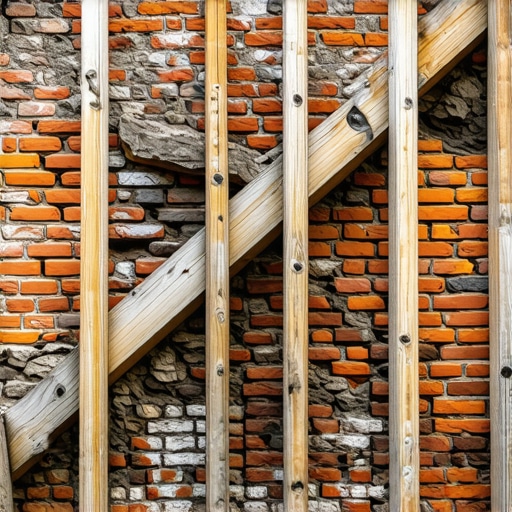
If you suspect a wall is imminent to fail, you don’t call a handyman; you call an engineer and start shoring. The goal of emergency bracing isn’t to ‘fix’ the wall, but to transfer the load from the failing masonry to a temporary wooden structure. For a vertical load failure (like a rotted lintel), you use ‘deadshores.’ These are heavy 4×4 or 6×6 timbers placed vertically to catch the weight of the masonry above the failure point. You must use a ‘headpiece’—a horizontal timber that spreads the load across multiple bricks—to avoid creating a new pressure point that could punch through the wall. For a wall that is bowing outward, such as a failing retaining wall, you need ‘raker shores.’ These are angled braces that use the ground as leverage. You must ensure the base of the raker is anchored into a ‘sole plate’ and staked into the earth with ‘deadman’ anchors to prevent the brace from sliding out. This is where retaining wall weep hole cleaning becomes a life-saving maintenance task; if those holes are clogged, the weight of the water-saturated soil behind the wall can reach 125 pounds per cubic foot, far exceeding the design capacity of any unreinforced brick wall.
Material Science: Why Softness is Strength
In historic masonry preservation, we live by one rule: the mortar must always be sacrificial to the brick. This is where most modern ‘lick-and-stick’ artists fail. They see a crumbling joint and think ‘the harder the better,’ so they reach for a bag of Type S or Type M Portland cement. This is a death sentence for old, hand-molded bricks. Old bricks are porous; they breathe. When you use a hard, non-porous cement mortar, you create a cold joint where moisture cannot escape. The moisture stays trapped behind the hard mortar, and during the first deep freeze, the expanding ice has nowhere to go but through the face of your historic masonry. To prevent this, we use sustainable tuckpointing mortars like lime putty or Type O mortar. These materials are high in lime, providing ‘autogenous healing’ properties—micro-cracks in the mortar will actually reseal themselves over time through carbonation. Understanding historic mortar analysis is not just academic; it’s about matching the chemical composition of the original mud to ensure the wall survives another century.
“Mortar for repair of historic masonry must be softer than the original units to ensure that any stress or moisture-related movement is accommodated within the joint, not the unit.” – ASTM C270 Standards
The Master’s Toolbelt: Tuckpointing Tools for DIY Stabilization
While I don’t recommend a DIYer tackle a collapsing wall, you should have the right tuckpointing tools for DIY stabilization if you’re waiting for a crew. This includes a hawk for holding your mud, a slicker or jointer for striking the joints, and a high-quality margin trowel for ‘buttering’ the bricks. When you are buttering a joint, the consistency of the mortar is everything. It should have the ‘tooth’ of peanut butter—sticky enough to hang upside down from your trowel but dry enough to break cleanly when you pull away. If it’s too wet, it will ‘burn’ and shrink, leaving gaps for water to enter. If it’s too dry, it won’t achieve the proper suction with the brick, and you’ll end up with honeycombing—voids in the joint that invite disaster. In fire-rated masonry installation, these voids are even more critical, as they can allow smoke and heat to bypass the structural integrity of the wall.
The Future of the Craft: Green Roofing and Beyond
Even as a third-generation mason, I have to adapt. We are seeing more green roofing masonry integration where the parapet walls must withstand constant moisture from rooftop gardens. This requires specialized flashing and sustainable masonry materials that can handle a permanent ‘wet’ state without losing structural integrity. We are no longer just laying soldier courses and headers; we are building living ecosystems. But the physics remain the same: gravity never sleeps, and water always finds a way. Whether you are dealing with a 100-year-old chimney or a modern fire-rated masonry installation, the key is understanding the capillary suction rate of your materials. If the brick sucks the water out of the mortar too fast, the mortar never properly hydrates and turns to dust. If the brick is too dense, the mortar won’t ‘grab.’ It’s a dance of chemistry and grit, and if you miss a step, the wall will tell you—eventually.