
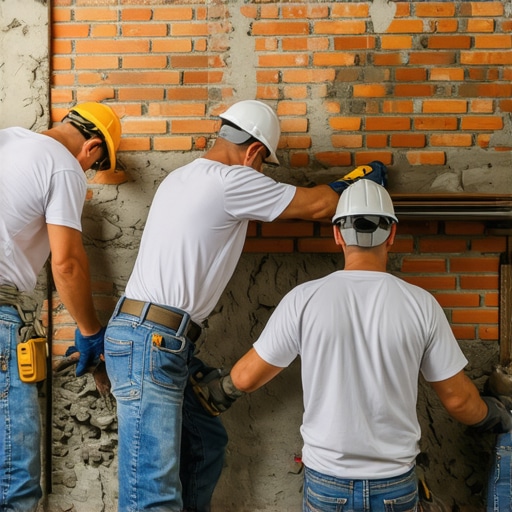
The Forensic Scene: When a Crack is More Than a Cosmetic Flaw
The homeowner called me out because of what they described as a simple hairline crack near the corner of their 1920s masonry warehouse. To the untrained eye, it looked like a minor settlement issue. But when I slid my fiber-optic borescope into the head joint, the reality was far more grim. The structural brick ties replacement that should have been holding the outer wythe to the inner load-bearing core had been reduced to nothing but orange, oxidized dust. The steel had rusted, expanded, and was literally pushing the face of the building outward. This isn’t just about aesthetics; this is about the physics of gravity and the slow, silent failure of a building’s skeletal system. I’ve spent thirty years in the mud, and if there is one thing I’ve learned, it’s that a wall doesn’t just fall down—it gives you a hundred warnings before it gives up the ghost.
The Physics of the Bond: Why Your Mortar Matters
In a load-bearing wall, the mortar is the shock absorber. It is the sacrificial element that must be softer than the brick it holds. When you see a modern handyman slap high-strength Portland cement into a soft, pre-war brick joint, you are watching a slow-motion demolition. Modern cement is brittle and hard. When the building breathes—and buildings do breathe with every thermal cycle—the soft brick expands against the hard cement and has nowhere to go. The result? The face of the brick pops off in a process called spalling. This is why structural repointing is a surgical procedure, not a patch job.
“Mortar should be designed to be weaker than the masonry units so that any stress-induced cracking occurs in the mortar joints where it can be easily repaired.” – BIA Technical Note 2
We look for the “tooth” of the stone or brick. For a proper bond, the new mortar must mechanically interlock with the microscopic irregularities of the masonry unit. If you don’t rake out the joints to a depth of at least twice the width of the joint, you’re just “buttering” the surface. That mud will fall out in three seasons. We use a slicker or a hawk to ensure the mortar is packed tight, eliminating voids where water can congregate.
The Anatomy of Structural Failure: Beyond the Face
Structural integrity often hinges on things you can’t see from the sidewalk. Take the retaining wall block replacement or retaining wall capstone replacement projects I see failing every spring. Usually, it’s not the block that failed; it’s the hydrostatic pressure behind it. If you haven’t performed retaining wall weep hole cleaning, you have a thousand tons of wet soil pushing against a vertical plane. The same logic applies to outdoor fireplace rebuild tasks. The thermal shock within a firebox requires a specific refractory mortar that can handle the expansion without honeycombing.
“The sand should be sharp and clean, free from salts that invite efflorescence.” – Vitruvius, De Architectura
When we talk about masonry birdsmouth cuts at the corners of a structure, we are talking about precision. A birdsmouth cut allows for a wrap-around fit that maintains the structural bond through a change in plane. Without this, you get a cold joint, a point of weakness where moisture will inevitably find its way in, freeze, and expand by 9%, blowing the corner apart.
The Restoration Process: A Deep Dive into Technique
Restoring a load-bearing wall starts with masonry cleaning. You cannot see the true condition of the mortar or the bricks through seventy years of soot and atmospheric pollutants. Once clean, we evaluate the brickwork pointing styles. Are we looking at a concave joint, a weathered joint, or a flush joint? The style isn’t just for looks; it dictates how the wall sheds water. A concave joint, struck with a slicker, is the most effective at compacting the mortar and directing water away from the brick edges.
In cases of severe lean, we utilize self-leveling masonry lifts to stabilize the foundation before we even think about the joints. If the base is moving, the pointing is a waste of time. For those dealing with modern disasters like stone veneer repair, the issue is almost always “lick-and-stick” syndrome. Contractors often fail to provide a drainage plane, leading to trapped moisture that rots the sheathing behind the stone. True masonry is an art of managing water, not just blocking it.
The Chemistry of Longevity
We must talk about the hydration process. When we mix our mud, we aren’t just adding water to dirt. We are initiating a chemical reaction. In historic restorations, we often use lime-based mortars that undergo carbonation. Over decades, the lime absorbs carbon dioxide from the air and reverts back to limestone. This allows for “autogenous healing”—micro-cracks in the mortar can actually seal themselves over time when moisture reacts with free lime in the joint. You don’t get that with a bag of cheap premix from a big-box store. You get that through understanding the material science of the ancients.
Whether it is a soldier course over a window lintel or a complex retaining wall capstone replacement, the masonry must be respected. If you treat it like a cosmetic skin, it will fail you. If you treat it like the structural heart of the home, it will outlast you. Do it once, do it right, or don’t do it at all.