
The Ghost of Ruined Facades
I remember walking onto a job site in the historic district where a ‘rehabilitation’ crew had just finished what they called a restoration. They used high-speed grinders and packed the joints with a modern Type S Portland mix that was harder than the 19th-century clay bricks it was supposed to protect. Within three seasons, the brick faces were popping off like scabs—a classic case of spalling caused by sheer ignorance of material physics. My mentor used to tell me that a mortar joint isn’t just a gap filler; it is the structural lung of the building. If you don’t respect the depth, the suction, and the chemistry, the building will eventually choke on its own moisture. This is why the industry has shifted toward high-precision tuckpointing machine services. It is not about speed; it is about the relentless consistency of the pack.
The Physics of the Void: Why Depth is Destiny
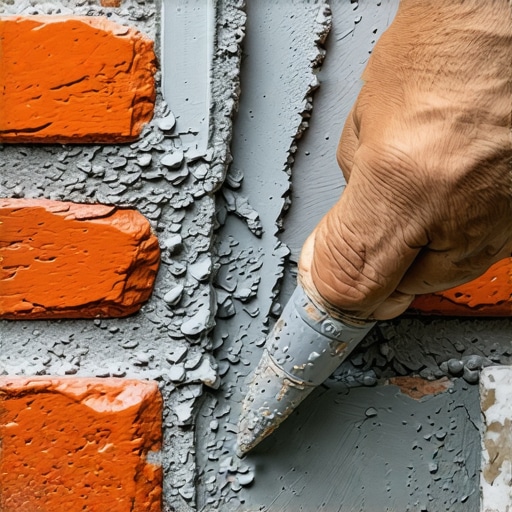
In the world of historic brickwork repointing, the depth of the mortar joint is the difference between a century of stability and a decade of decay. When you are tuckpointing brick walls, you aren’t just ‘buttering’ the surface. You are creating a structural bond. If your mortar depth is inconsistent, you create internal stress points. Imagine a bridge where the pilings are different heights; the load distribution becomes chaotic. The same happens at a micro-level in a masonry wall. Automatic tuckpointing tools, often powered by pneumatic systems or specialized augers, ensure that the concrete pump masonry mixes are injected at a constant pressure. This eliminates ‘honeycombing’—those nasty hidden air pockets that collect condensation and eventually turn into ice wedges during a freeze-thaw cycle.
“Mortar joints should be uniform in thickness and completely filled with mortar to ensure maximum resistance to water penetration.” – BIA Technical Note 1
The Chemistry of the ‘Mud’: Beyond the Bag
When we talk about sustainable tuckpointing mortars, we are looking at the carbonation cycle. Traditional lime mortars don’t just ‘dry’; they cure by absorbing carbon dioxide from the atmosphere, effectively turning back into stone over decades. Modern automatic tools allow us to use these stiffer, more authentic mixes that would be a nightmare to handle with a traditional hawk and trowel. These machines maintain a steady flow of ‘mud,’ ensuring that the moisture-to-solid ratio remains perfect from the first soldier course to the last. This is critical because ‘flashing’—where the mortar dries too fast and loses its bond—is the primary cause of failing retaining wall repair calls. If the mortar ‘burns’ because it lost its water to a thirsty brick before it could hydrate, you’re left with a brittle, sandy mess that will wash out in the first heavy rain.
Commercial Smokestacks and High-Altitude Precision
In commercial smokestack repair, the stakes are literally hundreds of feet in the air. You cannot afford a cold joint or a section where the mortar didn’t reach the back of the masonry unit. Automatic delivery systems ensure that the mix is packed tight against the ‘tooth’ of the existing brick. This level of compaction is nearly impossible to achieve manually over thousands of square feet of vertical surface. The machine’s nozzle ensures that every cubic inch of the joint is occupied by dense, well-compacted material, which is vital for the thermal expansion cycles these structures endure. Without this consistency, the stack develops micro-cracks that allow acidic flue gases to reach the reinforcement steel, rusting it to dust from the inside out.
The Art of the Strike
Once the machine has injected the mortar, the ‘slicker’ or jointer tool comes into play. Even with an automatic feed, the hand of the master mason is needed to strike the joint. This isn’t just for looks. Striking the joint compacts the surface, creating a ‘skin’ that sheds water. In stone wall repair or modular retaining walls, if the joint is left ‘hungry’ (underfilled) or ‘fat’ (overfilled), water will find a shelf to sit on. Water is the universal solvent, and its goal is to get behind your masonry. Once it’s in, hydrostatic pressure takes over. I’ve seen modular retaining walls bow and burst because the weep holes were clogged and the mortar joints were porous enough to act like a sponge rather than a shield.
“The selection of mortar should be based on the properties of the masonry units… The mortar should always be weaker than the masonry unit to ensure it acts as the sacrificial element.” – ASTM C270 Standard Specification
Chimneys: The Forensic Hotspot
Most of my chimney sweep and repair calls start with a homeowner complaining about a damp firebox. They think it’s a cap issue, but 90% of the time, it’s ‘wicking’ through failed mortar joints in the crown or the stack. The thermal shock a chimney undergoes—from freezing exterior temps to 500-degree internal gases—demands a mortar joint that is perfectly homogenous. Any variation in density caused by hand-packing results in differential expansion. The denser areas push against the looser areas, creating ‘stair-step’ cracks. Automatic tools eliminate this human error, providing a monolithic barrier that can handle the heat. In the end, whether it is a stone wall repair or a high-rise facade, the goal remains the same: Do it once, do it right, and use the tools that respect the physics of the stone.”