
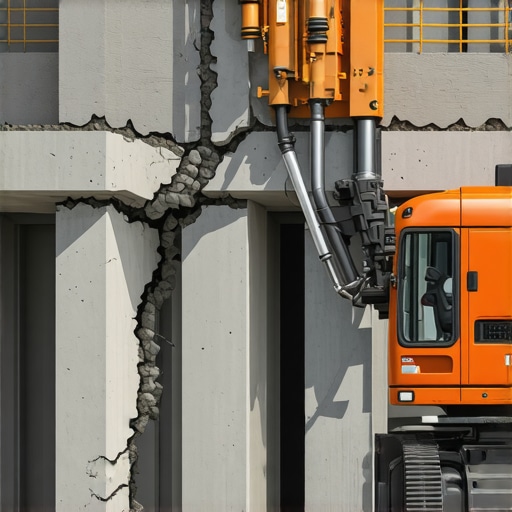
The Forensic Scene: When a Hairline Is a Heart Attack
The facility manager at the industrial complex called me in because he saw a ‘minor’ separation near the corner of the boiler house. To the untrained eye, it was a jagged line you could barely fit a nickel into. But I’ve been around mud and stone since I was tall enough to carry a bucket of water for my old man, and I know better. When I pulled out the high-resolution fiber-optic scope and threaded it into a weep hole, the reality was grim. The inner wythe of the 1960s-era masonry had completely sheared away from the backup wall. The structural steel was weeping rust, a slow-motion chemical fire eating the building from the inside out. This wasn’t a job for a hawk and a slicker. You couldn’t just butter the face of those bricks and call it a day. The ‘suction’ of those old, dry bricks would have sucked the moisture right out of a standard mortar before it even hit the back of the void, leaving nothing but a brittle mess. This is where automated grout injection turns the tide, moving beyond the limitations of manual tuckpointing into the realm of structural surgery.
“Water penetration is the single greatest threat to masonry durability, leading to the gradual degradation of structural integrity through cyclical expansion and contraction.” – BIA Technical Note 7
The Physics of the Void: Why Traditional Fixes Fail
In the North, we deal with the brutal reality of the freeze-thaw cycle. When water gets into a structural crack, it doesn’t just sit there; it expands by 9% the second the mercury drops. If you’ve filled that crack with a hard, non-breathable Portland-heavy mix, the pressure has nowhere to go but out, popping the brick face off in a process we call spalling. For years, spalled concrete steps repair and foundation fixes were handled with surface-level patches that inevitably failed because they didn’t address the internal cavity. Automated grout injection changed the game. By using high-performance mortar mixes that are engineered for thixotropic flow—meaning they stay liquid while being pumped but gel instantly once they reach their destination—we can fill every microscopic ‘honeycombing’ pocket deep within the wall. This isn’t just ‘filling a hole’; it’s restoring the monolithic nature of the structure.
Micro-Zooming into Grout Chemistry and Fluid Dynamics
When we talk about automated injection, we’re talking about managing the ‘tooth’ of the internal substrate. The grout must be thinner than the mud you’d use for a soldier course, yet it must possess enough internal cohesion to resist washing out. We use specialized pumps that monitor the back-pressure in real-time. If the pressure spikes, it means the grout has hit a dead end or a blockage; if it drops, we’ve found a major internal void. This level of precision is critical in commercial masonry maintenance and commercial smokestack repair, where the sheer volume of material required would be impossible to manage by hand. These mixes often include microsilica or polymers that allow for ‘self-leveling’ within the masonry lifts. We aren’t just guessing where the mud goes; we are using BIM masonry projects data to map the internal cavities and ensure 100% saturation of the void without blowing the face off the wall with too much hydraulic pressure.
“The selection of injection materials must consider the modulus of elasticity and the thermal expansion coefficients of the existing masonry to prevent secondary stress-induced cracking.” – ASTM C476-23
The Drone and the Digital Twin: Modern Forensic Masonry
Before we even start the pumps, we utilize drone chimney inspections to identify the thermal signature of moisture trapped behind the brick. The drone isn’t just a toy; it’s a flying infrared laboratory. It shows us where the ‘cold joints’ are—those areas where the original pour or lay-up failed to bond. On a recent project involving fire-rated masonry installation for a data center, we used these drones to verify that our injection had reached the very top of the wall. This high-tech approach, combined with self-healing concrete foundations technology, creates a barrier that is far superior to anything my grandfather could have achieved with just a trowel and a prayer. We are now seeing patio stone realignment and even self-leveling masonry lifts being controlled by sensors that ensure every stone is sitting on a perfectly compacted, injected base.
The Restoration Reality: Why ‘Lick-and-Stick’ Mentality Kills Buildings
I see it every day: a ‘handyman’ tries to fix a foundation crack with a tube of caulk or some cheap ‘hardware store’ mortar. They don’t understand the suction of the brick or the need for a ‘sacrificial’ mortar in historic contexts. If the mortar is harder than the brick, the brick will break. Automated grout injection allows us to use high-performance mortar mixes that are specifically dialed in to match the compressive strength of the original material. This is the difference between a repair that lasts five years and one that lasts fifty. Whether we are dealing with a sagging lintel or a failing commercial smokestack, the goal is always the same: do it once, or do it twice. And doing it twice in the world of structural masonry usually means someone is going to get hurt when the wall finally decides to quit.