
The Invisible Rot: A Forensic Reality Check
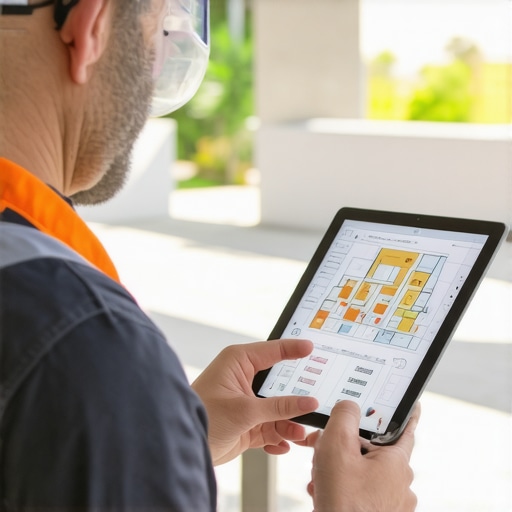
The homeowner stood on her porch, pointing at a single hairline fracture running through the soldier course above her garage. ‘It is just a settlement crack,’ she told me, hoping for a three-hundred-dollar patch job. But I have spent forty years reading the language of clay and lime, and this crack was screaming. I did not just look at the surface; I deployed a high-resolution AI masonry assessment tool linked to a thermal imaging sensor. When I put my digital scope inside the cavity, we did not see settling—we saw a catastrophe. The structural steel lintel was rusted to a state of exfoliated dust, expanding with enough force to lift the entire masonry veneer. Without that AI-driven forensic look, a local handyman would have smeared some ‘mud’ over the gap, hid the symptom, and waited for the day the whole lintel failed, potentially dropping three tons of brick onto the family car. This is where the old-world craft meets the new-world digital twin.
“Mortar should be designed to be weaker than the masonry units it binds, acting as a sacrificial element to accommodate movement and moisture.” – ASTM C270 Standard Specification for Mortar for Unit Masonry
The Physics of the ‘Ghost’ Estimate
Predicting the cost of masonry water damage repair used to be a guessing game played with a hammer and a prayer. You would tap the wall, listen for a hollow thud—what we call ‘drummy’ sections—and hope the decay did not go deeper. Today, BIM masonry projects allow us to create a three-dimensional heat map of a building’s envelope. We are looking at the ‘tooth’ of the substrate. When mortar loses its bond, it is often due to a failure in the carbonation process. In historic lime-based mortars, the calcium hydroxide reacts with atmospheric CO2 to form calcium carbonate crystals. If you inject a modern, hard Portland-based cement into a soft, historic joint, you create a ‘cold joint’ that traps moisture. The AI assessment calculates the exact density of the existing material, preventing the catastrophic error of using a mortar that is too hard, which would eventually pop the faces off the bricks in a process known as spalling.
Micro-Zooming into Crumbling Mortar Joint Repair
When we discuss crumbling mortar joint repair, we are really talking about the chemistry of hydration. In northern climates, the freeze-thaw cycle is a relentless beast. Water enters a hairline void, and as it turns to ice, it expands by nine percent. This internal pressure can reach thousands of pounds per square inch, shattering the internal matrix of the mortar. AI predictive modeling analyzes local meteorological data against the specific porosity of your brick type. It tells us whether we need simple tuckpointing machine services for aesthetic refreshment or a full structural repointing. Using a hawk and slicker to manually pack ‘mud’ into a joint is an art, but knowing exactly how many linear feet are compromised before the first scaffold is erected is a science. This precision eliminates the ‘change order’ culture that plagues the masonry industry.
Gravity and the Retaining Wall Batter Correction
A retaining wall is a dam that holds back a sea of soil. When a wall starts to lean, it is a failure of the ‘batter’—the intentional backward lean designed to offset hydrostatic pressure. Retaining wall batter correction is one of the most expensive repairs in the trade because it usually involves mass excavation. However, AI sensors can now detect millimeter-level shifts over a forty-eight-hour period, identifying if the movement is active or stabilized. If the soil is heaving due to poor drainage, the AI identifies the saturation point. We might find that instead of a total teardown, we can install helical piers or improve the drainage ‘weep holes’ to relieve the pressure. This forensic approach turns a sixty-thousand-dollar nightmare into a targeted five-thousand-dollar surgical fix.
“Water penetration is the single greatest threat to masonry durability and structural integrity.” – BIA Technical Note 7: Water Resistance of Brick Masonry
The Modular Masonry and Fire-Rated Future
In modern commercial builds, modular masonry construction and fire-rated masonry installation are governed by strict thermal mass requirements. We are no longer just stacking blocks; we are building thermal barriers. AI helps us predict the ‘R-value’ degradation over time. By scanning the density of the grout fill in a reinforced CMU (Concrete Masonry Unit) wall, we can identify honeycombing—air pockets where the concrete did not flow around the rebar. This is a critical fire-safety failure. Finding this with a scan before the wall is closed is the difference between a building that meets code and a literal chimney in a fire scenario.
Hardscape Truths: Brick Paver Driveway Repair
The wavy driveway is the hallmark of a lazy contractor. They focus on the ‘buttering’ of the top layer and ignore the base. Brick paver driveway repair is eighty percent dirt work and twenty percent stone. The AI assessment of the subgrade identifies soft spots in the clay or limestone screenings before we lay a single unit. We look at compaction physics; if the base is not compacted to ninety-five percent Proctory density, the pavers will sink. We use predictive modeling to determine the ‘interlock’—the friction between the sand and the vertical faces of the pavers. If your joint sand is washed out, the ‘arch action’ of the driveway is lost, and the load of a vehicle will drive individual bricks into the earth.
When to Pull the Trigger on Repair
Don’t be fooled by a ‘handyman special’ that promises a quick fix with a tube of caulk. Masonry is a breathing, moving organism. It expands in the summer sun and shrinks in the winter chill. If you don’t use the right ‘mud,’ or if you ignore the ‘batter’ of your walls, gravity will eventually collect its debt. AI masonry assessment is not just a high-tech gimmick; it is the modern mason’s trowel, allowing us to see through the brick to the heart of the structure. It ensures that when we strike a joint, we are doing it once, and we are doing it for the next hundred years.