
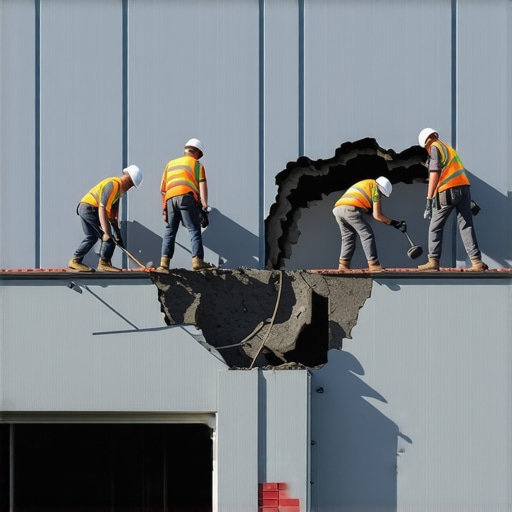
The Forensic Reality of the Skyward Edge
I was standing on a rusted-out suspension scaffold fourteen stories above the street, looking at a limestone coping stone that had shifted nearly three inches outward. To the untrained eye, it was just a crooked stone. To me, it was a forensic crime scene. When I slid my inspection probe into the void, I didn’t find mortar. I found a slurry of wet dust and rusted wall ties that crumbled like dry biscuits. This parapet wall—the most exposed and vulnerable part of any commercial structure—was essentially held together by gravity and luck. In this line of work, luck runs out when the first freeze hits. Most property managers treat commercial masonry facade maintenance as an aesthetic choice, but once the structural integrity of the edge is compromised, you aren’t looking at a repair bill anymore; you’re looking at a liability nightmare.
The Physics of the Three-Sided Attack
Parapet walls are unique in the world of structural masonry inspection because they are atmospheric sponges. Unlike a standard wall protected by a roof, a parapet is exposed to the elements on three sides: the front, the back, and the top. In Northern climates, this creates a brutal thermal cycle. When rain hits the masonry, it enters the pores of the brick. If your re-pointing services were done with a modern, high-strength Portland cement on a 1920s building, you’ve trapped that moisture. Water expands exactly nine percent when it freezes. That expansion generates thousands of pounds of pressure per square inch from the inside out. This is where we see spalling—where the face of the brick literally pops off because the mortar was too hard to let the wall breathe.
“Water penetration is the single greatest threat to masonry durability, particularly in elements lacking the protection of a roof overhang.” – BIA Technical Note 7
The Chemistry of the Mud: Why Mortar Type Matters
In the trade, we call mortar ‘mud,’ but it’s a complex chemical compound that must be engineered for the specific ‘tooth’ of the brick. For brick wall restoration, you cannot simply grab a bag of Type S from a big-box store and start buttering joints. Old-world masonry relied on lime-based mortars that were ‘sacrificial.’ The mortar was designed to be softer than the brick so that the inevitable stresses of thermal expansion and moisture would crack the mortar, not the masonry units. When a ‘handyman’ uses a hard mortar, the brick becomes the weakest link. We see this often in brick infill panel repair where the surrounding frame moves, and the rigid panels buckle because they have no ‘give.’ My process involves a structural masonry inspection that often includes laboratory analysis of the original binder to ensure the new mud matches the vapor permeability of the old.
The Anatomy of Failure: From Soldier Courses to Lintels
A common failure point in commercial parapets is the soldier course—those bricks stood on end for decorative effect. Without a proper ‘drip edge’ on the coping above, water runs down the face, enters the vertical head joints, and sits on the steel lintel. I’ve seen brick arch restoration projects where the original steel was so corroded it had expanded to twice its original thickness—a phenomenon known as ‘rust-heaving.’ This upward pressure can lift entire sections of a parapet, creating a ‘cold joint’ where the wall is no longer bonded to the building’s skeleton. This is where AI masonry assessment is changing the game. By using thermal imaging and high-resolution drone scans, we can identify these hidden pockets of moisture and steel delamination before they manifest as a crack on the surface.
Tuckpointing vs. Repointing: The Expert Distinction
Many clients use the terms tuck pointing services and re-pointing services interchangeably, but in the world of high-end restoration, they are vastly different. Repointing is the process of grinding out failed mud to a depth of at least twice the joint width and replacing it. Tuckpointing is a stylistic finish where a ‘bead’ of contrasting color is applied to the center of the joint to give the illusion of perfectly sharp, thin lines. If you’re paying for commercial masonry facade maintenance, you need structural repointing. I’ve seen too many ‘lick-and-stick’ jobs where the contractor just ‘buttered’ over the old joints with a hawk and trowel. That thin layer of new mud will delaminate within two seasons because it hasn’t established a mechanical bond with the ‘suction’ of the inner brickwork.
“The selection of mortar should be based on the strength and absorption characteristics of the masonry units to be bonded.” – ASTM C270 Standard Specification
Advanced Diagnostics and Modern Solutions
In modular masonry construction, we often see failures at the expansion joints. Commercial buildings are living organisms; they move, sway, and breathe. If the relief joints are caulked shut or filled with rigid mortar, the energy has to go somewhere, and it usually goes into a vertical shear crack. For concrete flatwork services integrated into the roof line, such as the structural slab under the parapet, we look for ‘honeycombing’—voids in the concrete that allow water to bypass the flashing entirely. My forensic approach uses borescope cameras to look inside the wall cavity. If I see the wall ties are ‘pencil-thin’ from oxidation, we move from simple repointing to a full-scale stabilization using helical anchors that tie the masonry veneer back to the backup wall without tearing the whole facade down.
The Long-Term Value of Forensic Maintenance
The cost of waiting is never linear; it’s exponential. A small leak in the parapet flashing leads to saturated masonry, which leads to freeze-thaw spalling, which eventually leads to a total structural failure of the brick arch restoration or the parapet itself. By the time you see the debris on the sidewalk, you’re looking at a six-figure emergency stabilization. A proactive AI masonry assessment and regular commercial masonry facade maintenance ensure that the ‘tooth’ of your building stays sharp for another century. Don’t trust your asset to someone who doesn’t know the difference between hydration and carbonation. In this game, the details are written in the mud.