
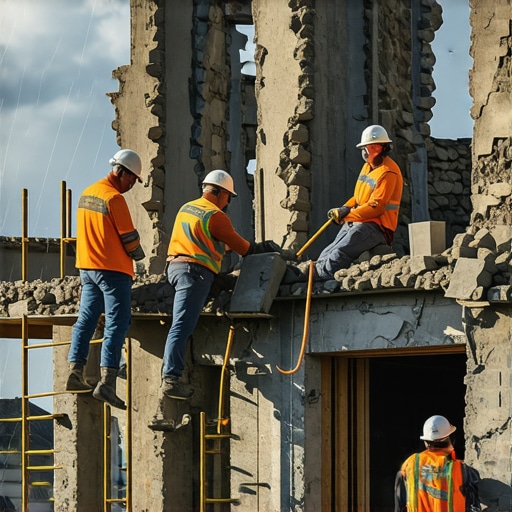
The Forensic Reality: More Than Just a Surface Crack
The homeowner stood on the damp lawn, pointing at what she described as a ‘minor hairline fracture’ running through the Flemish bond of her 1920s Tudor. To the untrained eye, it was a cosmetic nuisance. But when I inserted the fiber-optic scope into a weep hole near the water table, the reality was grim. Behind that ‘hairline’ crack, the structural steel lintel had oxidized so violently it had expanded to twice its original thickness, acting like a slow-motion wedge that was literally lifting the upper story of the house off its foundation. The storm hadn’t just brought rain; it had triggered a catastrophic failure of the brick quoin repair work done by a ‘handyman’ a decade prior. This is the world of forensic masonry—where we don’t look at the brick; we look at the physics of the void.
“Water penetration is the single greatest threat to masonry durability.” – BIA Technical Note 7
The Physics of Saturated Soil and Hydrostatic Pressure
When a storm dumps four inches of rain in two hours, the soil surrounding your foundation transforms. It isn’t just dirt anymore; it’s a heavy, fluid mass exerting hydrostatic pressure. For every foot of saturated soil depth, you’re looking at sixty pounds of lateral pressure per square foot. In a deep basement, that is thousands of pounds of force trying to push your wall inward. This is where foundation crack repair becomes a race against gravity. If you see a horizontal crack in the middle third of your basement wall, that’s not settlement—that’s the wall bowing under the weight of the earth. We don’t just slap some epoxy on that and call it a day. We look for the ‘cold joint’ where the pour was interrupted, or the lack of proper drainage that turned your backyard into a hydraulic ram.
The Anatomy of the Mud: Why Mortar Matching Services Save Structures
Most modern contractors treat mortar like glue. It isn’t glue. Mortar is the ‘sacrificial lamb’ of the wall. In the North, where the freeze-thaw cycle is a relentless hammer, your mortar must be softer than the brick it holds. If you use a high-strength Portland cement on a soft, pre-war brick, the brick will lose. Water gets trapped behind that hard cement, freezes, and expands by 9% in volume. Since the cement won’t budge, the brick face pops off in a process we call spalling. This is why mortar matching services are the backbone of any masonry damage assessment. We analyze the sand gradation and the lime-to-cement ratio to ensure the new ‘mud’ has the same vapor permeability as the old. We’re looking for ‘tooth’—that microscopic mechanical bond that occurs when the ‘suction’ of the brick pulls the cementitious paste into its pores.
Tuckpointing and Repointing: The Art of the Slicker
There is a massive difference between tuckpointing and repointing, and the ‘lick-and-stick’ crews don’t know it. Repointing is the process of grinding out failed joints to a depth of at least twice the joint’s width and ‘buttering’ in new mortar. Tuckpointing is a stylistic technique where we use a contrasting color of mortar to create the illusion of perfectly straight joints. When dealing with storm damage, we focus on the integrity of the bed joint. We use a slicker or a jointer tool to compact the mortar firmly against the brick. This compaction is vital; it reduces the porosity of the joint, making it harder for wind-driven rain to find a way in. If the guy you hired is just ‘shmearing’ mud over the top of the old joint without grinding it out, he’s not fixing your house; he’s hiding the evidence of its decay.
“The durability of a masonry wall is dependent upon the quality of the bond between the unit and the mortar.” – ASTM C270 Standard Specification
The Vulnerable Crown: Chimney Structural Repair
The chimney is the most exposed part of your home’s masonry system. It takes the full brunt of the wind, rain, and thermal expansion. I’ve seen chimneys where the chimney flashing repair was neglected for so long that the water had rotted the rafters three floors down. When we perform chimney structural repair, we aren’t just looking at the brickwork; we’re looking at the crown—that concrete slab on top. If the crown doesn’t have a proper drip edge, water runs down the face of the brick, enters the pores, and freezes. This creates ‘honeycombing’ in the mortar joints. We often have to implement self-leveling masonry lifts for heavy chimney caps to ensure water sheds away from the masonry rather than into it.
Commercial Masonry Facade Maintenance and Facade Cleaning
For larger buildings, commercial masonry facade maintenance is a different beast. You’re dealing with massive thermal movements. A 200-foot brick wall can expand significantly on a hot July afternoon. Without properly spaced relief joints, the wall will ‘explode’ at the corners. After a storm, facade cleaning isn’t just about aesthetics; it’s about removing the salts and pollutants that the rain drove deep into the masonry. If you leave those salts there, they’ll crystallize as the wall dries—a process called efflorescence—which can actually blow the face off the brick from the inside out. We use low-pressure chemical cleaning to neutralize these salts without destroying the ‘fire-skin’ of the brick.
The Stabilization Tactics: When to Panic
Emergency stabilization means stopping the movement. If we find a wall that is structurally compromised after a storm, we might use helical piers to reach stable soil or carbon fiber straps to arrest a bow in a foundation wall. But the real work is in the details: the brick quoin repair that restores the interlocking strength of the corners, the chimney flashing repair that seals the envelope, and the forensic understanding that masonry is a living, breathing system. Don’t let a ‘handyman special’ ruin your home’s value with a bag of cheap premix and a rusty trowel. Masonry is about the long game—building something that your grandkids will have to try hard to tear down. If your wall doesn’t ‘ring’ when you tap it, or if your mortar crumbles like a dry cookie, the storm has already won. It’s time to bring in the forensic team. [image-placeholder]