
The Ghost of the Facade: Why Your Granite Is Turning Gray
I remember walking up to a 1920s municipal building in the heart of the city where the stone looked like it had been through a house fire, but the sun was shining. The homeowner, or in this case, the city’s lead architect, thought it was just a century of city soot. But when I pulled out my 30x jeweler’s loupe and looked at the surface, I didn’t see dirt. I saw a graveyard. The previous crew had come in with a 4,000 PSI pressure washer and a bucket of unbuffered muriatic acid, thinking they were doing a favor. Instead, they had effectively ‘de-fleshed’ the stone. They had eaten away the mica and the potassium feldspar, leaving behind a jagged, micro-pitted surface that was now a magnet for every particle of diesel exhaust in the atmosphere. The granite hadn’t just lost its shine; its crystalline structure was screaming. This is the reality of modern ‘lick-and-stick’ mentalities applied to ‘Old World’ monuments.
Granite is often sold as the ‘invincible’ stone, the king of the Mohs scale, but in the world of historic masonry preservation, granite is a sensitive giant. It is a phaneritic, igneous rock, a complex soup of quartz, feldspar, and mica. When you treat it with the same aggression you’d use on a greasy garage floor, you aren’t just cleaning it; you are initiating a chemical divorce of its minerals. To clean granite without dulling it, you have to understand the ‘tooth’ of the stone and the molecular bond of the carbon crust you’re trying to remove. Most contractors reach for the ‘mud’ or heavy acids because they want to be on and off the job in a day. A true Master Mason knows that the best cleaning is a slow conversation between the solvent and the substrate.
“The cleaning of historic masonry should be undertaken using the gentlest means possible. Improper cleaning can cause irreversible damage to the masonry units and the mortar.” – BIA Technical Note 20
The Physics of the Pore: Why Pressure is Your Enemy
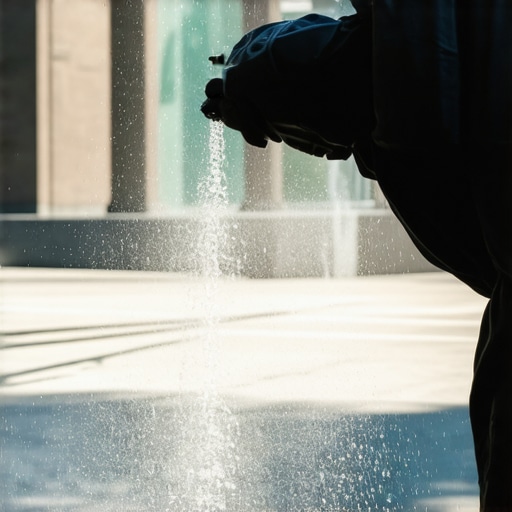
Let’s talk about the ‘micro-zoom’ of the granite surface. Granite is porous, albeit less so than limestone or sandstone. However, those pores are where the atmospheric pollutants live. When you blast the stone with high-pressure water, you aren’t just pushing the dirt out; you are driving moisture deep into the interior of the block. If you’re in a climate where the temperature swings, you’ve just signed a death warrant for that stone via the freeze-thaw cycle. Water expands 9% when it turns to ice. If you’ve forced water into the micro-fissures of a brick arch restoration or a granite header, that expansion will pop the face of the stone off in a process we call spalling. I’ve seen stone coping installation projects fail within three winters because the installer didn’t respect the hydrostatic pressure building up behind the facade.
Instead of pressure, we look for ‘suction’ and dwell time. We use the ‘JOS’ or ‘TORC’ systems—low-pressure vortex technologies that use a swirl of air, a tiny amount of water, and a fine granulate like calcium carbonate. It doesn’t ‘hit’ the stone; it ‘brushes’ it at a microscopic level. This preserves the ‘fire’ of the granite—that internal reflection of the quartz crystals that gives the stone its depth. If you lose that, you’re just looking at a gray rock. When we handle historic brick salvage or granite reclamation, the first thing we check is whether the previous ‘cleaner’ has already murdered the stone’s ability to breathe.
The Chemistry of Preservation: Surfactants and Poultices
When the staining is deep—think metallic salts or old ‘honeycombing’ from rusted internal rebar—you can’t just ‘butter’ some soap on it and hope for the best. This is where mortar matching services and forensic chemistry overlap. You have to identify if you’re fighting an organic stain (mold, algae) or an inorganic one (iron, manganese). For deep-set oils, we use a poultice. We mix a clay-like substrate with a specific solvent, apply it to the stone, and let it ‘wick’ the contaminant out as it dries. It’s a slow process, often taking 24 to 48 hours, but it’s the only way to avoid the ‘dulling’ effect of heavy-duty alkaline cleaners. If you use a cleaner with a pH that’s too high, you risk a ‘cold joint’ of chemical residue that will eventually crystallize and push the polish right off the stone.
In modern BIM masonry projects, we are now mapping these cleaning cycles into the building’s digital twin. We can predict where ‘wash-off’ from stone coping installation will cause staining on the granite below. If the coping isn’t installed with a proper drip edge, water will carry minerals from the mortar down the face of the stone, leading to efflorescence—that white, powdery salt that looks like a rash on the building’s skin. To fix this properly, you don’t just scrub the salt; you fix the drainage. You might even look at retaining wall block replacement strategies if the granite is part of a landscape feature where soil minerals are migrating into the stone.
“Water penetration is the single greatest threat to masonry durability. Proper detailing of copings, flashings, and weep holes is essential.” – ASTM C1194 Standards
Tuckpointing and the Sacrificial Principle
You cannot talk about cleaning a facade without talking about the joints. If you’re tuckpointing curved walls or restoring a granite entry, the mortar is the lungs of the wall. In historic masonry preservation, we follow the ‘sacrificial principle.’ The mortar must always be softer than the stone. If you or your ‘handyman’ uses a high-strength Portland cement on an old granite facade, the stone will lose the battle. As the building shifts and breathes, the hard cement won’t budge, so the granite will crack. We use Type N or even Type O lime-based mortars, carefully color-matched through mortar matching services to ensure the aesthetic is seamless without being structurally destructive.
For those looking at the cutting edge, 3D printed masonry repairs are starting to bridge the gap where stones are too damaged to save. We can scan a carved granite corbel, 3D print a mold, and cast a matching repair mortar that mimics the mineralogy of the original stone. But even with all this tech, from BIM masonry projects to mortarless masonry systems, the fundamental truth remains: masonry is a game of water management. Whether you’re doing a retaining wall block replacement or a delicate facade cleaning, if you don’t control the moisture, the masonry will fail. Don’t let a ‘slicker’ tool and a bucket of cheap ‘mud’ ruin a century of craftsmanship. Do it once, or you’ll be paying me to do it twice when the stone starts to crumble under the weight of bad decisions.
The Forensic Checklist for Granite Maintenance
Before you let anyone touch your facade with a chemical or a power tool, ask them about the ‘ion exchange.’ Ask them how they plan to neutralize the stone after cleaning. If they look at you like you have two heads, fire them. They aren’t masons; they’re vandals with a business card. A real pro will perform a ‘patch test’ in an inconspicuous area, checking for mineral shifts and ‘ghosting.’ We look for the ‘ring’ of the stone. A healthy granite block, when tapped lightly with a hawk or a small hammer, should have a clear, melodic tone. If it thuds, you have internal delamination, and cleaning it might be the least of your worries. At that point, you’re looking at structural stabilization, not just a wash and wax. Respect the stone, respect the chemistry, and the facade will outlive us all.