The Forensic Scene: When Hairlines Hide Catastrophe
The homeowner stood on their porch, pointing at what they described as a ‘harmless hairline crack’ in the lime-washed facade. They wanted a quick patch, a bit of cosmetic ‘butter’ to hide the blemish. But as a forensic inspector, I know the difference between a surface scratch and a structural scream. I pulled out my fiber-optic scope, inserted it through a 5mm weep hole, and what I saw was a graveyard. Behind that ‘minor’ crack, the internal steel masonry ties—once robust and galvanized—had been eaten away by moisture, reduced to a pile of red rust and dust. The entire brick wythe was essentially floating, held up by nothing but gravity and luck. This is the reality of masonry; what you see on the surface is rarely the full story. If we don’t address the physics of the wall, the wall will eventually address the ground. Most people think masonry is static, but it’s a living, breathing mechanical system that requires a deep understanding of chemistry and structural loads.
Myth 1: New Portland Cement is Better for Old Brick
One of the most persistent and destructive myths in the trade is that modern, high-strength Portland cement is a superior upgrade for 19th and early 20th-century masonry. This is a fundamental misunderstanding of material science. Pre-1940s bricks were fired in kilns that produced a relatively soft, porous unit. To accommodate this, the mortar—the ‘mud’—was composed of lime and sand. This lime mortar is ‘sacrificial.’ It is softer than the brick, allowing it to absorb the mechanical stresses of thermal expansion and moisture migration. When a ‘handyman’ slaps Type S Portland cement into a lime-based wall, they are creating a death sentence for the masonry. The cement is harder than the brick. When the wall expands in the summer heat, the brick has nowhere to go. Instead of the mortar compressing, the brick face shears off in a process known as spalling.
“Portland cement mortars should not be used in the restoration of historic masonry unless specifically called for by a qualified engineer or preservation specialist.” – BIA Technical Note 1
The chemistry is simple: lime mortar allows for vapor permeability, or ‘breathability.’ Portland cement acts like a plastic wrap, trapping moisture behind the joints. This water then undergoes the freeze-thaw cycle, expanding by 9% in volume and popping the face of your historic brick like a cork from a bottle.
Myth 2: Tuckpointing is Purely Cosmetic
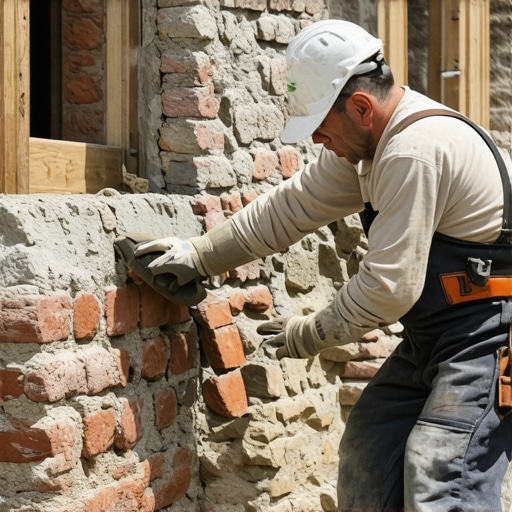
I hear it every week: ‘I just want the house to look pretty for the sale.’ This mindset treats tuckpointing—the process of removing failing mortar and replacing it with a contrasting ‘tuck’—as if it’s just a fresh coat of paint. In reality, tuckpointing is a critical structural intervention. Mortar joints are the gutters of your walls. When mortar begins to ‘honeycomb’ or powder out, it creates pathways for hydrostatic migration. This isn’t just about water getting in; it’s about the acidic salts that water carries. As moisture evaporates, it leaves behind salt crystals (efflorescence) that grow within the pores of the brick. This sub-florescence creates internal pressure that can reach thousands of pounds per square inch, literally exploding the masonry from the inside out. Proper tuckpointing restores the hydraulic integrity of the envelope. It’s not about the ‘look’; it’s about ensuring the load-bearing capacity of the soldier course and the header units remains intact. Without it, your chimney sweep and repair costs will skyrocket as the flue tiles begin to shift due to external structural failure.
Myth 3: AI Masonry Assessment Replaces the Human Eye
In the age of digital transformation, many companies are pushing AI masonry assessment as a catch-all solution. Don’t get me wrong, high-resolution drone imagery is a great tool for preliminary scouting, but a computer cannot feel the ‘suction’ of a brick or hear the ‘ring’ of a sound unit. A forensic inspector uses a specialized hammer to ‘sound’ the wall. A hollow thud indicates delamination that a camera simply cannot see. AI can identify a crack, but it cannot tell if that crack is ‘active’ (moving) or ‘dormant.’ It cannot analyze the carbonation depth of the lime or determine if the mortar has been ‘burned’ by flash-setting in the sun. We use AI to map the symptoms, but the diagnosis requires a master mason who understands how the foundation interacts with the modular retaining walls and the soil heaving beneath them. Modern technology is a slicker tool, but it isn’t the master of the hawk.
Myth 4: DIY Tuckpointing Tools are ‘Just as Good’
The shelves of big-box hardware stores are lined with tuckpointing tools for DIY enthusiasts, promising professional results for twenty bucks. This is where most homeowners go wrong. They buy a cheap angle grinder and a thick diamond blade, and they go to town on their joints. The result? They ‘scar’ the bricks, cutting into the top and bottom of the units because they lack the steady hand of a tradesman who has spent decades on a scaffold. A professional uses specialized thin-kerf blades and dust-shrouded vacuum systems to protect the masonry. More importantly, the ‘mud’ used in DIY kits is often a generic premix that doesn’t match the compressive strength or the color of the existing wall. Applying ‘butter’ to a joint without proper ‘raking’ (removing the old mortar to a depth of at least 3/4 inch) is just a Band-Aid. It will peel off within two seasons. A master mason uses a ‘slicker’ to compress the mortar into the joint, creating a mechanical bond that resists water penetration. It’s about the ‘tooth’ of the sand and the hydration curve of the mix, things a YouTube tutorial simply cannot teach you.
The Structural Anatomy of Fire and Earth
When we move beyond the facade, the stakes get even higher. Fire-rated masonry installation in commercial settings or fireplace hearths requires a specific understanding of thermal refractory physics. You can’t just use standard mortar; you need fireclay and calcium aluminate cements that can withstand 2,000-degree temperatures without ‘spitting’ or cracking. Similarly, when we look at retaining wall installation, the masonry is only as good as the geophysics behind it. I’ve seen modular retaining walls collapse because the contractor skipped the retaining wall geogrid installation. A geogrid is a synthetic mesh that provides tensile strength to the soil mass behind the wall. Without it, the weight of the wet earth (hydrostatic pressure) will eventually push the wall over, no matter how thick the stone is.
“The mortar joint is the sacrificial element of the wall; it must be more permeable and have lower compressive strength than the masonry units.” – ASTM C270 Standards Commentary
This principle applies whether you are doing a stone veneer repair or a massive foundation stabilization. The materials must work in harmony, not in competition.
Masonry Cleaning: The Silent Killer
Finally, we must address masonry cleaning. The most common myth is that a high-pressure power washer is the best way to clean a dirty brick wall. To a mason, seeing a pressure washer near a 100-year-old building is like seeing a chainsaw near a fine antique. High-pressure water strips away the ‘fire-skin’—the hard, protective outer layer of the brick. Once that skin is gone, the soft interior of the brick is exposed to the elements, leading to rapid decay. Proper cleaning involves low-pressure chemical mists that dissolve atmospheric soot without mechanical abrasion. It’s a slow, surgical process, but it’s the only way to preserve the integrity of the building’s skin. Whether you are dealing with a sagging foundation or just a few loose bricks, remember: masonry is an investment in centuries, not seasons. Don’t let a ‘handyman special’ turn your legacy into a pile of rubble. Trust the forensic evidence, respect the material science, and never underestimate the power of a properly mixed batch of mud.