
The Forensic Scene: A Ghost in the Wall
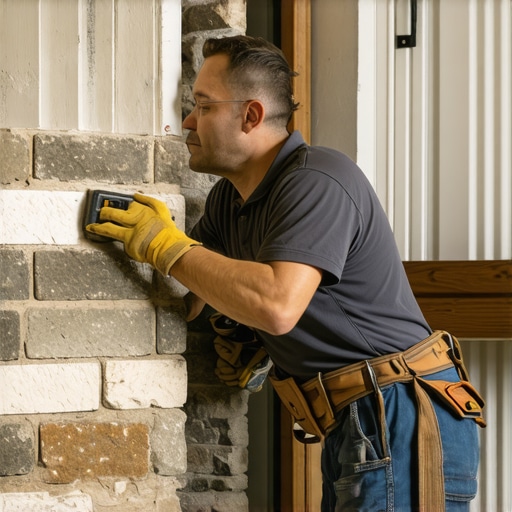
The homeowner pointed to a vertical hairline crack near the corner of her 1920s brick manor and told me she thought it just needed a bit of caulk. But when I inserted my high-definition borescope into a small void in the mortar joint, the reality was grim. Behind that face brick, the structural common brick wythe was dissolving. Decades of improper flashing had turned the interior of the wall into a swamp, and the steel lintels were so oxidized they had expanded to nearly twice their original thickness, a process we call ‘rust jacking.’ This isn’t just about a crack; it’s about the silent failure of a structural system. When we perform a 50-point masonry check, we aren’t looking at the brick; we are looking through it.
The Physics of the North: Why Your Steps Are Exploding
In our climate, the freeze-thaw cycle is the undisputed heavyweight champion of masonry destruction. If you are seeing the need for spalled concrete steps repair, you are witnessing the raw power of molecular expansion. Water is a unique beast; when it freezes, it expands by approximately 9%. If that water is trapped within the pores of a dense, non-breathable concrete or a brick that has been sealed with a cheap hardware-store ‘waterproofer,’ that 9% expansion creates internal hydraulic pressure that exceeds the tensile strength of the material. The result? The face of the masonry simply pops off. This is why freeze-thaw damage restoration is more than just buttering on some new mud. We have to analyze the ‘pore structure’ of the material. In historic masonry preservation, we often find that a previous contractor used a high-strength Portland cement for tuckpointing on soft, handmade bricks. Because the cement is harder and less permeable than the brick, the moisture gets trapped in the brick itself. When the freeze hits, the brick loses the fight, leading to catastrophic spalling while the cement joint remains stubbornly intact, mocking the ruins around it.
“Water penetration is the single greatest threat to masonry durability. Proper drainage and the use of compatible materials are the only defenses against the relentless forces of nature.” – BIA Technical Note 7
The Anatomy of the 50-Point Check: Dissecting the Vertical Plane
Our forensic inspection begins at the highest point: the chimney. A chimney crown repair is often the first line of defense we identify as failing. The crown—that slab of concrete or mortar sitting atop your chimney—is supposed to act as an umbrella. If it’s cracked, water hits the flue liner and begins its descent into the heart of your home. We check the chimney damper repair needs as well, as moisture often rusts these components shut, trapping damp air inside the masonry column. Moving down the wall, we look for ‘efflorescence’—that white, salty powder that looks like a ghost on your brickwork. That isn’t just a stain; it’s a symptom. It tells us that water is moving through the wall, dissolving internal minerals, and depositing them on the surface as it evaporates. It is the masonry’s way of screaming that it has a fever.
The Science of the Mortar Joint
When we talk about historic masonry preservation, we talk about the ‘sacrificial’ nature of the joint. In a properly built wall, the mortar should always be slightly softer and more permeable than the masonry units themselves. This ensures that any stress from movement or moisture exit happens in the joint—which can be easily ground out and replaced—rather than in the brick. We evaluate the ‘mud’ on your walls using the ASTM C270 standards. If we find Type S mortar where there should be Type O (a high-lime, low-strength mortar), we know we have a ticking time bomb. The process of tuckpointing—or more accurately, repointing—requires us to use a ‘hawk’ and a ‘slicker’ to pack the joints tightly, ensuring no ‘cold joints’ are formed where new mud meets old. We don’t just ‘butter’ the edges; we pack the joint to the full depth of the grind to ensure structural integrity.
Foundations and the Physics of Soil
One of the most critical phases of our 50-point check happens in the dark. Foundation wall bowing repair is a common finding in areas with heavy clay soils. Here, we aren’t just looking at the wall; we’re looking at hydrostatic pressure. When the soil becomes saturated, it exerts a massive lateral load on the foundation. If the wall wasn’t designed with adequate reinforcement, or if the drainage system has failed, the wall will begin to deflect inward. We look for ‘stair-step’ cracking in the block or ‘honeycombing’ in the poured concrete, which indicates poor vibration during the original pour. In the modern era, we are seeing the rise of BIM masonry projects where 3D modeling allows us to predict these stress points before a single stone is laid. We are even seeing the development of self-healing concrete foundations that utilize calcifying bacteria to ‘knit’ hairline cracks back together. While that tech is exciting, most of my days are spent dealing with masonry water damage repair caused by basic failures in 19th-century physics.
“Mortar shall be specified by either proportion or property specifications. The choice of mortar type should be based on the structural requirements and the type of masonry units being used.” – ASTM C270 Standard
The ‘Lick-and-Stick’ Epidemic
Nothing gets my blood boiling like modern thin-veneer stone. This ‘lick-and-stick’ garbage is often applied without a proper drainage plane (a rainscreen). Without that air space, moisture gets trapped behind the stone, rots the OSB sheathing, and creates a mold factory. During our inspection, we use moisture meters to check the substrate. If the readings are high, we know the ‘master’ who installed it forgot the weep holes or used a ‘soldier course’ of brick as a water-trap. Real masonry is about breathing. It’s about the ‘tooth’ of the stone and the ‘suction’ of the brick. If you choke the wall with plastic-based paints or non-breathable sealers, you are sentencing your building to a slow, damp death.
Conclusion: The Value of the Forensic Eye
A 50-point masonry check isn’t an expense; it’s an insurance policy against the hubris of modern construction and the decay of time. Whether we are identifying the need for a chimney crown repair or designing a complex foundation wall bowing repair, our goal is to respect the material science that has kept structures standing for millennia. You can hire a handyman to slap some mud in a crack, or you can hire a forensic expert to find out why that crack is there in the first place. Do it once, or do it twice—the choice is usually written in the mortar. “, “image”: { “imagePrompt”: “A forensic masonry inspector using a borescope to look inside a cracked historic brick wall, gritty lighting, close-up on the weathered brick texture and professional tools.”, “imageTitle”: “Forensic Masonry Structural Inspection”, “imageAlt”: “A professional mason inspecting the internal structure of a failing brick wall using a borescope camera.” }, “categoryId”: 123, “postTime”: “2023-10-27T10:00:00Z” }