
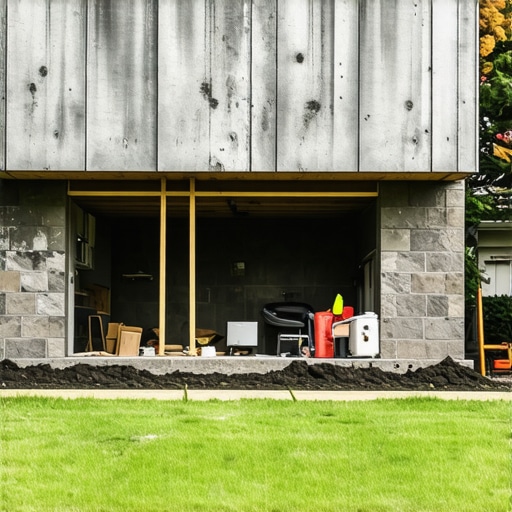
The Forensic Scene: When a Hairline Crack Becomes a Structural Emergency
I remember standing in a damp basement in the dead of November. The homeowner was a DIY enthusiast who thought he could fix everything with a tube of caulk. He called me because of what he described as a ‘cosmetic hairline crack’ along the third course of blocks. But when I pulled out the borescope and peered into the hollow cores of those CMUs, I didn’t see concrete; I saw a graveyard of rusted steel and standing water. The structural integrity had been compromised years ago by the silent, crushing weight of saturated clay. The wall wasn’t just cracked; it was deflective, leaning in by nearly three inches at the midpoint. This is the reality of masonry water damage repair: by the time you see the symptom on the inside, the disease has already consumed the skeleton of the structure.
The Physics of the Bow: Hydrostatic Pressure and Soil Mechanics
To understand how to fix a wall without digging up the entire perimeter, you first have to respect the physics of what’s pushing against it. We are talking about hydrostatic pressure. In regions with heavy clay soils or frequent freeze-thaw cycles, the earth acts like a hydraulic ram. When the soil saturates, it expands. If you live in a climate where the ground freezes, that water expands by roughly 9% in volume, exerting thousands of pounds of lateral force against your foundation.
“Water penetration is the single greatest threat to masonry durability, leading to efflorescence, spalling, and structural failure if not managed through proper drainage and reinforcement.” – BIA Technical Note 7
Most ‘contractors’ will tell you that you need to dig out the yard, waterproof the exterior, and maybe replace the wall. That’s a $30,000 bill and a destroyed landscape. But as a forensic mason, I look for the ‘Cure’ rather than the ‘Band-Aid.’ We focus on the tensile strength of the interior face. Concrete and masonry are legendary for their compressive strength—you can stack a skyscraper on them—but they have almost zero tensile strength. When the outside soil pushes, the inside of the wall stretches. Since masonry can’t stretch, it cracks and bows.
The Carbon Fiber Revolution: High-Tensile Masonry Reinforcement
Instead of the sledgehammer and the backhoe, we utilize aerospace technology adapted for the job site. Carbon fiber reinforced polymer (CFRP) straps are the secret to modern foundation stabilization. When we talk about fixing a wall without excavation, we are leveraging the massive tensile capacity of carbon. We start by prepping the substrate. You can’t just slap a strap on a dirty wall. We use a diamond grinder to take the wall down to the ‘bright’ masonry, ensuring we have the right ‘tooth’ for the epoxy to bite into. If you have a stone veneer over brick or a decorative finish, that has to come off first. We need the raw structural unit.
Once the wall is prepped, we apply a high-modulus structural epoxy. This isn’t your hardware store glue; this is ‘mud’ that undergoes a complex exothermic reaction to fuse the carbon fiber to the masonry. We ‘butter’ the strap, lay it onto the vertical axis of the bow, and use a slicker to ensure there are no air pockets. The result? A wall that is now 10 times stronger than it was the day it was built, with zero footprint in your backyard.
Commercial Masonry Facade Maintenance and the Multi-Unit Challenge
The stakes get even higher when dealing with commercial masonry facade maintenance. Large scale structures often suffer from ‘shelf angle’ failure. When the steel lintels or shelf angles rust, they expand—a phenomenon called ‘oxide jacking.’ This can push out a brick veneer installation or even a heavy stone facade restoration project, making it look like the building is shedding its skin. In these cases, we don’t just look at the bow; we look at the fire-rated masonry installation protocols and the movement joints. Without proper concrete flatwork services at the grade level to shed water away, even the best interior fix will eventually fail due to base saturation.
The Micro-Zoom: Hydration and the Chemistry of Repair
Why does old mortar crumble while new ‘lick-and-stick’ veneer falls off in three years? It comes down to the carbonation of lime versus the hydration of Portland cement. In a brick patio restoration or a chimney structural repair, we often see people using Type S mortar (very hard) on old, soft bricks. This is a death sentence. The mortar must be the ‘sacrificial’ element.
“The selection of mortar for restoration must ensure that the mortar is weaker than the masonry units to prevent irreversible damage to the historical fabric.” – ASTM C270 Standards
When we perform facade cleaning or masonry water damage repair, we analyze the ‘suction’ of the brick. If the brick is dry and thirsty, it will suck the water out of your ‘mud’ before it can hydrate, leaving you with a brittle, dusty joint that has no structural value. We call this ‘burning’ the joint.
When to Panic: Identifying Structural vs. Settling Cracks
Not every crack is a disaster. If you see a vertical crack that follows the mortar joints (a stair-step pattern), you are likely looking at minor settlement. But if you see a horizontal crack running mid-way up the wall, or if you see honeycombing in the concrete, you are in the ‘danger zone.’ This indicates that the wall is no longer acting as a single unit; it has ‘hinged.’ At this point, the hydrostatic pressure is winning. This is when you stop looking at brick veneer installation aesthetics and start looking at structural stabilization. If you ignore a bowing wall, the next step is a ‘blowout,’ where the wall literally collapses under the weight of a heavy rainstorm.
Final Verdict: Do It Once, or Do It Twice
I’ve spent forty years in the mud, with a hawk in one hand and a trowel in the other. I’ve seen homeowners spend thousands on facade cleaning to make a failing building look pretty, only to have the wall collapse two years later because they ignored the bowing foundation. Whether it’s a chimney structural repair or concrete flatwork services, the logic remains the same: manage the water, respect the physics of the soil, and never trust a ‘handyman’ with a structural problem. A bowing wall doesn’t have to mean a ruined yard, but it does mean you need a professional who understands the difference between a cosmetic fix and a forensic solution.