5 Masonry Damage Assessment Signs You Can’t Ignore in 2026
The Ghost in the Wall: A Forensic Discovery
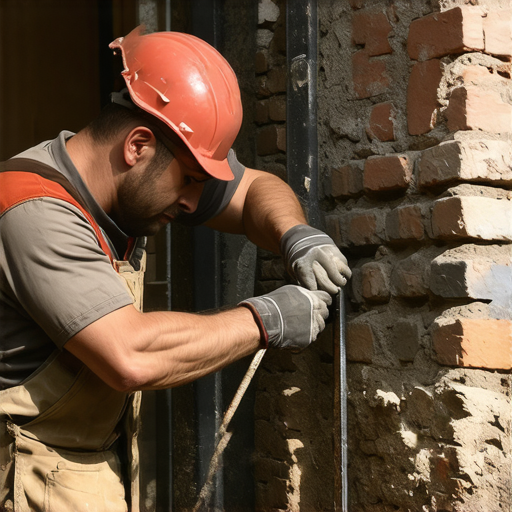
The homeowner stood on the manicured lawn of his colonial revival, pointing at what he called a ‘hairline nuisance’ near the third-story lintel. To the untrained eye, it was a thin, jagged line in the mortar. To me, a man who has spent forty years following the trail of failing lime and shifting earth, it looked like a death rattle. I pulled my fiber-optic scope from its case and bored a tiny hole through the mortar joint. When the screen flickered to life, the horror was confirmed. The structural steel was gone—not just rusted, but reduced to an orange, flaky powder that fell away at the slightest vibration. The brick skin was hanging by its own weight, detached from the backup wall because the internal anchors had vanished. This is the reality of structural brick ties replacement in the modern age: what you see on the surface is rarely the whole story.
1. The Rust-Jacking of Concealed Structural Ties
In 2026, we are seeing a massive spike in ‘rust-jacking’ within commercial masonry facade maintenance. This isn’t just simple oxidation; it is a slow-motion explosion. When the original galvanized or—heaven forbid—uncoated steel ties are exposed to moisture, they begin to oxidize. This chemical reaction creates iron oxide, which occupies up to ten times the volume of the original steel. This expansion exerts an irresistible force from the inside out, often manifesting as horizontal cracks along the bed joints every 16 to 24 inches.
“Steel corrosion in masonry is a volume-increasing reaction, exerting pressures that can exceed 10,000 psi, far surpassing the tensile strength of any mortar.” – ASTM C1232 Standard Terminology
Failure to address this leads to facade delamination. We no longer just ‘patch’ these; we employ surgical masonry damage assessment techniques, using magnetic rebar locators and thermal imaging to map the decay before the entire ‘soldier course’ decides to take a walk toward the sidewalk.
2. The Spall and the Soft-Brick Tragedy
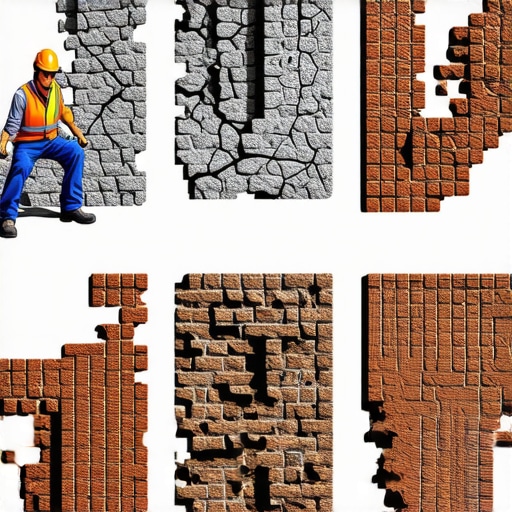
In the North, the freeze-thaw cycle remains our primary antagonist. When I see a brick face ‘spalling’—popping off like a scab to reveal a soft, dusty interior—I know exactly what happened. Some ‘handyman’ came along and used modern Type S Portland cement to repoint a wall built in 1920. Here is the physics: old bricks are soft and porous. They need to breathe. If you ‘butter’ those joints with a hard, non-breathable cement, you trap the moisture. When that water hits 32 degrees Fahrenheit, it expands by 9%. Since the hard ‘mud’ won’t budge, the pressure is forced back into the brick, blowing the face off. Structural repointing requires a sacrificial lamb—the mortar must be softer than the brick. We use lime-based sustainable masonry materials that allow for vapor permeability, ensuring the wall ‘sweats’ rather than shatters. Using the wrong ‘mud’ is a crime against the trade.
3. Chimney Saturation and the Damper Death Spiral
Chimneys are the most exposed structural elements of any building, taking a beating from 360 degrees. If you notice white, salty powder (efflorescence) on your chimney, you are looking at the residue of a deep-seated moisture problem. Chimney leak detection in 2026 has evolved; we use ultrasonic testing to find voids in the flue liners that are allowing acidic condensation to eat the masonry from the inside out. When the interior masonry is saturated, your chimney damper repair becomes more than just a mechanical fix; it becomes a race to save the stack. The moisture mixes with soot to form sulfuric acid, which leaches the calcium right out of the mortar joints, leaving behind a sandy grit that can’t support a hawk full of plaster, let alone a three-ton brick chimney.
4. Retaining Wall Deflection and Hydrostatic Pressure
A ‘wavy’ wall is a failing wall. I often see modular retaining walls leaning toward the driveway, the owners hoping a few more bags of topsoil will fix the look. It won’t. This is a failure of the drainage plane. Water weighs 62.4 pounds per cubic foot. When rain saturates the soil behind a wall without proper ‘weep holes’ or a gravel chimney, that hydrostatic pressure is enough to snap concrete block like a dry twig. In high-end commercial projects, we are now utilizing self-leveling masonry lifts to ensure the base remains perfectly planar, but if the geotechnical compaction wasn’t done with a vibratory sheep’s-foot roller to at least 95% Proctor density, that wall is destined for the scrap heap.
“Vertical expansion joints are mandatory to accommodate the irreversible moisture expansion of clay brick and the thermal contraction of the structure.” – BIA Technical Note 18
5. The Illusion of Metallic Masonry Finishes
Modern architecture is obsessed with metallic masonry finishes and thin-brick veneers. While these look sharp in a rendering, they are forensic nightmares. These coatings can mask ‘honeycombing’—voids in the concrete or mortar—that allow water to pool against the structural substrate. If you see a ‘cold joint’ where one pour of concrete didn’t properly fuse with the next, and it’s been covered by a metallic glaze, the corrosion of the internal rebar is invisible until the concrete starts ‘spitting’ chunks. Real masonry doesn’t hide behind paint. It stands on the quality of its ‘slicker’ work and the depth of its bed joints. Don’t be fooled by a pretty face; if the ‘tooth’ of the mortar didn’t grab the stone during the initial lay, no amount of finish will keep it from falling when the ground heaves in the spring.
![Stop Retaining Wall Leans with 3 Pro Reinforcement Fixes [2026]](https://masonryrescue.com/wp-content/uploads/2026/03/Stop-Retaining-Wall-Leans-with-3-Pro-Reinforcement-Fixes-2026.jpeg)
![4 Geogrid Mistakes Ruining Retaining Walls [2026 Checklist]](https://masonryrescue.com/wp-content/uploads/2026/02/4-Geogrid-Mistakes-Ruining-Retaining-Walls-2026-Checklist.jpeg)
![Why Sagging Windows Need New Brick Lintels Fast [2026 Fix]](https://masonryrescue.com/wp-content/uploads/2026/02/Why-Sagging-Windows-Need-New-Brick-Lintels-Fast-2026-Fix.jpeg)