Stop Trip Hazards: 5 Patio Stone Realignment Fixes for 2026
The Anatomy of a Trip Hazard: Why Your Patio is Dancing
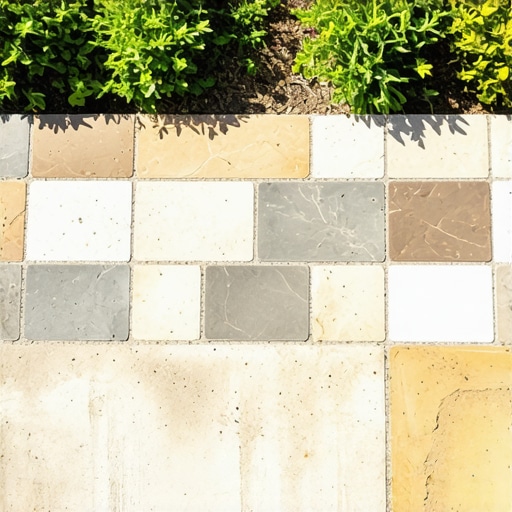
I was called out to a job recently where a homeowner was convinced their patio was possessed. Every spring, the slate pieces in the walkway would shift, rise, and sink like piano keys played by a ghost. I spent twenty minutes with a level and a laser, but the real story was in the dirt. I saw a hairline gap between the stones where water had been siphoning down into a poorly compacted base for three seasons. When I finally pried one up, the ‘base’ wasn’t more than an inch of loose sand over native clay. That is not masonry; that is a lawsuit waiting to happen. Most people think a patio is just stone, but a master knows a patio is actually an engineered drainage system that happens to have a pretty face.
“Surface drainage is the most important factor in the performance and life of any pavement system. Water must be directed away from the pavement structure as quickly as possible.” – BIA Technical Note 29
1. The Precision of AI Masonry Assessment and Forensic Diagnosis
In 2026, we are moving beyond the ‘eyeball’ method of masonry damage assessment. I now use AI masonry assessment tools that analyze pixel-level shifts in stone orientation over a six-month period. These algorithms can detect sub-centimeter heaving before it becomes a hazard. When a stone tilts, it is usually a failure of the ‘tooth’ of the aggregate base. We look for ‘honeycombing’ in the sub-strate where water has washed away fines, leaving voids that collapse under load. To fix a trip hazard, you first have to understand the soil’s friction angle. If you are dealing with a clay-heavy soil, the capillary action pulls moisture up, which then expands by 9% during the freeze-thaw cycle. This expansion exerts thousands of pounds of pressure per square inch, easily popping a heavy flagstone out of its bed. Realignment starts with a forensic look at why the stone moved in the first place.
2. Stabilizing the Foundation with Modular Retaining Walls
If your patio is on a slope, the stones aren’t just sinking; they are migrating. This is lateral creep. To stop it, we often need to install modular retaining walls to provide a rigid perimeter. Think of it as a girdle for your landscape. A modular system allows for the movement of moisture while holding the lateral pressure of the stone bedding. Without a solid edge restraint, your stones will spread out like pancake batter on a griddle. When we set these walls, we ensure the ‘toe’ of the wall is buried deep enough to resist the frost line. If the wall moves, the patio moves. It is all one interconnected skeletal system. I have seen guys try to ‘butter’ the edges with cheap mortar to hold them in place, but that ‘mud’ just cracks the first time the temperature drops below forty degrees.
3. The Science of Advanced Masonry Adhesives and Edge Bonding
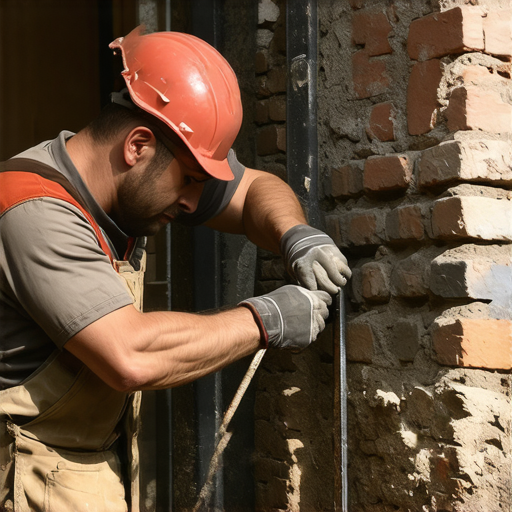
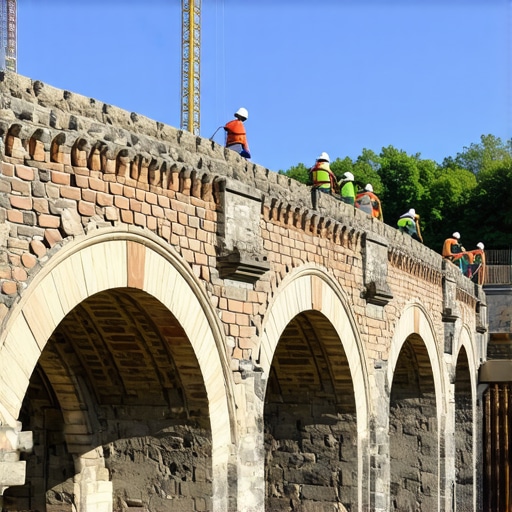
For stones that refuse to stay seated, we turn to advanced masonry adhesives. These aren’t your hardware store tubes of liquid nails. We are talking about high-modulus, moisture-cure polyurethanes that maintain flexibility even when the ground is frozen solid. When I apply these, I am looking for a chemical bond that can withstand the shear forces of a thousand-pound mower crossing the surface. However, you cannot just squirt glue on dirt. You have to prep the stone, removing the ‘slick’ or the laitance from the underside. This ensures the adhesive can bite into the pores of the stone. For brick veneer installation or brick quoin repair, these adhesives provide a secondary line of defense against moisture intrusion that would otherwise lead to spalling. If you have a brick arch restoration project where the keystone is slipping, these high-tech bonds are the only thing keeping that arch from becoming a pile of rubble.
“Adhesion of masonry units to the substrate is dependent upon the development of a full and intimate contact between the mortar and the unit’s surface.” – ASTM C270 Standard Specification for Mortar
4. Hydrology Control: Porous Stone Sealers and Drainage Repairs
The biggest killer of patios is internal hydraulic pressure. When water gets trapped inside the stone’s molecular structure, it has nowhere to go but out, taking the face of the stone with it. This is why porous stone sealers are non-negotiable in 2026. A silane-siloxane sealer doesn’t just sit on top like a piece of plastic; it penetrates the ‘thirsty’ stone and creates a hydrophobic barrier deep within. This prevents the stone from becoming saturated, which is the primary cause of the heave-and-sink cycle. If we find that the patio is constantly damp, we look for deeper issues like a failing chimney flue liner installation that might be dumping water into the foundation or a masonry water damage repair requirement in the nearby retaining walls. You have to manage the site’s entire hydrology if you want the stones to stay level.
5. The Surgical Fix: Brick Quoin Repair and Sub-Base Injection
Sometimes, the fix isn’t about moving the stone but about stabilizing what is under it. For high-value areas, we use a technique similar to brick quoin repair, where we reinforce the corners and edges to prevent ‘tipping.’ We might even use structural foam injection to fill the voids beneath the stones—a process that requires the same precision as a chimney flue liner installation. If the stones are part of a larger structural feature, like a grand entrance, we may need to perform a full brick arch restoration to ensure the load-bearing elements aren’t compromised by the shifting ground. Once the stone is realigned, we ‘slick’ the joints with a high-performance polymeric sand that hardens like stone but remains permeable enough to breathe. Don’t let a ‘handyman’ tell you to just throw more sand on it. You do it right once, or you’ll be doing it again when the next frost hits.
![Why Your 2026 Chimney Needs a Heat Shield [Safety Update]](https://masonryrescue.com/wp-content/uploads/2026/04/Why-Your-2026-Chimney-Needs-a-Heat-Shield-Safety-Update.jpeg)
![3 Sustainable Block Cutting Tactics to Cut Project Waste [2026]](https://masonryrescue.com/wp-content/uploads/2026/02/3-Sustainable-Block-Cutting-Tactics-to-Cut-Project-Waste-2026.jpeg)
This post really hits the nail on the head about how much engineering goes into what we usually see as just a ‘stone patio.’ I think one of the often overlooked aspects is the importance of proper site assessment before laying stones. I’ve seen cases where homeowners skip the proper sub-base preparation, leading to these heaving issues years down the line. The use of AI tools for disturbance detection sounds promising, especially for older patios where guesswork might lead to unnecessary removal. I’ve found that integrating a good drainage plan from the start, including sealing and proper slope grading, can make a huge difference. In my experience, addressing the root cause – like poor water management – is more effective than just realigning stones or patching surface issues. For those dealing with slopes, do you recommend modular retaining walls as a first step, or should they be paired with drainage improvements? I’d love to hear what’s worked best for others in similar situations.