5 Commercial Parapet Wall Repair Mistakes to Avoid in 2026
The Forensic Scene: Behind the Coping Stone
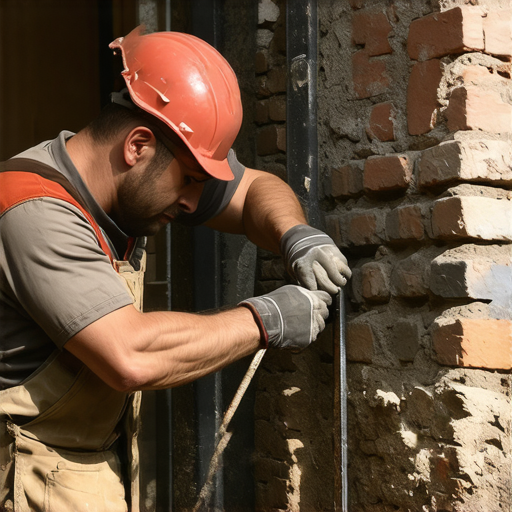
I was standing on a fourteen-story rooftop last November, the kind of height where the wind doesn’t just blow; it bites. The property manager told me it was just a minor leak in the corner office. I took a 4-pound hammer and tapped the interior face of the parapet wall. It didn’t ring. It thudded—a wet, hollow sound that tells a forensic mason everything he needs to know. When I pulled my borescope through a failing mortar joint, I didn’t see solid masonry. I saw a cavern of rusted steel and ‘mud’ that had reverted to the consistency of damp beach sand. The structural steel was so far gone from oxidation that it had expanded to twice its original thickness, a phenomenon we call ‘rust jacking,’ which was literally lifting the five-ton stone balustrade off its bed. The homeowner or manager thinks it is a hairline crack; I see a liability that could drop a thousand pounds of limestone onto the sidewalk below.
Mistake 1: The Portland Poison (Wrong Mortar Specification)
The most egregious sin in commercial parapet wall repair is the use of high-strength Portland cement on historic substrates. In my three decades of ‘buttering’ bricks, I’ve seen more damage done by well-meaning contractors with a bag of Type M mortar than by a century of rain. Historic bricks, particularly those fired before the mid-20th century, are porous and soft. They need to breathe. When you slap a hard, dense cement over these joints, you create a vapor barrier. Moisture gets trapped behind that hard shell. When the temperature drops and that water expands by 9%, it has nowhere to go but out through the face of the brick. This is why you see spalled concrete steps repair and brick faces popping off like scabs.
“Mortar should always be weaker than the masonry units it binds, acting as a sacrificial element that allows for thermal expansion and moisture evaporation.” – BIA Technical Note 2
We call it the sacrificial principle. In 2026, if your contractor isn’t talking about historic pointing styles and testing the compressive strength of your existing masonry before mixing their ‘mud’ on the hawk, they are destroying your building. For a proper restoration, we often look to Type O or K mortars, or even pure lime putties that undergo a carbonation process over months, turning back into stone while remaining flexible enough to handle the building’s micro-movements.
Mistake 2: The Capillary Trap (Ignoring Flashing and Reglets)
Water doesn’t just fall; it climbs. Through capillary action, moisture can move upward through microscopic pores in masonry. Many commercial parapet wall repair jobs fail because the ‘pro’ ignores the through-wall flashing. They think a bit of caulk at the retaining wall capstone replacement point is enough. It isn’t. Without a proper stainless steel or copper flashing membrane that extends through the entire width of the wall, water will find its way into the core. I’ve seen chimney flashing repair jobs where the lead was just ‘licked’ onto the surface. In a parapet, the flashing must be integrated into a reglet—a precut groove in the masonry—to ensure a mechanical seal. When water enters the top of a wall because of a failed capstone, it begins a slow-motion demolition. This is why chimney leak detection often reveals that the problem isn’t the chimney at all, but a parapet wall acting like a giant sponge. We need to ensure that retaining wall weep hole cleaning is performed not just on the ground, but that the drainage systems within the parapet are clear of mortar ‘dangle’—the excess mud that falls inside the cavity during construction and creates a bridge for water to cross.
Mistake 3: The Myth of the ‘Lick-and-Stick’ Patch
Commercial owners love the word ‘patch’ because it sounds cheap. In the world of commercial smokestack repair and high-rise maintenance, a patch is often a death sentence. When I see spalled concrete steps repair done with a simple thin-set, I know it will fail within two freeze-thaw cycles. The problem is the cold joint. New concrete or mortar does not naturally bond to old, carbonated material. You need to ‘tooth’ the old work, creating a mechanical key, and often use a bonding agent that matches the pH of the substrate. For stone balustrade restoration, this means drilling and pinning with stainless steel all-thread and epoxy, not just slapping some ‘mud’ in the crack. If you are correcting retaining wall batter correction issues, a superficial patch won’t stop the hydrostatic pressure of the earth behind it. You have to address the physics of the lean, which usually involves excavating and fixing the drainage, not just ‘slicking’ the front to look pretty.
Mistake 4: Mismanaging Thermal Expansion and Relief
A commercial building is a living thing. It breathes, and more importantly, it moves. A brick wall can expand significantly under the summer sun. If your commercial parapet wall repair doesn’t include properly spaced control joints, the wall will create its own—usually in the form of a jagged vertical crack. This is especially true in retaining wall capstone replacement. Long runs of stone need expansion gaps filled with high-grade backer rod and silicone, not hard mortar. When the mortar is too stiff, and the wall tries to grow, the pressure builds until the ‘soldier course’ at the top starts to kick out. I’ve seen parapets leaning six inches out over the street because the thermal expansion had no relief. We call this ‘wall creep.’ It’s a slow-motion disaster that requires retaining wall batter correction techniques applied to a vertical structure.
Mistake 5: Neglecting the Internal Skeleton
The most invisible mistake is ignoring the wall ties and structural steel. In many commercial parapet wall repair projects, the masonry is just the skin. The bones are steel. If chimney leak detection shows water has reached the structural I-beams, a simple repointing job is like putting a band-aid on a gunshot wound. The oxidation of steel creates ‘honeycombing’ in the surrounding mortar, weakening the entire assembly. For commercial smokestack repair, we often have to use ultrasonic thickness gauges to see if the internal reinforcement still has the cross-sectional area to handle the wind load. If you don’t treat the rusted steel with a zinc-rich primer or replace the ties during the historic pointing styles restoration, the ‘rust jacking’ will just crack your new mortar within three years. You’re not just a mason; you’re a surgeon. You have to get to the bone to save the limb.
The Physics of the Slicker: Doing it Right
When we finish a joint, we don’t just wipe it. We use a slicker or a jointer tool to compress the mortar. This compaction is vital; it closes the pores on the surface of the ‘mud’ and creates a ‘skin’ that sheds water. If you leave the mortar ‘sandy’ or ‘open,’ you are inviting the freeze-thaw cycle to move in and start its demolition. A true master knows the ‘suction’ of the brick—how fast it pulls the water out of the mortar. If the brick is too dry, it ‘burns’ the mortar, robbing it of the water needed for hydration and leaving it brittle. If it’s too wet, the mortar will smear and won’t bond. It’s a delicate dance of chemistry and timing that no ‘handyman special’ can ever replicate. Do it once, or do it twice. In this business, doing it twice usually involves a structural engineer and a lawyer.