
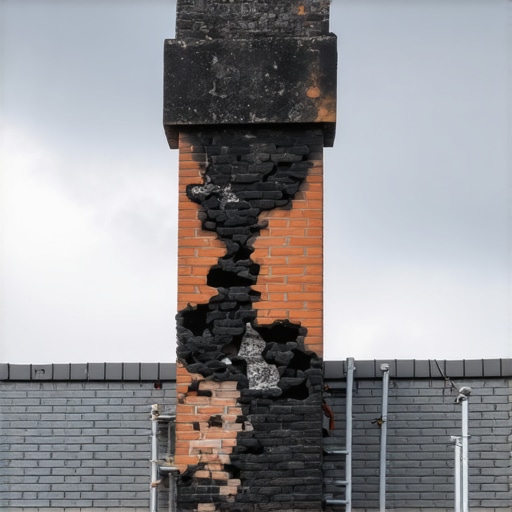
The Forensic Scene: When 30,000 Kelvins Hits Your Flue
The homeowner stood in the driveway, pointing at what looked like a minor scuff mark near the crown of his chimney. He thought it was just a hairline crack, a bit of cosmetic masonry work for a weekend. But when I put my scope inside the flue, the reality was grim: the terracotta liners hadn’t just cracked; they had effectively vaporized in sections, and the internal structural steel reinforcement was scorched, losing its tensile strength instantly. A lightning strike isn’t just a ‘hit’; it is a massive, instantaneous injection of thermal energy that turns the moisture inside your bricks into high-pressure steam. If that steam can’t escape, the brick doesn’t just crack—it undergoes a microscopic explosion.
The Physics of the Strike: Thermal Shock and Pore Pressure
To understand why emergency chimney repairs are non-negotiable after a strike, we have to look at the chemistry of the ‘mud’—the mortar—and the masonry units themselves. Most residential chimneys are built with clay bricks that have a specific porosity. When lightning hits, it follows the path of least resistance, which is often the moisture trapped within the mortar joints or the soot buildup on the flue liners. In a microsecond, the temperature jumps to five times the surface of the sun. This causes what we call ‘spalling’ on a catastrophic scale. The water molecules within the brick lattice expand by 1,600 times their liquid volume. This creates internal pressure that exceeds the 3,000 PSI compressive strength of the brick, blowing the ‘face’ off the masonry.
“Water penetration is the single greatest threat to masonry durability, and when combined with high-voltage thermal events, the structural integrity of the chimney is compromised beyond the point of simple cosmetic repair.” – BIA Technical Note 7
The Hidden Danger: Stone Veneer Over Brick
One of the most dangerous modern trends I see during forensic inspections is stone veneer over brick. While it looks high-end, it acts as a mask. During a lightning strike, the energy can travel behind the veneer, blowing the bond between the stone and the substrate. Because the veneer is often applied with high-performance mortar mixes that are too rigid, the chimney can appear fine on the outside while the structural brick core has turned to rubble. We call this ‘honeycombing’—the interior is hollow and failing, but the ‘lick-and-stick’ stone is holding it together like a loose bandage. When we perform re-pointing services after a strike, we often find that the moisture trapped between these layers has caused the masonry to ‘cook’ from the inside out.
Foundation Underpinning and Seismic-Like Shifting
It sounds extreme, but a direct lightning strike can actually necessitate foundation underpinning. The massive discharge of energy into the earth can cause a localized ‘desiccation’ of the soil around the chimney’s base. In heavy clay soils, this sudden loss of moisture causes the soil to shrink, leading to a settlement of the chimney stack. If you see a ‘soldier course’ of bricks at the top looking crooked after a storm, don’t just look up—look down. We look for ‘stair-step’ cracks in the foundation. If the strike was powerful enough, it might require helical piers or deep-soil injection to stabilize the stack before we even think about picking up a hawk and trowel.
The Restoration Reality: Sustainable Tuckpointing Mortars
When we get to the actual repair, we don’t just slap any Type S mortar on the wall. For historic chimneys, we use sustainable tuckpointing mortars—typically lime-based mixes that allow the building to breathe. If you use a mortar that is harder than the brick (like modern Portland-heavy mixes), the next thermal expansion cycle will cause the brick to shatter. We mix our ‘mud’ to be the sacrificial lamb. It has to be softer than the masonry units. While applying the mortar, we ‘butter’ the joints carefully, ensuring there are no ‘cold joints’ where new material meets old. This is where the skill of the mason comes in; using a slicker to compress the joint is vital. Proper compaction with a slicker ensures the ‘tooth’ of the mortar bites into the brick, creating a watertight seal.
“The masonry must be considered as a living system where the mortar serves as the lungs of the structure, facilitating the movement of moisture without causing internal stress.” – ASTM C270 Standards
Modern Solutions: Mortarless Masonry Systems and Reinforcement
In some emergency rebuilds, we move away from traditional methods toward mortarless masonry systems or retaining wall reinforcement techniques for the chimney breast. These systems allow for better movement during thermal shocks. We are also seeing a rise in metallic masonry finishes that can be integrated as conductive paths—effectively a built-in lightning rod—but these must be installed with surgical precision to avoid creating ‘arcing’ points that could ignite the home’s framing. For the DIYer, tuckpointing tools for DIY are available, but after a lightning strike, this is not a weekend project. You lack the thermal imaging cameras and the forensic bore-scopes needed to see if the internal flue has a 40-foot vertical crack that will leak carbon monoxide into your master bedroom.
The Final Strike: Why You Can’t Wait
A chimney that has survived a lightning strike is a ticking time bomb. The first rain after the strike will enter those microscopic fissures. In the winter, that water will freeze and expand, turning small cracks into structural failures. Whether you need a full rebuild or targeted re-pointing services, the goal is to restore the ‘breathability’ and structural load-bearing capacity of the stack. Don’t be fooled by a clean exterior. Masonry is about the science of the bond, the suction of the brick, and the integrity of the flue. If you don’t respect the physics of the strike, the next storm will finish what the lightning started.