
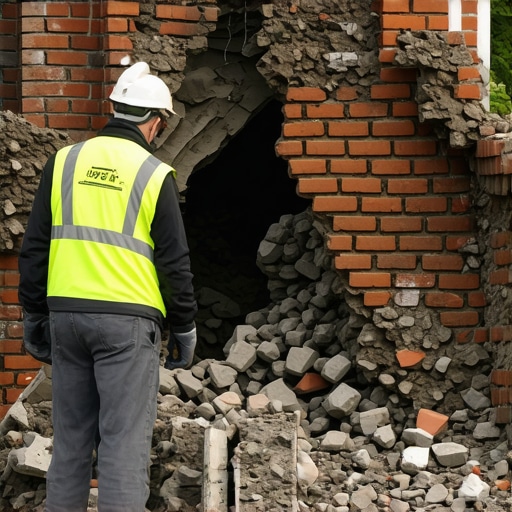
The Forensic Scene: When Kinetic Energy Meets Stationary History
The call usually comes in at 2:00 AM, or shortly after the morning coffee has gone cold. The sound of a bumper meeting a soldier course isn’t just a thud; it is the sound of structural bonds, forged decades ago, screaming under the weight of two tons of steel. I remember one specific site: a delivery truck had backed into a 1920s brick quoin at the corner of a historic estate. The homeowner thought it was just a few loose bricks. But when I put my scope inside the cavity, I saw the truth. The impact hadn’t just displaced the facade; it had sheared the metal ties and the structural steel behind it was rusted to a fine, orange dust. The wall wasn’t standing because of its strength; it was standing because of habit. One more freeze-thaw cycle, and that entire corner would have collapsed into the driveway.
The Physics of Impact and the Myth of the ‘Simple Fix’
When a vehicle impacts a brick retaining wall, the damage is rarely localized to the point of contact. You have to understand the ‘tooth’ of the masonry. Brick is a modular system held together by a chemical bond—the mortar. When a car hits that system, the energy travels. It doesn’t just stop at the cracked brick; it vibrates through the mud (mortar) joints, often cracking the tuckpointing twenty feet away. If the wall is a retaining structure, you aren’t just dealing with gravity; you’re dealing with lateral hydrostatic pressure. That wall was holding back tons of saturated earth. Now, that structural integrity is compromised.
“Water penetration is the single greatest threat to masonry durability, and structural impact creates the perfect conduit for moisture ingress.” – BIA Technical Note 7
In Northern climates where the freeze-thaw cycle is a relentless enemy, a car hit is a death sentence if not handled with forensic precision. Water expands 9% when it freezes. If that impact created even a hairline foundation crack, water will find it. It will sit there, wait for the temperature to drop, and then it will pop the face right off your brick. This is known as spalling, and it’s the cancer of the masonry world. You don’t just need a ‘handyman’ with a bag of premix from a big-box store; you need a specialist who understands brick wall restoration and the chemistry of the materials involved.
The Anatomy of Repair: More Than Just Buttering Bricks
The first thing a forensic mason does is check the footing. If the impact was significant, the entire wall might have shifted on its base. This is where foundation helical pier installation comes into play. If the earth beneath has been destabilized or the wall has tilted, we have to screw massive steel piers into the load-bearing strata of the soil to ‘pin’ the wall back in place. It’s a surgical procedure for a structural patient. We aren’t just buttering the back of a brick and shoving it back in; we are re-establishing the wall’s relationship with the earth.
Then there’s the retaining wall geogrid installation. Modern masonry isn’t just what you see on the surface. Behind a high-performance wall lies a geogrid—a synthetic mesh that stabilizes the soil. If a car impact has torn that grid, the wall will eventually bow and fail, regardless of how pretty the tuckpointing brick walls look on the outside. We have to excavate, replace the grid, and ensure the concrete flatwork services provided for the drainage channels are still functional. If you see honeycombing in the concrete behind the brick, you know the original pour was weak, and the impact just exposed the contractor’s old sins.
The Chemistry of the ‘Mud’: Why Type Matters
One of the biggest mistakes I see in historic brickwork repointing is the use of modern Portland cement on old, soft bricks. Before 1940, bricks were fired at lower temperatures. They are porous, ‘breathing’ blocks of clay. Modern mortar is incredibly hard and brittle. If you use it to repair an old wall, the mortar becomes stronger than the brick. When the wall expands and contracts with the sun, the mortar won’t give. Instead, it crushes the edges of the historic bricks. This is why we use the ‘Sacrificial Principle.’ The mortar must be softer than the brick. We mix specialized Type O or Type N lime-based mud that allows the wall to move without self-destructing.
“The mortar should always be weaker than the masonry units so that any stress-induced cracking occurs in the joints, which are easier to repair than the units themselves.” – ASTM C270 Standard Specification for Mortar for Unit Masonry
When we perform brick efflorescence removal after a repair, we aren’t just washing the wall. Efflorescence—that white, powdery salt—is a symptom of deep-seated moisture. It’s the wall’s way of sweating out its problems. If you just scrub it off, it’ll be back in a month. You have to stop the source of the water, which often means fixing the foundation crack repair issues that the car impact started.
The Execution: Using the Hawk and the Slicker
Watching a master work the joints is like watching a surgeon. We use a hawk to hold the mud and a slicker or jointer tool to strike the joint. Each stroke has to be consistent to ensure the ‘suction’ of the brick pulls the moisture out of the mortar at the right rate. If it dries too fast—what we call ‘flash setting’—it will crumble. If it stays too wet, it will bleed down the face of the wall, leading to a mess that no amount of acid washing can fix. For brick quoin repair, where the corners meet, the alignment must be perfect to within a sixteenth of an inch, or the entire visual ‘line’ of the property is ruined.
When to Panic: Assessing the Damage
If you see a stair-step crack following the mortar joints, the wall has settled or shifted. If you see a horizontal crack, the wall is likely bowing under hydrostatic pressure, and the car hit was just the catalyst. In either case, tuckpointing is only the cosmetic finish. The real work is underneath. You need a team that handles foundation crack repair and concrete flatwork services to ensure the base is as solid as the day it was poured. Don’t be fooled by a ‘lick-and-stick’ contractor who promises a one-day fix. Proper historic brickwork repointing takes time, the right weather, and an obsessive attention to the chemistry of the stone.