
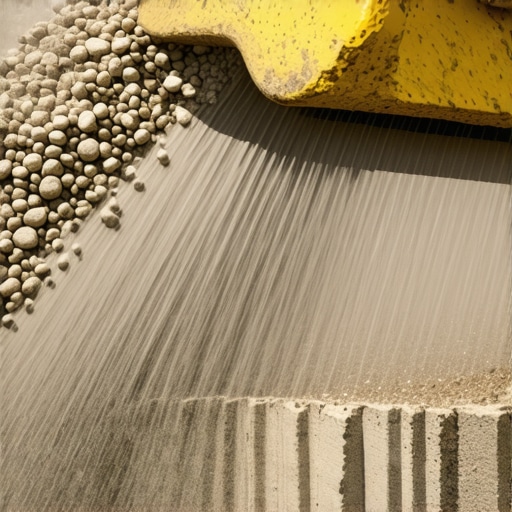
The Forensic Reality of a Blown Pump Line
The developer thought it was just a slow pour, a minor hiccup in the schedule of a high-rise masonry project. But when the four-inch pump hose bucked like a dying snake and let out a metallic scream, I knew the aggregate gradation was a catastrophe. I put my scope inside the wall cavity after the blowout; what I saw was a textbook case of mechanical segregation. The structural steel was barely coated, and the aggregate had bridged, creating a blockage that could have killed a man. This wasn’t a equipment failure; it was a physics failure. Most modern contractors treat mud like it is just wet dirt, but in the world of high-pressure pumping, the geometry of your stone is the difference between a structural masterpiece and a pile of honeycombing debris.
“Grout for masonry should be of a fluid consistency to ensure complete filling of the grout spaces without segregation of the constituents.” – ASTM C476: Standard Specification for Grout for Masonry
In the harsh freeze-thaw cycles of the North, where water expands 9% upon freezing, the density of your pump mix is your only defense against brick spalling prevention. If your aggregate is too large for the pump orifice, you get internal friction that burns out the pump seals and leaves you with a void-riddled wall. I have seen failing retaining wall repair jobs where the contractor tried to force a standard 3/4-inch stone mix through a 2-inch line. The result? A structural skeleton with the strength of Swiss cheese. The physics of the ‘lubricating layer’ is what these guys miss. You need a specific ratio of fines to coarse aggregate to create a pipe-wall lubricant that allows the heavier stones to tumble through the center of the flow without snagging.
The Physics of Aggregate Gradation and Sieve Analysis
Micro-zooming into the mix, we have to talk about the ‘ball bearing effect.’ Ideally, your aggregate should be rounded or cubical, not elongated or flaky. When we perform historic mortar analysis on structures that have stood for two centuries, we see a naturally graded sand that follows a specific curve. Modern pump mixes require even tighter tolerances. If the aggregate is too uniform in size, the void spaces between the stones are too large, requiring excessive cement paste to fill. This leads to massive shrinkage and cracking. We use AI masonry assessment tools now to analyze the particle distribution before the truck even leaves the yard. This isn’t just for show; it is about ensuring the mix has the ‘tooth’ to bond to the masonry units while remaining fluid enough to travel 200 feet through a hose.
When we look at retaining wall geogrid installation, the interaction between the pumped grout and the soil reinforcement is critical. If the grout is too thick due to oversized aggregate, it won’t properly encapsulate the geogrid apertures, leading to a pull-out failure. I have been called to scenes where a retaining wall batter correction was attempted by injecting grout behind a leaning wall. Because the aggregate was poorly graded, the grout ‘flash set’ in the hose, causing a pressure spike that actually blew the face off the wall rather than straightening it. You have to understand the Newtonian fluid dynamics of the slurry. If the stone size exceeds one-third of the smallest pump-line diameter, you are asking for a ‘plug’ that will ruin your day and your profit margin.
The Relationship Between Pumping and Surface Integrity
One of the biggest scams in the industry is the ‘handyman special’ where they try to use a pump mix for masonry joint sand repair or tuckpointing cost estimation projects. You cannot pump a standard Type N mortar the same way you pump a structural grout. The sand-to-cement ratio is different, and the ‘suction’ of the brick will pull the moisture out of the mix instantly if you don’t use a pumping aid. For historic pointing styles, such as the beaded or weathered joint, the aggregate must be fine enough to be manipulated by a slicker without dragging. If you try to pump a mix with 1/4-inch stone into a 3/8-inch joint, you’ll end up with a mess that no porous stone sealers can save.
“Water penetration is the single greatest threat to masonry durability, and the quality of the mortar-to-unit bond is the primary defense.” – BIA Technical Note 7
The chemistry of the cement hydration in a pump mix is an exothermic dance. In hot climates, the heat of hydration can cause the mix to ‘burn’ in the line. In the North, we worry about the air-entrainment. We need those microscopic bubbles to provide a pressure-relief valve for freezing water. But pumping can actually ‘knock’ the air out of the mix if the aggregate is too abrasive. This leads to a dense but brittle material that will eventually fail. I always tell my crews: ‘Butter’ the bricks if you must, but if you’re pumping, you better respect the stone size. A well-designed mix flows like lava; a bad one moves like a heart attack in a hose. If you ignore the sieve analysis, you’ll be paying me to come out with my forensic kit to tell you why your $100,000 wall is now a liability.
The Economic Impact of Proper Mix Design
Contractors often complain about the cost of specialized pump mixes. They see the bill and think they can save a few bucks by using local ‘bank-run’ gravel. That is the quickest way to a failing retaining wall repair. When you factor in the labor of a five-man crew standing around while you try to clear a blocked line, the ‘expensive’ mix is actually the cheapest part of the job. Furthermore, the long-term cost of brick spalling prevention is significantly lower than the cost of a full-scale facade restoration ten years down the road. Use the right mud, check your batter, and never, ever trust a mix that hasn’t been through a proper sieve test. As my grandfather used to say, ‘The trowel doesn’t lie, but the pump truck might.’ In this game, you either do it once, or you do it twice at triple the price.