
The Deceptive Beauty of the Masonry Facade
To the untrained eye, a brick wall is a solid, immovable object. To a third-generation mason, it is a living, breathing assembly of individual units held in a delicate dance of tension and compression. When that dance stops, the music is replaced by the sound of cracking mortar and the silent, deadly pull of gravity. Re-pinning brick infill isn’t just about cosmetic repairs; it is about forensic structural stabilization of a building’s very skin. If you ignore the warning signs, you aren’t just looking at a repair bill; you are looking at a potential catastrophic failure.
The Forensic Scene: When the Scope Reveals the Rot
I recall a project on an old textile mill in the Northeast. The homeowner thought it was just a hairline crack—a minor nuisance that could be hidden with a bit of a concrete patch. But when I put my scope inside the cavity through a weep hole, I saw the structural steel was rusted to dust. The internal ties, the literal umbilical cords connecting the brick veneer to the structural backup, had snapped. The brick was standing on its own, essentially a massive, 40-foot-tall stack of loose teeth held together by nothing but habit and prayer. That is the reality of historic masonry preservation: what you see on the surface is rarely the whole story. When the internal anchoring fails, the wall begins to ‘belly out,’ creating a bow that, once it passes the center of gravity, is irrecoverable without total intervention.
The Physics of Delamination and Thermal Kinetic Force
In the world of historic brick salvage, we understand that buildings are not static. In climates where the temperature swings 80 degrees in a single season, the brick infill undergoes massive thermal expansion. If you have a 100-foot run of brick, it can expand nearly three-quarters of an inch in the summer sun. Without proper relief joints, that force has nowhere to go but out. This is where self-leveling masonry lifts and modern pinning systems come into play. We are essentially retrofitting the building with the skeletal support it lost to a century of oxidation.
“The primary cause of masonry distress is the ingress of water and its subsequent effect on the internal metal ties and the masonry units themselves.” – BIA Technical Note 28B
When moisture penetrates the outer wythe, it reaches the mild steel ties used in early 20th-century construction. As that steel rusts, it expands up to ten times its original thickness. This ‘oxide jacking’ exerts enough pressure to lift an entire soldier course or snap the bond between the brick and the mud. This is why we don’t just ‘butter’ some new mortar on top and call it a day.
The Mechanics of Re-Pinning: Helical Ties and Anchors
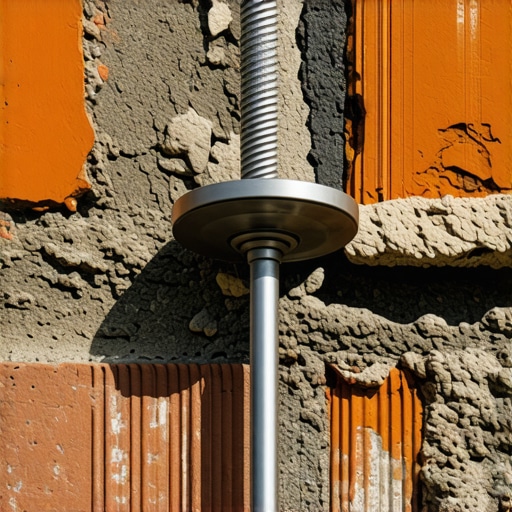
The stabilization process involves the installation of stainless steel helical ties. We drill a pilot hole through the brick and into the substrate—whether it’s concrete, CMU, or timber. The tie is then driven home. The geometry of the helical tie allows it to cut its own thread into the material, creating a mechanical interlock that doesn’t rely on chemical adhesives that might fail during a fire-rated masonry installation. We are restoring the structural connection while allowing for a minute amount of movement. It’s the difference between a rigid, brittle fix and a resilient, structural one.
The Chemistry of the Mortar: Why Softness is Strength
One of the biggest mistakes I see in historic masonry preservation is the use of modern Portland cement on old, soft bricks. High-PSI mortar is the enemy of old buildings. When you use a hard mortar in a tuckpointing cost estimation, you are signing the death warrant for the brick. The mortar must be the ‘sacrificial lamb.’ It needs to be softer than the brick so that when the wall moves, the mortar yields, not the clay. If the mortar is too hard, the freeze-thaw cycle will cause the face of the brick to pop off—a process we call spalling.
“Mortar for use in historic restoration should be compatible with the existing masonry units in terms of strength, porosity, and vapor permeability.” – ASTM C270 Standards
In my shop, we still mix our ‘mud’ with lime putty for these jobs. It has a ‘self-healing’ property. When a micro-crack forms, the lime reacts with carbon dioxide in the air to form new calcite crystals, effectively sealing the crack. Modern mortarless masonry systems have their place in new builds, but for the restoration of a 1920s facade, you need the ‘tooth’ and suction that only a traditional wet-laid joint provides.
Restoring the Lintel: The Hidden Support
Often, brick lintel replacement goes hand-in-hand with re-pinning. The lintel is the horizontal steel member that carries the load over windows and doors. If you see ‘stair-step’ cracking radiating from the corners of a window, your lintel is failing. As it rusts, it sags, and the masonry above it loses its arching action. We must shore up the wall, remove the failing steel, and replace it with galvanized or stainless steel, often finished with metallic masonry finishes to prevent future corrosion. This isn’t a task for a handyman with a slicker; it requires a deep understanding of load paths and shoring physics.
Financial Reality: Tuckpointing Cost Estimation
When homeowners ask about a tuckpointing cost estimation, they are often shocked at the price. But they are paying for more than just buttering joints. They are paying for the grinding—using a diamond blade to remove the old mortar to a depth of at least 1 inch—the cleaning of the joint, and the multi-lift application of new mortar. A ‘smear job’ where the new mortar is just slapped over the old will peel off in two seasons. To do it right, you have to create a clean, square ‘pocket’ for the new mud to bite into. This prevents honeycombing and ensures a waterproof seal.
The Final Defense: Drainage and Retaining Walls
If you are dealing with a failing retaining wall repair, the issue is almost always hydrostatic pressure. Water builds up behind the wall, and because there’s no way out, it pushes the entire structure forward. We see the same thing in brick infill when the weep holes are clogged. You can pin the wall all you want, but if you don’t manage the water, the physics of hydraulic pressure will eventually win. We use drainage mats and weep vents to ensure the cavity behind the brick remains dry. It’s about more than just the concrete patch; it’s about the entire ecosystem of the building envelope.
Conclusion: The Master’s Warning
Do not be seduced by mortarless masonry systems or cheap epoxy ‘fixes’ for structural problems. Masonry is a craft of centuries, not seasons. When you are re-pinning a historic facade, you are honoring the work of the men who came before you. Use the right ties, the right lime-rich mud, and never skip the forensic investigation. A wall that is properly pinned and pointed will stand for another hundred years, long after the modern ‘lick-and-stick’ veneers have crumbled to dust in the driveway. Do it once, do it right, and respect the stone.