
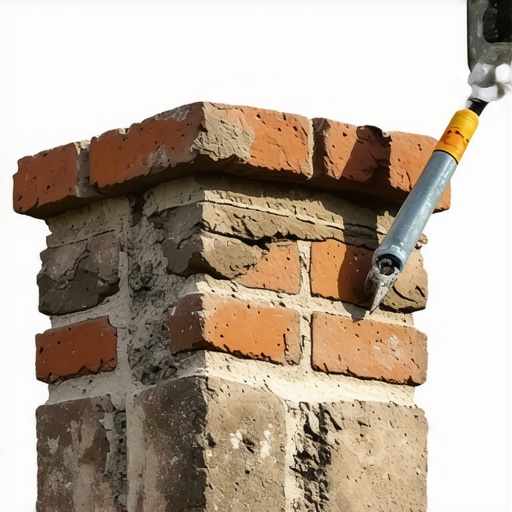
The Diagnostic Ear of a Master Mason
I remember my uncle standing on a scaffold in the biting wind of late November, his knuckles scarred by decades of lime and grit. He didn’t just look at a chimney; he listened to it. He would take the wooden handle of his trowel and give a rhythmic tap to the header course. If the brick gave back a high-pitched ‘sing,’ we were in good shape. But if it produced a hollow, muffled thud, he’d look at me and say, ‘The ghost has left the clay.’ That thud was the sound of internal delamination, a chimney that had been eaten from the inside out by moisture. Most homeowners see a bit of dust on their roof and think it is just age. It isn’t age. It is a chemical war where the chimney is losing.
“The chimney is the most vulnerable part of the building’s exterior due to its exposure to the elements on all four sides.” – BIA Technical Note 19B
When we talk about crumbling mortar joint repair, we are actually discussing the management of phase-change physics. In northern climates, your chimney is a vertical radiator that undergoes extreme thermal shock. On a Tuesday, the internal temperature might be 400 degrees Fahrenheit while the exterior face is -10. This creates a massive vapor pressure gradient. Moisture within the masonry is driven toward the cold face. If you have used a modern, high-strength Portland cement on an old chimney, you have effectively built a pressure cooker. The water can’t get out through the dense ‘mud,’ so it stays in the brick. Then it freezes. When water turns to ice, it expands by approximately 9% in volume. That 9% is enough to shatter the internal cell structure of the clay, leading to freeze-thaw damage restoration needs that could have been avoided with a softer, breathable lime-based mix.
The Anatomy of Failure: From the Crown Down
A chimney doesn’t just fail; it is murdered by neglect. It usually starts at the top with a faulty chimney crown repair job. I’ve seen handymen slap a half-inch of leftover sidewalk concrete over the top of a chimney and call it a ‘cap.’ That is a death sentence. Concrete shrinks as it cures, creating hairline fractures. Those fractures suck in rainwater via capillary action. Once that water is inside the flue, it begins the process of masonry water damage repair from the top down. A proper crown needs a ‘wash’—a slope that sheds water—and an overhang with a drip edge to keep the water from running down the face of the brick veneer installation. Without that drip edge, the water saturates the top three feet of the stack, leading to the dreaded white powder known as efflorescence, which is just the masonry’s way of crying salty tears before it dies.
The Physics of the ‘Sacrificial’ Joint
One of the biggest mistakes in modern masonry is the belief that harder is better. It isn’t. In the world of brick arch restoration and historic maintenance, the mortar must always be the ‘sacrificial’ element. You want the mortar to be softer than the brick. Why? Because buildings move. They breathe. They expand in the sun and contract in the frost. If the mortar is harder than the brick (like a Type S or high-strength Portland), the stress of that movement won’t be absorbed by the joint. Instead, the brick itself will crack. This is why structural brick ties replacement becomes necessary; the entire outer wythe of the wall begins to peel away because it has no room to move. When I’m mixing mud on a hawk, I’m looking for that perfect ‘suction.’ You want a mortar that has enough lime to self-heal. Lime is ‘autogenous’—if a tiny crack forms, water reacts with the unhydrated lime to seal the crack back up. That’s how the Romans did it, and that’s why their walls are still standing while your 10-year-old chimney is falling apart.
“Mortar should be weaker than the masonry units it binds to ensure that stresses are relieved through the mortar joints rather than the units themselves.” – ASTM C270
The Forensic Process of Repointing
Let’s talk about the ‘slicker’ and the ‘mud.’ When we perform tuckpointing cost estimation, we aren’t just looking at the square footage. We are looking at the depth of the decay. You can’t just ‘butter’ over old, sandy mortar. That’s a ‘lick-and-stick’ job that will peel off in two seasons. You have to grind out the old joints to a depth of at least 3/4 of an inch, or until you hit sound material. I prefer a manual chisel for brick infill panel repair to avoid nicking the edges of the brick, which ruins the ‘tooth’ of the masonry. Once the joints are clean, you have to pre-wet the brick. If you put wet mud into a dry brick, the brick will suck the water out of the mortar too fast—a ‘flash set.’ The mortar ‘burns,’ loses its bond, and you end up with a cold joint that will let water right back in. You want to pack the mortar in layers, firmly, using a jointer tool to strike the joint once it is ‘thumbprint hard.’ This compaction is what creates the weather-tight seal.
When to Panic: Identifying Structural Threats
Is it just a cosmetic issue, or is your chimney about to become a pile of rubble in your driveway? Look for the soldier course—those bricks standing vertically. If you see vertical cracks running through the bricks themselves rather than the mortar, you have a foundation settlement issue or severe thermal expansion. If the mortar is so soft you can dig it out with your fingernail, the binder has washed away, leaving only sand. This is the stage where crumbling mortar joint repair is no longer optional; it is a structural emergency. If you ignore it, the moisture will eventually reach the structural brick ties, rusting them to nothing, and then the only thing holding your chimney up is gravity and luck. And in masonry, luck is a very poor building material. Stop looking for the cheapest bid. Look for the man who knows the difference between hydration and drying, and who understands that a chimney is a living, breathing machine of clay and lime.