
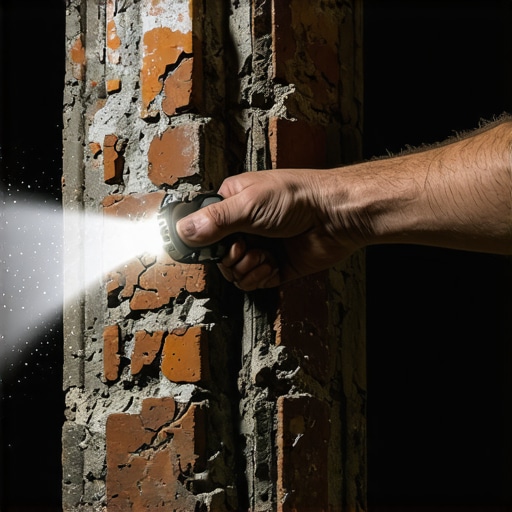
The Forensic Scene: When the ‘Hairline’ is a Warning Shot
I was standing in the cavernous service corridor of a 1982-era shopping mall, the kind of place where the air smells of old grease and damp concrete. The facility manager pointed to what he called a ‘nuisance crack’—a vertical line running through the concrete block foundation. He wanted a quick patch, a bit of epoxy and some paint. But when I pulled my borescope out and fed the fiber-optic lens into a core-drilled hole, the reality was grim. Behind that ‘nuisance’ was a cavity filled with water and structural steel that had been reduced to a heap of orange flakes. The steel hadn’t just rusted; it had undergone a volume expansion of nearly seven times its original thickness, a process known as oxide jacking that was literally blowing the Concrete Masonry Unit (CMU) restoration apart from the inside out. This wasn’t a cosmetic fix; this was an emergency masonry repair waiting to happen.
“Water penetration is the single greatest threat to masonry durability. Once moisture bridges the envelope, the structural integrity of the assembly is compromised by chemical and physical degradation.” – BIA Technical Note 7
The Physics of the Failure: Why Commercial Malls Melt
In the world of commercial tuckpointing and large-scale infrastructure, we deal with physics that don’t apply to your neighbor’s brick bungalow. A mall is a massive heat sink. During a July afternoon, a 400-foot-long south-facing wall of a department store can expand by several inches. If the original masons didn’t include adequate control joints, or if those joints have been filled with non-compressible ‘handyman specials,’ that energy has to go somewhere. It manifests as ‘bowing,’ where the wall starts to resemble a ship’s sail. In the North, we have the added joy of the freeze-thaw cycle. When water gets trapped in the ‘cells’ of a concrete block foundation, it freezes. Water expands 9% upon freezing. It exerts thousands of pounds of pressure per square inch against the interior faces of the block. Over forty years, this hydraulic ramming action turns the interior of the wall into gravel.
The Anatomy of Concrete Masonry Unit Restoration
When I’m called in for a concrete masonry unit restoration, I’m looking for the ‘tooth’ of the remaining material. Most people think you just slap some new mud on. Wrong. You have to understand the hydration process. When we use sustainable tuckpointing mortars, we are looking at the molecular bond between the silicate in the block and the calcium hydroxide in the mortar. Modern Portland-heavy mortars are often too stiff for these aging structures. If the mortar is harder than the block, the block will fail first. We use ‘sacrificial’ mortar—something with enough lime to allow for autogenous healing, where small cracks actually seal themselves over time through carbonation. To fix a failing CMU wall, we often have to perform a concrete block foundation repair that involves reinforcing the hollow cores with rebar and high-slump grout, but only after we’ve addressed the hydrostatic pressure building up behind the wall from poor parking lot drainage.
Foundation Helical Pier Installation: The Surgical Cure
Sometimes the masonry isn’t the problem—it’s the dirt it’s sitting on. In many of these suburban malls, the ‘soil’ is actually just compacted fill from the 1970s. When that soil gives way, you see the classic stair-step crack. This is where foundation helical pier installation comes into play. We aren’t just ‘underpinning’; we are essentially building a bridge from the bottom of the footing down to load-bearing strata or bedrock. These steel shafts are screwed into the earth with hydraulic torque motors until we hit a specific resistance. We then ‘butter’ the top of the pier bracket and transfer the weight of the mall’s massive structural columns onto the steel. It’s a permanent fix that stops the settlement that makes stone facade restoration impossible.
Stone Facade Restoration and Advanced Masonry Adhesives
Many malls built in the late ’80s used ‘lick-and-stick’ stone or thin-set veneers. This is where I see the most dangerous failures. The advanced masonry adhesives of thirty years ago are brittle now. I’ve seen 200-pound slabs of granite held up by nothing but a prayer and a prayer doesn’t have much shear strength. When we perform a stone facade restoration, we’re often mechanical-fixing the stone back to the substrate with stainless steel pins. We don’t trust adhesives alone. We use a ‘hawk’ and ‘slicker’ to repoint the joints, ensuring that the commercial tuckpointing provides a weather-tight seal while still allowing the building to breathe. If you trap moisture behind a stone veneer in a freeze-thaw climate, you’re creating a ticking time bomb.
“The selection of mortar for masonry restoration must be based on the physical properties of the masonry units. A mortar that is too high in compressive strength can lead to irreversible damage to the masonry units themselves.” – ASTM C270 Standard Specification for Mortar
The Chimney and Parapet: The Mall’s Achilles Heel
Don’t get me started on chimney rebuild services for mall boiler vents or the parapet walls that ring the roof. These are the most exposed elements of the building. They get hit by wind, rain, and sun from both sides. Most facade cleaning crews just blast these with high-pressure water, which is the worst thing you can do. It drives water deep into the masonry ‘cold joints’ and destroys the bond. A proper restoration requires grinding out the old ‘mud’ to a depth of at least twice the width of the joint, then ‘buttering’ in new mortar in lifts to ensure there are no voids. If the parapet is leaning, we’re looking at a full teardown and rebuild, often involving a soldier course of brick for aesthetic consistency and structural header bonds for strength.
Conclusion: The Cost of the Quick Fix
Managing an aging mall is about triage. You can spend $10,000 now on commercial tuckpointing and proper drainage, or you can spend $500,000 later when a section of the facade ends up in the sidewalk. Forensic masonry isn’t just about looking at cracks; it’s about understanding the chemistry of the C-S-H gel in the concrete and the physics of thermal movement. It’s about knowing that a ‘slicker’ in the hands of a master is a better tool than a caulk gun in the hands of a handyman. Do it once, do it right, or the building will eventually make the decision for you.