
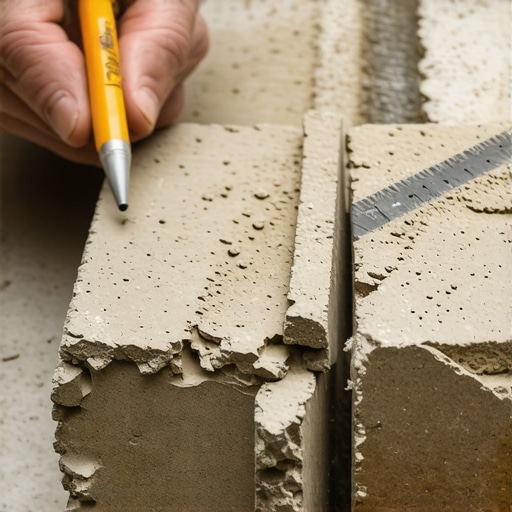
The Forensic Scene: The Graveyard of Indiana Limestone
I walked onto a site last November in the heavy damp of a Northeast autumn. The contractor was sweating, and not because of the labor. Around him lay three thousand dollars worth of Indiana limestone, hacked into useless, jagged chunks. He was attempting a birdsmouth cut—that precise 90-degree notch where a stone unit wraps around a corner or receives a structural member—and he was losing the war. Every time he neared the internal apex of the cut, the stone would ‘pop,’ a hairline fracture shooting through the bedding plane of the material, rendering the unit structural garbage. He thought it was a bad batch of stone. I knew better. He was fighting the physics of the material without the right ‘mud’ or the right technique. When I put my scope into the cracks of the brick quoin repair he’d already finished, I saw the truth: he wasn’t just wasting stone; he was creating future failure points where moisture would inevitably congregate and freeze.
The Anatomy of the Birdsmouth: Physics and Stress Concentrations
In the world of forensic masonry, we look at the birdsmouth as a ‘re-entrant corner.’ When you cut a 90-degree notch into a solid block, you are creating a point of extreme stress concentration. If you’ve ever seen foundation wall bowing repair, you know that forces like to find the weakest point. In a stone unit, that point is the internal corner of your cut. As the diamond blade spins at 5,000 RPM, it introduces thermal energy and mechanical vibration. If you over-cut that corner—meaning the kerf of the blade extends past the meeting point—you’ve effectively created a perforated line for the stone to snap. To avoid waste, the master mason uses a ‘stop-cut’ technique. We plunge-cut to within an eighth of an inch of the mark, then finish the internal corner with a hand-set or a high-frequency reciprocating diamond file. This preserves the structural integrity of the ‘arris’—the sharp exterior edge—and prevents the unit from becoming a ‘dead soldier’ on the scrap pile.
“Stone shall be sound, durable, and free from laminations, cracks, and other defects that might impair its structural integrity or appearance.” – ASTM C568
Micro-Zoom: The Chemistry of the Kerf
When you are performing stone balustrade restoration or brick quoin repair, the chemistry of the cut matters as much as the geometry. As the blade grinds through the calcium carbonate or silica structure of the masonry, it creates a slurry. In a birdsmouth cut, this slurry can pack into the back of the notch, creating hydraulic pressure if you aren’t using a constant-flow wet saw. This ‘slurry-lock’ can actually blow the face off a delicate piece of limestone. Furthermore, the heat generated can cause ‘thermal shock.’ In colder climates, if you dry-cut and then immediately set that stone into wet mortar, the ‘suction’ or initial absorption rate of the stone changes. The stone is thirsty and hot; it sucks the water out of your ‘mud’ before the hydration process can properly bind the cementitious particles. This leads to a ‘cold joint’ where the stone just sits on the mortar rather than bonding with it. Always temper your stone with a light misting—not a soak—before setting a complex cut.
Material Science: Why the ‘Mud’ Dictates the Cut
If you’re working on a commercial smokestack repair or a historic facade, you’re likely dealing with softer, older masonry. Modern Portland cement is the enemy here. It is too hard, too brittle, and lacks the breathability required for natural stone or pre-1940s brick. For a birdsmouth joint, I always specify a Type N or even a Type O lime-rich mortar. Why? Because the mortar must be the sacrificial element. If the building shifts—and buildings always shift—you want the mortar to crack, not your precision-cut birdsmouth stone. Using tuckpointing machine services with a high-pressure lime mix ensures that the void behind the birdsmouth is fully ‘buttered,’ leaving no air pockets for chimney leak detection experts to find later. Air pockets are where water collects, and as we know, water expands 9% upon freezing. That 9% is enough to shatter a limestone quoin like it was made of glass.
The Role of AI Masonry Assessment in Waste Reduction
We are entering an era where AI masonry assessment tools can scan a facade and calculate the exact dimensions for every replacement unit, including the ‘waste factor.’ Traditionally, a mason would order 20% extra material. With precision scanning, we can drop that to 5%. This is critical when you are doing brick patio restoration or patio stone realignment where the stones are irregular. The AI can determine the best orientation for a birdsmouth cut based on the visible grain or ‘bed’ of the stone, ensuring the load is distributed across the natural layers rather than against them. This is the same logic used in self-healing concrete foundations—designing the material to handle its own internal stresses before they become catastrophic failures.
“The selection of mortar for a particular masonry unit should be based on the properties of that unit, the environmental conditions, and the structural requirements.” – BIA Technical Note 8
Practical Steps: The Master’s Workflow for Birdsmouth Cuts
- The Layout: Use a sharp carpenter’s pencil, not a fat wax crayon. In masonry, a 1/16th of an inch is the difference between a ‘tight’ joint and a ‘handyman special.’
- The Relief Cut: Before making your primary notch cuts, make several parallel relief cuts into the waste portion of the stone. This relieves the internal tension and prevents the ‘pop.’
- The Buttering: When applying your ‘mud,’ use a ‘hawk’ and trowel to ensure the back of the notch is fully coated. Do not just ‘spot-bond’ the corners. You need 100% coverage to prevent hydrostatic pressure from building up behind the stone.
- The Striking: Once set, use a ‘slicker’ or jointer tool to compress the mortar into the joint. This ‘striking’ action isn’t just for looks; it densifies the surface of the mortar, making it more resistant to water penetration.
Conclusion: The Cost of the Quick Fix
I’ve seen too many ‘lick-and-stick’ crews try to fake a birdsmouth by mitering two thin pieces of stone together. That isn’t masonry; it’s carpentry with rocks. A true birdsmouth is a single, solid unit that provides structural continuity around a corner. Whether you are doing commercial smokestack repair or a simple brick patio restoration, the principles remain the same: respect the stone, understand the physics of the cut, and never use a harder mortar than the material you are laying. Do it once, or do it twice—the stone doesn’t care about your schedule, only about the laws of gravity and thermodynamics.