
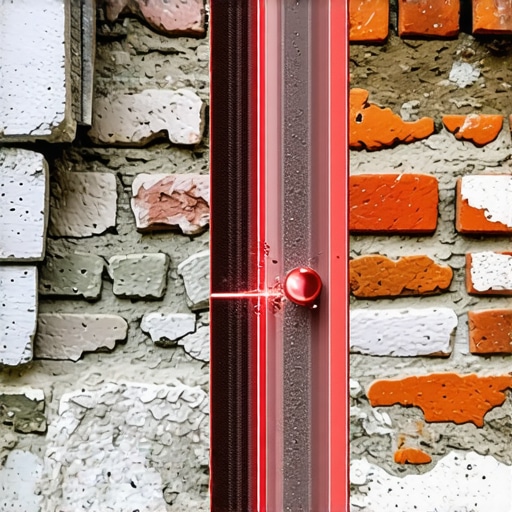
The Curse of the Polka-Dot Facade
Walk down any historic district in Philadelphia or Chicago, and you will see it: the architectural equivalent of a bad skin graft. A beautiful 1920s Tudor or a stately Victorian marred by repointing that looks like a child tried to repair a masterpiece with grey play-dough. The joints are too thick, the color is off by three shades of beige, and the texture is as smooth as plastic. As a third-generation mason, it makes my teeth ache. For decades, matching mortar was a dark art performed by guys like my mentor, Silas. Silas didn’t have a lab; he had a magnifying glass and a ritual. He used to take a sample of the original mud, crush it between two smooth stones, and then spread it on a piece of dark felt. He’d stare at the sand grains for twenty minutes, muttering about ‘river silt’ and ‘crushed limestone.’ He could tell if the sand came from a local creek or a commercial quarry just by the way the light hit the silica. He’d say, ‘If you don’t match the sand, the color won’t stay.’ He was right, but even Silas was limited by the human eye’s inability to see the chemical ‘ghosts’ inside the binder. Today, we don’t have to guess. We use AI masonry assessment and digital scanning to do what Silas’s eyes couldn’t: achieve a perfect molecular match.
“Water penetration is the single greatest threat to masonry durability. The compatibility of repair mortar with the original materials is paramount to preventing structural failure.” – BIA Technical Note 7
The Physics of the Sacrificial Joint
Before we talk about the lasers and the software, we have to talk about why matching matters. It isn’t just about aesthetics; it’s about structural survival. In the world of masonry repair services, we live by the Sacrificial Principle. The mortar must always be softer and more permeable than the brick itself. Why? Because buildings breathe. Moisture moves through walls like a slow-motion tide. If you use a modern, rock-hard Portland cement mix on old, soft-fired clay bricks, the moisture gets trapped. When the freeze-thaw cycle hits—and water expands by 9%—that trapped moisture has nowhere to go. Instead of the mortar joint giving way, the face of your brick pops off in a process we call spalling. This is where high-performance mortar mixes come in. We aren’t just looking for a color match; we are looking for a vapor-permeability match. We need to know the exact ratio of lime to cement to sand. If you get it wrong, you aren’t fixing a building; you are signing its death warrant.
How Digital Scanning Reads the ‘DNA’ of Mud
When we perform an AI masonry assessment, we aren’t just taking a picture. We use a handheld spectrophotometer to capture the chromaticity coordinates of the mortar. This tool measures how the surface reflects light across the visible spectrum. But that’s just the surface. The real work happens when we take a ‘biscuit’—a small chunk of the original mortar—and run it through digital scanning that analyzes sand gradation curves. We look at the ‘tooth’ of the aggregate. Was the sand sharp and angular (crushed stone) or rounded (river-washed)? The software compares these samples against thousands of known sand profiles. This allows us to recreate the exact texture that Silas used to find by touch. This level of precision is critical for commercial smokestack repair, where the heat and wind loads are so extreme that any inconsistency in the mortar’s thermal expansion coefficient will lead to catastrophic cracking within a single season.
Chimney Forensics and the High-Altitude Fight
The chimney is the most abused part of any structure. It’s a heat-conducting tower exposed to the elements on all four sides. When someone calls for chimney repair services, they usually think they just need a little ‘tuckpointing.’ But my first move is always chimney leak detection. I’m looking for the ‘weeping’ joints where water has bypassed the chimney flashing repair job some handyman did with a tube of caulk. Modern chimney repair services now utilize digital diagnostics to check for flue integrity. If I see brick efflorescence removal is needed, I know there is a salt migration issue. That white, powdery ‘fuzz’ on the bricks isn’t just an eyesore; it’s the sound of the brick crying. It means water is moving through the wall, dissolving salts, and depositing them on the surface as it evaporates. If we don’t fix the chimney cap replacement or the flashing first, the most perfect mortar match in the world won’t last five years.
“Mortar should be designed to be sacrificial to the masonry units, ensuring that stresses and moisture are managed within the joints rather than the masonry itself.” – ASTM C270 Standard Specification
The Rust Burst: Brick Lintel Replacement
Sometimes, the crack isn’t the mortar’s fault. If I see a horizontal crack above a window, I know exactly what I’m looking at: the rust burst. This is where brick lintel replacement becomes unavoidable. The steel lintel—the ‘L-bracket’ that holds up the bricks over an opening—starts to oxidize. As steel rusts, it can expand up to ten times its original thickness. That expansion force is enough to lift an entire soldier course of bricks. You can’t just butter over that crack with more mud. You have to cut the masonry out, replace the steel, and then use your digital scan to match the new mortar to the old surrounding wall so the repair ‘disappears.’ We call this ‘re-skinning the ghost.’ It requires a steady hand with the hawk and slicker, and a deep understanding of how the new high-performance mortar mixes will hydrate and shrink over the first 28 days.
The Final Word: Do It Once, or Do It Twice
In this trade, you either respect the chemistry or the chemistry will humiliate you. Many contractors will ‘slick’ a joint with a hard Type S mortar because it’s easy to work with and sets up fast. They want to get in and get out. But they are creating a cold joint—a failure of bond where the new mud doesn’t actually ‘marry’ to the old. By using AI masonry assessment, we ensure that the binder-to-aggregate ratio is identical to the original, allowing for a seamless chemical bond. Whether it is a simple chimney flashing repair or a massive commercial smokestack repair, the goal is the same: permanence. Don’t let a ‘handyman special’ ruin your heritage. Use the technology. Match the mud. Protect the brick. Because once the face of a historic brick is gone, it’s gone forever. You don’t want to be the guy who turned a 100-year-old masterpiece into a polka-dot eyesore.