
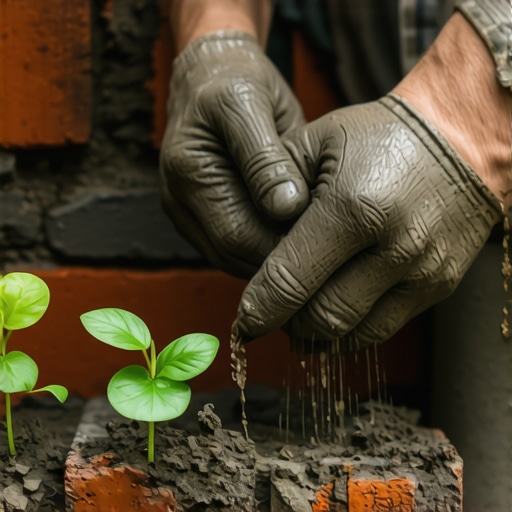
The Forensic Scene: A Ghost in the Wall
I recently stood before a 1920s brick warehouse where the owner complained about what he thought was a simple cosmetic issue. ‘Just a few flakes on the ground,’ he said. When I climbed the staging and ran my fingers over the facade, the faces of the bricks crumbled into red dust. This wasn’t a material failure; it was a forensic crime scene. A decade ago, a ‘handyman’ had repointed the soft, porous lime-baked bricks with modern, high-carbon Type S Portland cement. The wall couldn’t breathe. The hard cement acted like a tourniquet, trapping moisture behind the face of the brick. When the temperature dropped, that trapped water expanded, blowing the faces off the masonry in a process we call spalling. Beneath the surface, the structural brick ties replacement that should have happened years ago was ignored, and the original iron ties had rusted to a fraction of their thickness, leaving the outer wythe literally hanging by a thread of friction.
The Physics of the Carbon Footprint
To understand why low-carbon mortar is more than just a green trend, you have to look at the chemistry of the ‘mud’ on your hawk. Traditional Portland cement is a thermodynamic nightmare. It requires heating limestone and clay to nearly 2,700 degrees Fahrenheit in a kiln. This process, known as calcination, releases massive amounts of CO2 both from the fuel burned and the chemical reaction itself. When we talk about making masonry more eco-friendly, we are returning to the ‘Carbonation Cycle.’ Pure lime mortar (non-hydraulic) actually re-absorbs CO2 from the atmosphere as it cures, turning back into calcium carbonate—literally back into stone. This isn’t just about the environment; it’s about mechanical compatibility. High-carbon cements are rigid and brittle. Low-carbon lime mortars are flexible, allowing for the natural thermal expansion of a building without the need for excessive cracked brick wall repair.
“Water penetration is the single greatest threat to masonry durability, and the use of overly dense mortars accelerates the decay of historic masonry units.” – BIA Technical Note 7
Structural Brick Ties and Veneer Detachment
When we perform a brick veneer detachment repair, we often find that the failure started with the chemistry of the mortar and ended with the physics of the ties. Modern brick veneer installation relies on corrugated or wire ties to hold the ‘skin’ to the ‘bones’ of the building. In an eco-friendly build, using a low-carbon mortar mix that is rich in lime provides a ‘buffer’ for these ties. Lime is naturally alkaline, which helps inhibit the corrosion of the steel. When you see a wall bowing outward, it’s a sign that the structural brick ties replacement is overdue. The ‘tooth’ of a low-carbon mortar allows for a micro-flexibility that high-carbon mixes lack. If you butter a brick with a mix that is too hard, any structural movement in the foundation or the soil—the kind of movement that eventually requires foundation underpinning—will manifest as a catastrophic shear crack rather than a manageable hairline fissure.
The Micro-Zoom: Hydration vs. Carbonation
Let’s get tactile with the science. Portland cement hardens through hydration—a rapid chemical reaction with water that creates a crystalline structure. It’s fast, but it’s unforgiving. Low-carbon lime mortar hardens through carbonation. As the water evaporates, CO2 from the air enters the pores of the mortar and reacts with the calcium hydroxide. This is a slow-motion birth of stone. For an outdoor kitchen masonry build, using a lime-based mix ensures that the heat from the grill won’t cause the cold joint issues you see in brittle cements. If you are doing brick lintel replacement over a window or door, you need that mortar to be the ‘sacrificial’ element. You want the mortar to fail before the brick does. That is the fundamental law of the old masters: the mortar must always be softer than the masonry unit.
“The durability of the work depends on the choice of materials and the method of their mixture… for lime is the bond of the structure.” – Vitruvius, De Architectura
Waterproofing and the Chimney Crisis
One of the biggest scams in the industry is the ‘permanent’ brickwork sealants application. Most of these store-bought sealers are film-forming resins that choke the wall. In a low-carbon masonry system, we use silanes or siloxanes that are vapor-permeable. This allows liquid water to stay out but lets water vapor escape. This is critical during a chimney cap replacement. The chimney is the most exposed part of the structure, subjected to the most extreme freeze-thaw cycles. If you use a high-carbon, non-breathable mix on a chimney, you’re essentially building a ticking time bomb. The same logic applies to commercial parapet wall repair. These walls are exposed on both sides; they need to breathe or they will honeycomb from the inside out. A soldier course at the top of a wall looks beautiful, but without a low-carbon, flexible mortar, those vertical bricks will be the first to pop when the thermal expansion hits its peak in July.
The Reality of Restoration
True sustainability isn’t just about the carbon in the bag; it’s about the lifespan of the wall. If you have to tear down and rebuild a wall every 20 years because you used the wrong ‘mud,’ you are a failure as a mason. Cracked brick wall repair should be a surgical procedure, not a patch job. When we use a slicker to strike a joint in a lime-based restoration, we are ensuring that the building can stand for another century. Whether it is foundation underpinning to stabilize a shifting corner or a simple brick lintel replacement, the goal is always the same: respect the physics of the materials. Do not be seduced by the speed of modern ‘lick-and-stick’ products. Real masonry is a slow game. It’s about the suction of the brick, the dampness of the sand, and the patience of the carbonation process. Build it once, build it right, and let the carbon stay in the ground where it belongs.