
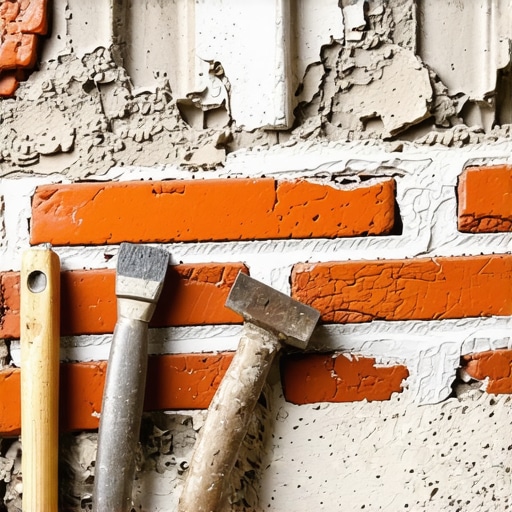
The Ghost of Portland Cement: A Historic Facade’s Executioner
I remember standing before an 1880s Victorian in a neighborhood where the architecture is the only thing keeping the property values from plummeting. The owner was proud. He had just spent ten grand on a ‘refresh’—the joints were white, crisp, and hard as granite. He didn’t realize he had just signed his home’s death warrant. My mentor, a man who had more limestone dust in his lungs than oxygen, used to run his thumb over a joint and tell me exactly how much sand was in the mix just by the ‘grit’ against his skin. He taught me that an old wall is a living, breathing organism. If you choke it with modern Portland cement, it will literally tear itself apart to find air. That Victoran? Two winters later, the faces of the bricks were popping off like scabs, a process we call spalling, because the water trapped behind that ‘hard’ mortar had nowhere to go but through the brick itself. This is the reality of brick wall restoration; it is a forensic science, not a cosmetic upgrade.
The Chemistry of the ‘Mud’: Why Your Local Hardware Store Is Your Enemy
In the world of brick wall restoration, the term ‘mud’ refers to the mortar, but not all mud is created equal. Most modern masons reach for Type S or Type M mortar. These are hydraulic cements. They set fast, they have high compressive strength, and they are utterly lethal to historic clay. Historic bricks, fired in kilns that lacked the precision of modern computer-controlled ovens, are softer and more porous. They expand and contract with the seasons. We use a ‘sacrificial’ principle: the mortar must always be softer and more permeable than the brick. When the house shifts or the temperature drops, we want the mortar joint to take the stress, not the brick. Micro-zooming into the chemistry, modern Portland cement creates a dense crystalline structure through a rapid hydration process. In contrast, traditional lime putty mortar cures through carbonation—absorbing CO2 from the air over months or even years. This creates a flexible, ‘self-healing’ joint. When a hairline crack forms in lime mortar, rainwater dissolves a bit of the free lime and redeposits it into the crack, effectively sealing it. You don’t get that with a 94-pound bag of Quikrete.
“Mortar should be designed to be sacrificial to the masonry units. It is easier and cheaper to repoint a wall than it is to replace the brick or stone itself.” – NPS Technical Preservation Brief 2
The Forensic Toolbelt: Moving Beyond the 4-Inch Grinder
Watch a ‘handyman’ approach a historic tuckpointing job and you’ll see him pull out a 4-inch angle grinder with a diamond blade. To a forensic mason, that’s like a surgeon walking into an operating room with a chainsaw. One slip and you’ve cut into the ‘skin’ of the brick, destroying the fire-hardened face and exposing the soft interior to the elements. Proper brick wall restoration and brick infill panel repair require surgical precision. We use specialized pneumatic chisels—essentially miniature jackhammers—that vibrate at a frequency designed to shatter the mortar bond without bruising the brick. For narrow joints, we use ‘sustainable block cutting’ techniques with dust-extraction systems and oscillating blades that can reach into the ‘tooth’ of the joint. The goal is to remove the failing material to a depth of at least twice the width of the joint, ensuring the new lime-based mud has enough surface area to grab onto. If the joint is too shallow, the new mortar won’t have the ‘suction’ needed to stay put, leading to a cold joint that will flake off within a single season.
The Anatomy of Failure: Lintels and Structural Ties
Sometimes the problem isn’t the mortar at all, but what’s hiding behind it. During a brick lintel replacement, we often find that the original steel angle iron has oxidized. As steel rusts, it expands up to ten times its original thickness. This ‘rust jacking’ exerts thousands of pounds of pressure on the surrounding masonry, resulting in the classic diagonal ‘stair-step’ cracks you see above windows. You can’t just butter over those cracks; you have to support the load, remove the masonry, and install a new, flashed, and primed lintel. Similarly, we often see structural brick ties replacement as a necessity in multi-wythe walls. The original corrugated metal ties that held the outer layer of brick to the inner structure often rot away, leaving the facade ‘bowing’ outward like a sail in the wind. We use helical stainless steel ties that are driven through the mortar and into the backup material, providing a mechanical connection that won’t rust out. It’s about the physics of tension and compression, not just making it look pretty.
The Aesthetics of Forensic Masonry: Staining and Cleaning
After the structural work is done, we deal with the aesthetics. Facade cleaning on a historic home should never involve a high-pressure washer. I’ve seen 3,000 PSI blast the character right off a 100-year-old building. We use low-pressure chemical mists that break the surface tension of the carbon and atmospheric soot. If we have to replace broken units, finding a match is nearly impossible. This is where masonry staining comes in. Instead of a ‘lick-and-stick’ paint that will peel, we use breathable mineral stains that chemically bond with the clay. This allows us to match the patina of the original wall while maintaining the vapor permeability of the system. Even tile grouts on masonry applications, often seen in entryways or decorative friezes, require a specific mix to prevent honeycombing—the formation of voids within the grout that trap water and lead to freeze-thaw failure. For capstones, we focus on retaining wall capstone replacement using fiber-reinforced mortars in the bedding joints only where extra tensile strength is needed to combat the lateral pressure of the soil behind the wall. The capstone must have a proper drip edge to shed water away from the face of the wall, preventing the very moisture penetration that causes the mortar to fail in the first place.
“Water penetration is the single greatest threat to masonry durability.” – BIA Technical Note 7
The Bottom Line: Do It Once or Do It Twice
In the North and Midwest, where the freeze-thaw cycle is a relentless hammer, you cannot afford to get this wrong. When water gets trapped in a non-breathable joint and expands by 9% as it turns to ice, it will find a way out, usually by taking the face of your brick with it. Whether you are dealing with retaining wall capstone replacement or complex brick infill panel repair, the physics remains the same. Use a slicker or a hawk to apply the right material, in the right way, with the right tools. If a contractor tells you they can do the whole house in a weekend with a bag of Type S, show them the door. A true master knows that you don’t just fix a wall; you honor the guy who built it a century ago by making sure it stands for another hundred years. Using modern shortcuts on a historic home isn’t just a bad investment—it’s a crime against craftsmanship.