
The Silent Inward Fold: A Forensic Masonry Perspective
I remember a job site in the rust belt where the homeowner had a horizontal crack running the length of the west basement wall. To the untrained eye, it was just a hairline fracture. But when I put my scope inside the cavity and checked the plumb line, I saw the structural steel was rusted to dust and the wall was leaning four inches inward at the center. The hydrostatic pressure from the clay outside was literally folding the house like a piece of cardboard. They thought they’d have to excavate the entire perimeter, destroying their grandmother’s prize-winning rose garden and a $30,000 deck. But in the world of forensic masonry, we have ways of fighting back from the inside out.
Structural bowing is a physics problem, not just a cosmetic one. It occurs when the lateral earth pressure exceeds the structural capacity of the masonry units—whether that’s cinder block, poured concrete, or multi-wythe brick. To fix this without a backhoe, we have to talk about the micro-zoom of soil mechanics and the chemistry of tension. When clay soils saturate, they undergo a molecular expansion. The water molecules wedge themselves between the silicate layers of the clay, increasing the volume and pushing against your foundation with thousands of pounds of force per square foot. This is where foundation underpinning usually comes in, but when we want to avoid digging, we turn to advanced tension-based materials.
“Water penetration is the single greatest threat to masonry durability, leading to hydrostatic pressure that can compromise the lateral stability of foundation walls.” – BIA Technical Note 7
The Physics of Carbon Fiber and Internal Reinforcement
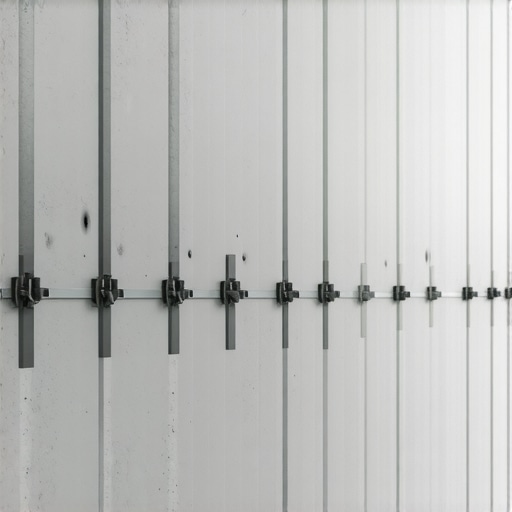
If your wall is bowing less than two inches, we don’t need a shovel; we need carbon fiber. Unlike steel, which is bulky and prone to oxidation (rust) when exposed to the dampness of a basement, carbon fiber is an aerospace-grade material that is ten times stronger than steel in tension. When we apply carbon fiber straps to a bowing wall, we are creating a rigid ‘exo-skeleton.’ We start by grinding the wall surface to achieve the perfect tooth for the epoxy. This isn’t a handyman special where you just slap some glue on; we use a diamond-grinding wheel to open the pores of the masonry. If the wall has a soldier course of brick or a header row, we must ensure the strap spans the entire vertical height to distribute the load.
The chemistry of the epoxy is critical. We use a high-modulus, structural epoxy that saturates the carbon weave. As the epoxy cures, it forms a mechanical bond with the silicate in the concrete or brick. The strap now takes the entire tension load that the soil is exerting on the wall. The wall wants to bow further, but the carbon fiber, which has zero stretch, says ‘no.’ This is a permanent fix that requires zero exterior excavation. It’s the same principle used to reinforce bridge pilings and skyscraper columns.
Structural Brick Ties and the Veneer Crisis
Sometimes the bowing isn’t in the foundation but in the brick veneer above grade. I see this constantly with stone veneer repair and stone veneer over brick applications. The original builders often used cheap corrugated metal ties that rot out after twenty years. When those ties fail, the brick wall becomes a ‘free-standing’ curtain that can collapse in a high wind. We fix this through structural brick ties replacement using helical anchors. We drill a tiny pilot hole through the mortar joint and drive a stainless steel helical tie through the brick and into the wood or masonry backup. This stitches the house back together without removing a single brick. It’s surgery, not a demolition.
The Art of the Mud: Mortar Repointing Services
When a wall bows, the mortar joints on the exterior are compressed, and the interior joints are stretched. This often leads to the need for mortar repointing services. You can’t just use any mud. If you have an older home, using a modern Type S Portland cement is a death sentence for the brick. High-Portland mortars are too hard; they have a high compressive strength but zero flexibility. When the house moves—and houses always move—the hard mortar will crush the edges of the soft, historic bricks. This is called spalling.
“Mortar should always be weaker than the masonry units it binds, acting as a sacrificial element to accommodate thermal expansion and structural shifts.” – ASTM C270 Standard Specification for Mortar
We use a slicker or a jointer tool to strike the joints, ensuring we get the right suction. For tuckpointing curved walls, this is even more critical. The geometry of a curve means that the outer radius is under tension while the inner is under compression. A master mason knows how to blend the lime and sand to create a Type N or Type O mortar that allows the wall to breathe while providing tuckpointing weatherproofing that keeps the freeze-thaw cycle from popping the faces off your masonry.
Chimneys, Retaining Walls, and Lateral Force
Bowing isn’t limited to basements. I’ve seen retaining wall reinforcement jobs where the retaining wall capstone replacement was ignored, allowing water to pour into the core of the wall. That water freezes, expands by 9%, and pushes the stones out of alignment. We can often fix these by installing internal ‘deadman’ anchors or soil nails from the face of the wall, avoiding the need to dig up the entire hillside. Similarly, chimney interior parging is a vital forensic repair. When the flue gases interact with moisture, they form a weak sulfuric acid that eats the mortar from the inside out. Parging the interior with a calcium aluminate mix seals those cracks and restores the structural integrity of the stack.
Why Most “Fixes” Fail
The reason most homeowners end up digging is that they wait too long or hire someone who doesn’t understand the cold joint or honeycombing in their concrete. If you see a horizontal crack, the wall is sliding. If you see a stair-step crack, the wall is settling. If you see a vertical crack that is wider at the top than the bottom, your foundation is ‘rolling.’ Each of these requires a different forensic approach. The hawk and the trowel are tools of the trade, but the mind of the inspector is the most important tool on the truck. Don’t let a salesman talk you into a $60,000 excavation until you’ve explored the tension-strength miracles of modern masonry science. You can save the yard, save the roses, and most importantly, save the structural integrity of your home from the inside out.