
The Forensic Scene: When the Earth Decides to Move
The homeowner pointed at a thin, jagged line running through the third course of his fieldstone wall and told me he just wanted it ‘pointed up with some fresh mud.’ I didn’t even reach for my hawk and trowel. Instead, I pulled out the borescope and slipped it into a widening gap near the base. What I saw wasn’t just a crack; it was a structural autopsy. The internal structural brick ties replacement that should have been holding the veneer to the core were snapped like dry twigs. The soil behind the wall had saturated to the point of liquefaction, and the entire 20-ton mass was sliding toward the pool. He thought it was a cosmetic blemish. I knew it was a slow-motion disaster. This is the reality of foundation wall bowing repair—you aren’t fighting the stone; you are fighting the physics of the planet. When a wall starts to lean, the ‘tooth’ of the mortar has already lost its grip. You can butter those joints until you’re blue in the face, but without addressing the sub-grade failure, you’re just putting a tuxedo on a corpse.
“Hydrostatic pressure can exert forces exceeding 1,000 pounds per square foot against a buried wall, far surpassing the lateral resistance of standard gravity masonry.” – BIA Technical Note 15
The Physics of the Lean: Hydrostatic Pressure and Soil Heaving
In the Northeast, we deal with a brutal freeze-thaw cycle that makes amateur masonry look like a joke within three seasons. Water is the undisputed heavyweight champion of destruction. When water gets trapped behind a wall because the drainage is clogged or non-existent, it undergoes a phase change. As it freezes, it expands by 9% in volume. That expansion has to go somewhere. It pushes against the back of the masonry, creating a cold joint where the wall meets the footing. Over time, this repeated punching results in foundation wall bowing repair needs that go far beyond simple aesthetics. If you’re seeing historic brickwork repointing needs every couple of years on a retaining structure, it’s not the mortar’s fault—it’s the soil. Saturated clay soil can weigh 120 pounds per cubic foot. Combine that with the ‘wedge’ of soil pushing down and out, and you have a recipe for a catastrophic blowout. This is why commercial masonry maintenance often involves checking for honeycombing in the concrete core—those air pockets where water hides and waits to freeze.
The Helical Pier: Why It’s the Only Permanent Cure
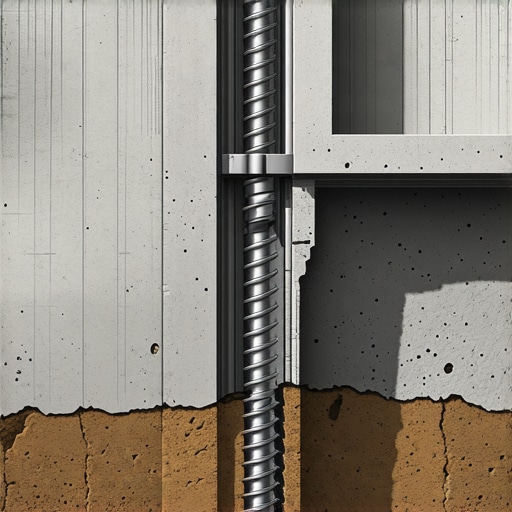
So, why helical piers? Because excavating a 15-foot high wall to replace it from the bottom up is a $100,000 nightmare. Helical piers allow us to perform a surgical strike. We use hydraulic drivers to screw these high-strength steel shafts deep into the earth, past the ‘active zone’ of moving, wet topsoil, and into the load-bearing strata below. We aren’t just Propping the wall up; we are anchoring it to the bedrock of the earth itself. The pier consists of a central shaft with several helix plates that act like a screw. As we drive it, we monitor the torque. The math is simple and unforgiving: higher torque equals higher load capacity. We then attach a bracket to the wall’s footing or the wall itself. This stops the sinking and, in many cases, allows us to jack the wall back toward its original vertical position. This is a far cry from a ‘handyman special’ where someone slaps on advanced masonry adhesives and calls it a day. Those adhesives have their place in outdoor masonry fountain restoration or securing a chimney cap replacement, but they won’t hold back 50 tons of moving hillside.
“The ultimate load capacity of a helical pile is directly proportional to the installation torque, providing a verifiable factor of safety during the installation process.” – ASTM D1143 Standard
Integration and the Modern Mason’s Toolkit
In the modern era, we are seeing a shift in how we manage these structures. For instance, green roofing masonry integration is becoming a major factor in urban wall loads. A saturated green roof adds thousands of pounds of dead weight that an old retaining wall was never designed to handle. We have to look at the whole system. If I’m out there doing a chimney flue liner installation, I’m also looking at the foundation. Why? Because a sinking wall on the north side of a house can pull the entire chimney stack away from the roofline. It’s all connected. We’ve even started seeing robotic masonry repair units being used for massive commercial sea walls, but for your backyard or a local shop, it still comes down to a man, a machine, and a deep understanding of soil mechanics. Whether you’re dealing with a soldier course that’s starting to tip or a stone face that’s spalling due to internal moisture, the solution has to be structural. You don’t fix a broken leg with a Band-Aid, and you don’t fix a sinking wall with a slicker and a bag of Type N mortar. You go deep, you find the stable ground, and you anchor that wall once and for all.