
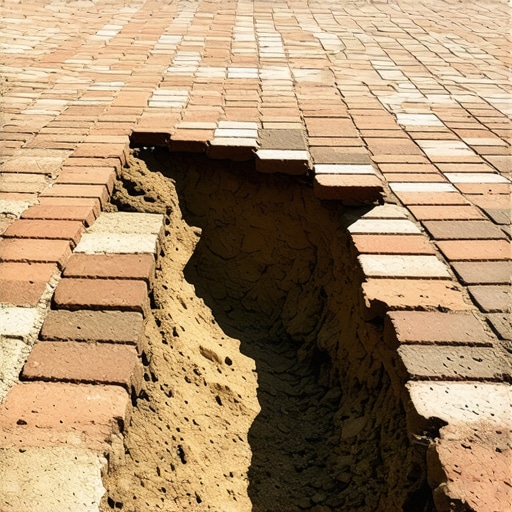
That sagging, wavy profile in your driveway isn’t just an eyesore; it is a structural failure crying out for a masonry damage assessment. When you see that ‘smile’ shape—the middle of the drive dipping lower than the edges—you are looking at a fundamental breakdown of the sub-base and the physics of interlock. I have spent thirty years looking at these failures, and it usually comes down to a contractor who cared more about the ‘lick-and-stick’ aesthetics than the ‘tooth’ of the ground they were building on.
The Ghost of the Subgrade: Why It Sinks
My old mentor, a man who could tell the moisture content of a pile of ‘mud’ just by the way the sun hit it, used to perform what he called the ‘Thud Test.’ He’d take a heavy iron tamper and drop it on the subgrade. If the ground didn’t ring back with a sharp, bone-jarring vibration, he’d look at the homeowner and say, ‘This ground is lying to you.’ He knew that if the subgrade wasn’t compacted to at least 95% of its maximum dry density, those pavers would eventually find their way to the center of the earth. Most driveways sink in the middle because that is where the tire tracks concentrate the load. We call this ‘rutting,’ but the cause is deep-seated. It’s the migration of fines—the tiny particles of sand and stone—downward into the soft soil below because someone forgot to lay down a stabilization fabric.
“The performance of a segmental pavement system is dependent upon the quality of the subgrade and the compaction of the base materials.” – ICPI Technical Manual
When the base fails, the water has nowhere to go. It sits in the low spots, saturating the bedding sand. In a climate where the temperature swings, that water undergoes the freeze-thaw cycle, expanding by 9% and shattering the interlock of the pavers. This is the same reason you see cracked brick wall repair becoming necessary on the perimeter; the entire earth is moving, and the masonry is just the victim of the soil’s bad behavior.
The Physics of Interlock and the ‘Wick’ Effect
A paver driveway is not a solid slab; it is a flexible pavement system. It relies on three-dimensional interlock: vertical, rotational, and horizontal. If you lose the sand in the joints, you lose the bridge. This often happens because of poor tuckpointing weatherproofing on adjacent structures or failing outdoor masonry fountain restoration projects nearby that leak constant moisture into the driveway’s edge. Water is a lubricant. When it gets into the bedding sand, the angular grains of sand start to slide past one another instead of locking. This is when the ‘wavy’ pattern starts. You might also notice white, crusty powder on the surface, requiring brick efflorescence removal. That’s the water pulling salts out of the base material and depositing them on your expensive pavers as it evaporates. It’s a sign that your driveway is literally breathing out the failure of its foundation.
The Forensic Reality: Foundation vs. Paver
Sometimes, a sinking driveway is just the ‘canary in the coal mine.’ If your driveway is sinking specifically where it meets the garage or a retaining wall, we might be looking at a larger geotechnical issue. In severe cases, I’ve had to recommend foundation helical pier installation for the adjacent structure because the soil was so poorly consolidated that the house and the driveway were both headed for the basement. Historic masonry preservation techniques teach us that you can’t fight the earth; you have to manage the water. If you don’t have a 1% to 2% slope away from the center, you’re just building a swimming pool filled with bricks. For commercial parapet wall repair or brick wall restoration, we always look at the drainage first. The same applies here. Without a ‘slicker’ joint or a properly swept polymeric sand, the water will find the path of least resistance: straight down into your base gravel.
“Proper drainage is the most critical factor in the long-term performance of any masonry or pavement structure.” – ASTM C1780 Standard Practice
The Fix: Do It Once or Do It Twice
If you want to stop the sink, you don’t just ‘add more sand’ to the top. That’s a ‘handyman special’ that will last exactly one rainstorm. You have to pull the pavers, excavate the saturated base, and rebuild with a crushed, angular stone that has a high ‘angle of repose.’ You need tuckpointing on any adjacent masonry to ensure water isn’t entering the system from the side. You need to ensure the sub-base is ‘choked’—meaning the smaller stones fill the voids between the larger stones so they can’t shift. This is the same logic we use in brick wall restoration: the materials must work in harmony. If you use a mortar that is too hard for a soft brick, the brick pops. If you use a base that is too soft for a heavy SUV, the driveway sinks. It’s not magic; it’s masonry forensics. Take the time to assess the soil, manage the water, and remember: the ‘mud’ never lies.