
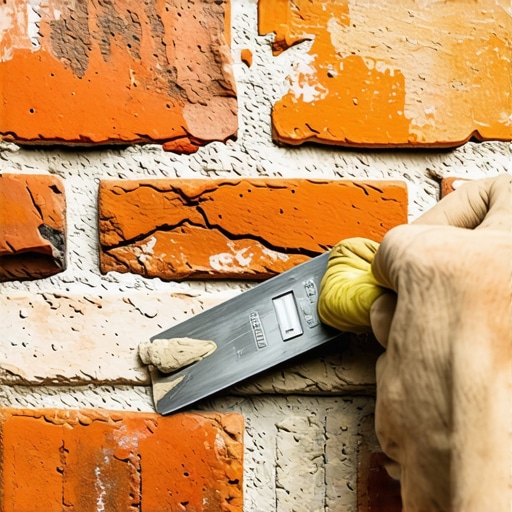
The Forensic Scene: When the Wrong Mud Becomes a Murder Weapon
I was called out to a sprawling 1924 Dutch Colonial last October. The homeowner was proud of a recent ‘patch job’ on the chimney and the north-facing gable. To the untrained eye, it looked solid—clean, grey, and hard as a diamond. But when I pulled my borescope from the truck and peered into a hairline fissure near the cracked brick wall repair site, the reality was gruesome. The previous contractor had used a high-strength Type S Portland cement on top of century-old, soft-fired clay bricks. Because the new mortar was denser than the brick, it had turned the wall into a pressure cooker. Moisture was trapped behind a literal wall of stone, and the internal structural steel was already exfoliating—bloating with rust until it was three times its original thickness. The masonry wasn’t just cracking; it was being pushed apart from the inside out. This wasn’t a repair; it was a slow-motion demolition.
“The mortar should be weaker than the masonry units so that any stress-induced cracking occurs in the mortar joints where it can be repaired more easily.” – BIA Technical Note 2
In the world of structural repointing, if you don’t respect the physics of the original build, you are destined to destroy it. Most modern guys come in with a bag of off-the-shelf mix and start slapping it on. They don’t understand the ‘suction’ of a dry brick or the ‘tooth’ required for a proper bond. They just want to butter the joint and move on to the next job. But real masonry is about material compatibility and moisture vapor transmission rates.
The Chemistry of Breathability: Why Mortar Choice is a Physics Problem
When we talk about professional mortar matching, we aren’t just talking about the color of the mud. We are talking about the modulus of elasticity and the compressive strength of the binder. Historic bricks, particularly those fired before the 1940s, are essentially sponges. They are porous, soft, and designed to move. The mortar is meant to be the sacrificial lamb of the system. It should be the first thing to fail, the first thing to let water out, and the easiest thing to replace. When you introduce a modern, non-breathable Portland mix, you create a vapor barrier. The water gets in (it always gets in), but it can’t get out through the joint. Instead, it tries to escape through the face of the brick. During a freeze-thaw cycle, that trapped water expands by 9%, and it takes the entire face of your historic brick with it. This is how you end up needing a masonry rescue after disaster.
For a successful outdoor fireplace rebuild or a gable restoration, we look at the aggregate. I’ve spent hours sifting through sand samples to find the right gradation. Is it river sand with rounded edges, or crushed limestone with sharp, jagged points? That geometry determines how the mortar ‘keys’ into the brick. If the sand is too fine, the mortar shrinks and pulls away from the edges, creating a cold joint. If it’s too coarse, you can’t get a tight slicker finish, and you’ll be fighting honeycombing before the sun sets.
The Precision of Tuckpointing vs. Repointing
There’s a lot of confusion between tuckpointing and repointing, and the ‘handyman specials’ thrive on that ignorance. Repointing is the process of grinding out failing mortar to a depth of at least twice the width of the joint and replacing it with fresh mud. It’s structural. Tuckpointing, however, is an aesthetic trick of the eye. We use a base mortar that matches the brick color perfectly, then lay a thin, contrasting ‘fillet’ or ‘bead’ of white or cream lime putty over the top. This creates the illusion of perfectly sharp, narrow joints on irregular, handmade bricks. It’s surgical work. You have to have a steady hand with the hawk and the slicker to get those lines straight. If your contractor doesn’t know the difference, he’s not a mason; he’s a guy with a trowel.
“Mortar for masonry should be selected based on the physical properties of the units being bonded.” – ASTM C270 Standard Specification for Mortar for Unit Masonry
We see this need for precision even in modern applications like metallic brick colors application or masonry staining. Sometimes, even with the best mortar match, the weathered patina of the surrounding wall makes the new repair stand out like a sore thumb. That’s where forensic staining comes in. We use mineral-based pigments that chemically bond with the masonry, rather than sitting on top like paint. It allows the wall to continue breathing while masking the ‘scar tissue’ of the repair.
From Fountains to Foundations: The Modern Tech of Masonry
Even though I’m a third-generation guy, I don’t ignore the tools of the future. For complex BIM masonry projects, we use 3D modeling to map out the stress points in a building’s envelope before we ever touch a chisel. This is vital when doing something as delicate as an outdoor masonry fountain restoration. Fountains are a nightmare of hydrostatic pressure and efflorescence—those white, salty stains that bloom when water carries minerals to the surface. If you don’t match the mortar density to the stone in a water feature, the whole thing will be a pile of loose rubble within three winters.
We also apply this forensic approach to masonry joint sand repair for historic courtyards. People forget that the joints in a paver system are what provide the friction to lock the units together. If you use a cheap polymeric sand that doesn’t allow for thermal expansion, the pavers will heave and buckle. You need a mix that has the right ‘give’ while still resisting washout from heavy rains. It’s about balance—strength vs. flexibility, density vs. porosity.
The Hard Truth of Restoration
At the end of the day, cracked brick wall repair isn’t about filling a hole. It’s about understanding why the hole appeared in the first place. Was it settlement? Was it the lack of control joints? Or was it a previous ‘pro’ who used the wrong mud and choked the life out of the building? When you see a wall that has stood for 100 years, it’s a testament to the original mason’s knowledge of the local soil and the climate. My job is to respect that legacy. Don’t settle for a patch that will kill your home. Demand a match that will save it.