The Forensic Scene: The Crack That Lied
The homeowner thought it was just a hairline crack, a little ‘settling’ in the corner of a 1920s Tudor. But when I put my scope inside that fissure, I didn’t see clean brick. I saw the structural steel was rusted to dust and the footing below had snapped like a dry twig. The ‘standard’ fix—slapping some epoxy in there or pouring a little extra concrete underneath—would have been like putting a band-aid on a compound fracture. This house wasn’t just settling; it was sinking into a layer of plastic clay that hadn’t seen the sun in ten thousand years. This is where the amateurs walk away and the forensic masons start talking about helical piers.
The Physics of Failure: Why Standard Underpinning Often Stalls
In my forty years of smelling damp lime and mixing mud, I’ve seen thousands of ‘standard’ foundation repairs fail. Standard underpinning usually involves digging out a section under the footing and pouring a concrete ‘pier.’ It relies on the existing soil directly beneath the house to hold the weight. The problem? If that soil is expansive clay or loose fill, you’re just adding more weight to a sinking ship. You’re increasing the mass without reaching a stable stratum. This leads to honeycombing in the new pour and eventually, a cold joint that separates under the first heavy rain. When we talk about masonry repair services, we have to look beyond the surface. We have to look at the ‘tooth’ of the soil itself.
“Deep foundations are necessary when the soil at shallow depths does not have the capacity to support the structural loads or when settlement of the surface soils will be excessive.” – ASTM D1143 Standard Test Methods for Deep Foundations
The Helical Pier: A Structural Screw into the Earth
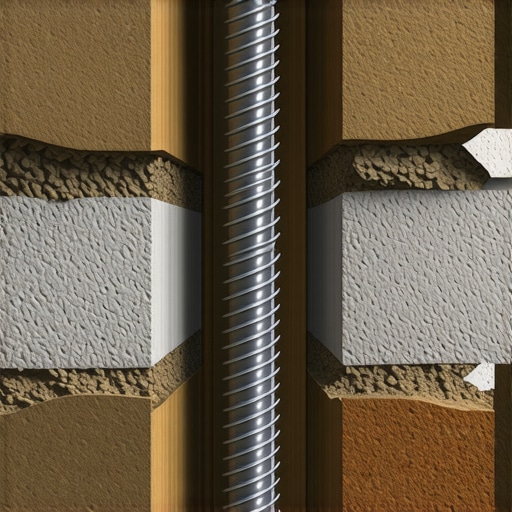
Unlike push piers that rely on the weight of the house to drive them down, helical piers are screwed into the ground using hydraulic torque. We’re talking about a heavy-duty steel shaft with circular flighting—think of it as a massive wood screw for a skyscraper. We micro-zoom into the torque-to-capacity ratio here. As that pier spins, we monitor the resistance. We aren’t stopping until we hit ‘refusal’ or a load-bearing soil layer that can actually handle the thousands of pounds of masonry above it. This is the ‘Cure’ versus the ‘Band-Aid.’ For historic masonry preservation, this is often the only way to save a sagging facade without dismantling the entire brick wall restoration project.
The Critical Role of Soil Geotechnical Logic
If you’re in a region with heavy freeze-thaw cycles, the physics change. Water expands 9% when it turns to ice. If your foundation is sitting in that ‘active zone’ of the top few feet of soil, the house is going to heave and drop every year. This creates those classic stair-step cracks in your stone veneer repair. Standard concrete piers often get ‘heaved’ right along with the soil. Helical piers bypass this active zone entirely. They go deep—sometimes 30, 40, or 60 feet—into the stable, non-reactive earth. This is why retaining wall geogrid installation is often paired with deep piering on sloped properties; you need to tie the structural mass to something that doesn’t move when the mud gets slick.
Integrating Repairs with Master Craftsmanship
Once the piers are set and the house is leveled (a process that makes a house ‘groan’ in a way you never forget), the masonry work begins. You can’t just throw modern Type S mortar into a 100-year-old wall. That’s how you blow the faces off the bricks. Old bricks are soft; they need a sacrificial lime-based mortar. We’re talking about historic brick salvage and careful masonry birdsmouth cuts to ensure the new work fits into the existing geometry without looking like a patch job. I’ve seen guys ‘butter’ the edges of a brick and call it a day, but a real mason knows you need full bed joints and proper suction to ensure the wall acts as a monolithic unit again.
“Water penetration is the single greatest threat to masonry durability, and the foundation is the first line of defense.” – BIA Technical Note 7
The Science of Protection: Sealants and Grout
After the structural stabilization, we address the skin. Brickwork sealants application isn’t about painting on a plastic film. It’s about silane-siloxane penetrating water repellents that allow the brick to breathe while keeping liquid water out. If you trap moisture inside a brick wall with a cheap ‘lick-and-stick’ sealant, the next freeze will pop those faces off faster than you can say ‘lawsuit.’ The same applies to tile grouts on masonry in decorative entryways. You need flexibility. You need materials that respect the thermal expansion of the building. A long wall can expand significantly in the summer sun; without relief joints and proper modular retaining walls logic, the masonry will simply crush itself.
The Hard Truth: Do It Once or Do It Twice
I’ve walked onto too many jobs where a homeowner paid $10,000 for a ‘quick fix’ only to call me three years later when the cracks reopened. They think they’re saving money, but they’re just financing a future disaster. Whether it’s stone veneer repair or a full-scale brick wall restoration, the foundation dictates the lifespan of the craft. If the dirt is moving, your masonry is moving. Period. Use the ‘slicker’ to finish those joints right, mix your ‘mud’ to the perfect consistency, but never, ever trust a foundation that hasn’t been tied to the bedrock of the earth. That’s the difference between a master and a handyman.