
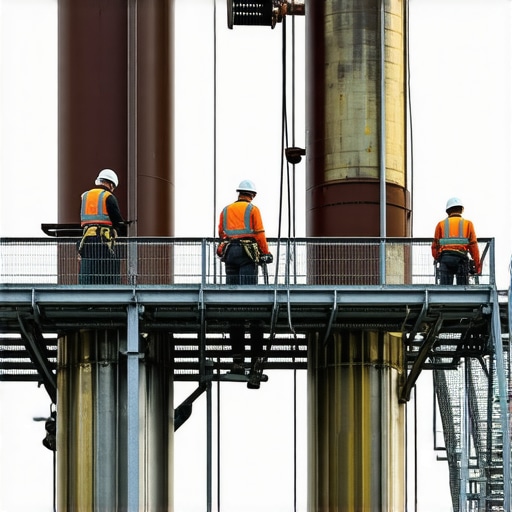
The industrial landscape is littered with the ghosts of masonry failures, most of them hiding in plain sight. I remember standing on a suspended scaffold 150 feet in the air, peering into the throat of a coal-fired exhaust stack. The plant manager thought it was just a surface issue, a bit of soot and aging. But when I ran my inspection scope through the interior liner, I saw the structural steel was rusted to dust and the brickwork was held together by little more than habit and gravity. That stack was a ticking time bomb, a five-hundred-ton liability that could have leveled the facility. This is the reality of forensic masonry: by the time you see the crack, the war is already half-lost. Industrial safety compliance isn’t just about hard hats and yellow tape; it’s about the chemical integrity of the very walls that house the operation.
The Thermal Physics of Industrial Failure
Industrial masonry, particularly in smokestacks and furnaces, operates under a set of physics that would make a residential bricklayer’s head spin. We aren’t just dealing with the weather; we are dealing with a constant state of thermal shock. When a stack is in operation, the temperature differential between the inner flue and the exterior shell creates massive internal stresses. This is where modular masonry construction becomes a double-edged sword. While it allows for faster builds, the sheer volume of mortar joints increases the points of potential failure. If the thermal expansion isn’t managed through proper control joints, the wall will inevitably buckle.
“Chimneys and fireplaces are subjected to much more severe exposure than other parts of the building.” – BIA Technical Note 19
In a high-heat environment, we see a phenomenon similar to the ‘flash setting’ found in hot-weather masonry in the South. The heat from the flue gases can wick moisture out of the mud (mortar) before it has time to properly hydrate. This leads to a brittle, dusty joint that lacks the ‘tooth’ necessary to bond the units together. When this happens, emergency masonry repair isn’t just a recommendation; it’s a mandate for survival. We see this often in chimney interior parging, where the refractory mortar is applied too thin or under too much heat, leading to ‘honeycombing’—a structural cancer that allows acidic gases to eat the brick from the inside out.
The Chemistry of Acidic Condensation
The real killer in industrial stacks isn’t the heat; it’s the cooling. As exhaust gases rise, they hit the ‘dew point’—the temperature at which sulfuric and nitric acids condense into liquid form. In an unlined or poorly maintained stack, these acids soak into the tile grouts on masonry and the porous brick faces. This is where the micro-zooming gets ugly. The acid reacts with the calcium hydroxide in the mortar, converting it into gypsum. Gypsum has a larger molecular volume than the original lime, which causes internal expansion and literal explosions at a microscopic level. The mortar joints don’t just wash away; they push the bricks apart.
This is why brickwork pointing styles are more than an aesthetic choice. In an industrial setting, a weathered or ‘struck’ joint is essential to ensure that any condensation or external moisture is shed away from the wall immediately. A ‘recessed’ or ‘raked’ joint is an invitation for acid to sit and fester. For those of us who have spent our lives with a hawk in one hand and a slicker in the other, we know that the way you finish a joint determines how many decades a structure will stand.
Modern Solutions and Safety Compliance
To meet modern safety standards, we are seeing a shift toward robotic masonry repair. In environments where human life is at extreme risk from falling debris or toxic fumes, these remote-controlled systems can grind out failed joints and apply new refractory materials with a precision that even a third-generation master would envy. However, even the best robot cannot replace the forensic eye. You have to understand why the wall is failing. Is it a cold joint from a previous poorly managed pour? Is it honeycombing caused by poor vibration during the initial construction?
We are also seeing the rise of mortarless masonry systems in peripheral industrial structures. These systems rely on mechanical interlocks rather than the chemical bond of mortar. While they offer some benefits in terms of speed and seismic flexibility, they require absolute precision in the base and retaining wall batter correction. If your base is off by a fraction of a degree, a fifty-foot wall becomes a leaning tower of liability. Industrial managers often overlook the ‘ground-level’ masonry like patio stone realignment near facility entrances or retaining wall batter correction in loading docks, but these are the areas where OSHA trip-and-fall violations rack up the fastest.
“Mortar for masonry construction shall be of a type that will result in the required strength and durability for the intended use.” – ASTM C270
The Parapet Problem: Roofline Risks
One of the most ignored aspects of industrial safety is commercial parapet wall repair. These walls, sitting at the very top of the building, take the brunt of the wind and rain. They are also subject to ‘differential movement’ where the roof deck and the wall expand at different rates. Without proper flashing and a ‘soldier course’ that is properly tied into the structural backup, these parapets can peel away and fall to the sidewalk below. A forensic inspection often reveals that what looks like a simple crack is actually the result of rusted wall ties—the internal skeleton of the wall has disappeared, leaving only a shell of brick and old mud.
When we approach a commercial parapet wall repair, we aren’t just buttering the ends of bricks and stuffing them in. We are looking at the drainage. If water is trapped behind the masonry, the freeze-thaw cycles of the North will pop the faces off the brick (spalling) in a single season. The physics is simple: water expands 9% when it freezes. That 9% expansion is stronger than the tensile strength of the toughest kiln-fired brick. If you don’t give that water a way out through weep holes and proper flashing, it will make its own way out by destroying the wall.
The Truth About Industrial Longevity
In this business, you don’t get points for being fast; you get points for being right. I’ve seen ‘handyman specials’ where someone tried to fix a structural crack with a tube of caulk and some tile grouts on masonry that didn’t belong there. It’s a joke. You can’t hide the laws of thermodynamics. When you are responsible for an industrial facility, your masonry is your first line of defense. Whether it’s the chimney interior parging that protects the shell from acid or the modular masonry construction that provides the fire rating for your warehouse, the craftsmanship matters. Do it once, do it right, or be prepared to explain to a forensic inspector like me why the wall didn’t hold when it mattered most.