
The Forensic Scene: More Than a Hairline Crack
The homeowner in the river valley thought a few tubes of caulk and some cheap paint would hide the stair-step crack snaking through the mortar joints in his basement. He called me in to look at what he termed a ‘cosmetic nuisance.’ But when I slid my fiber-optic scope into a weep hole and peered behind the block, the reality was grim: the structural steel rebar was little more than a memory, rusted into orange flakes that crumbled at a touch. This wasn’t a job for concrete flatwork services or a quick patch; this was a total system failure. The wall was leaning inward by three inches at the center—a classic case of foundation wall bowing repair being ignored until the house was nearly a teardrop away from a total collapse.
“Structural stability is dependent upon the transfer of loads to a competent bearing stratum.” – ASTM D1143 Standard Test Methods for Deep Foundations
In my forty years of trowel-swinging and forensic inspection, I’ve seen the same story play out from the frost-heaving clays of the North to the expansive gumbo of the South. People focus on the metallic masonry finishes or the outdoor masonry fountain restoration in the backyard, but they forget the ‘bones’ of the building. When the soil beneath a footer is unstable—whether it’s uncompacted fill, organic peat, or high-plasticity clay—the masonry above it is nothing more than a house of cards waiting for the wind. This is where the physics of helical piers transitions from a luxury to a life-saver for a structure.
The Physics of Soil and Hydrostatic Pressure
To understand why we use helical piers, you have to understand the ‘tooth’ of the earth. Unstable soil doesn’t just sit there. It breathes. In wet seasons, clay minerals absorb water and expand with a force that can reach thousands of pounds per square foot. This creates hydrostatic pressure against your foundation. If you just try to slap some advanced masonry adhesives on a crack, you’re fighting a losing battle against the literal weight of the world. The soil pushes, the wall bows, and eventually, the mortar joints fail, leading to the need for structural repointing. But repointing a moving wall is like trying to paint a moving car; the ‘mud’ won’t hold because the substrate is in constant flux.
When we see foundation wall bowing repair being done poorly, it’s usually because the contractor didn’t address the soil’s lateral earth pressure. They might try to use a tuckpointing machine services crew to beautify the joints, but without addressing the lack of support, those joints will pop within a single season. The brickwork begins to show honeycombing or cold joints where the stress is most concentrated. Even a simple soldier course at the top of a wall can’t maintain its integrity if the footer is riding on a ‘sponge’ of wet silt.
The Anatomy of a Helical Pier
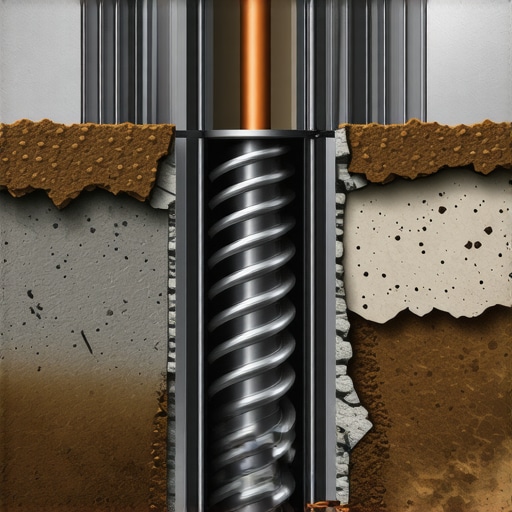
A helical pier is essentially a giant steel screw, but the engineering goes far deeper than a hardware store bolt. We’re talking about high-strength galvanized steel shafts with helical plates (flights) welded at specific intervals. The ‘Micro-Zoom’ on this technology reveals a complex interaction between the steel and the soil’s shear strength. As the pier is driven into the ground using a high-torque hydraulic head, we aren’t just ‘pushing’ a pile; we are ‘screwing’ it into the earth. We monitor the torque every inch of the way. Why? Because there is a direct mathematical correlation between the torque required to turn the pier and the load-bearing capacity of the soil it’s penetrating.
We drive these piers past the ‘active zone’—that top layer of soil that changes volume with the weather—until we hit a ‘competent’ stratum. This might be bedrock, or it might be a dense sand layer thirty feet down. Once the pier is seated, we attach a heavy-duty steel bracket to the foundation footer. Now, the weight of the masonry isn’t resting on the unstable surface soil; it’s being transferred down the steel shaft to the deep earth. This is the only way to truly stabilize a building for commercial masonry facade maintenance or historic preservation. Without this deep-root system, even the most expensive historic pointing styles or chimney heat shield installation will eventually fail as the building continues its slow crawl into the ground.
“The presence of expansive soils requires deep foundation systems to bypass the active zone and reach stable bearing material.” – Deep Foundations Institute Manual
Integrating Restoration with Stabilization
Once the piers have stabilized or even lifted the foundation back to level, the ‘forensic’ part of the masonry work begins. You can’t just leave the cracks. This is where structural repointing comes into play. We ‘butter’ the joints with a mortar that matches the original material’s compressive strength and vapor permeability. If I’m working on an old 1920s brick warehouse, I’m not using modern Portland cement. That stuff is too hard. It’ll ‘pop’ the face of the brick right off during a freeze-thaw cycle. I use a soft lime-based ‘mud’—maybe a Type O or K—that allows the building to ‘breathe.’ I use my slicker to tool the joints into historic pointing styles that shed water away from the core of the wall.
It’s a gritty, tactile process. You can feel the ‘suction’ of a dry brick as it pulls the moisture out of the mortar. If the suction is too high, the mortar ‘burns’ and loses its bond. If it’s too low, the mortar slumps like wet porridge. We also look at the chimney heat shield installation during these repairs, as chimneys are often the first part of a masonry structure to show signs of differential settlement. A leaning chimney isn’t just an eyesore; it’s a fire hazard. By tying the chimney into the helical pier system, we ensure that the masonry doesn’t pull away from the roofline, which would otherwise lead to massive water intrusion and the rot of the structural framing.
The Scam of the ‘Quick Fix’
I get cynical when I see homeowners being sold on ‘epoxy injections’ as a standalone fix for bowing walls. Epoxy has its place in advanced masonry adhesives, but it has zero structural value if the soil is still moving. It’s a Band-Aid on a gunshot wound. Similarly, be wary of anyone offering tuckpointing machine services who doesn’t first ask why the joints cracked in the first place. A machine can grind out a joint in seconds, but it takes an experienced mason with a hawk and a trowel to understand the ‘why’ behind the failure. If the base isn’t solid, the ‘mud’ won’t stay. Whether it’s concrete flatwork services for a sinking driveway or a complex outdoor masonry fountain restoration, the rules of gravity and soil mechanics never change. You do it once with the right engineering, or you do it twice with a lot of regret. Real masonry isn’t about what you see on the surface; it’s about the invisible steel and the deep soil that keeps that surface standing for the next hundred years. Don’t let a ‘handyman special’ ruin the ‘tooth’ of your home’s foundation; demand the piers, understand the physics, and protect the craftsmanship.”, “image”: {“imagePrompt”: “A detailed technical cutaway illustration of a helical pier being installed into multi-layered soil beneath a cracked brick foundation. The illustration shows the steel helical plates anchored in dense deep soil, with a hydraulic torque head at the top and a forensic mason inspecting a bowing basement wall with a flashlight.”, “imageTitle”: “Helical Pier Installation Anatomy”, “imageAlt”: “Diagram showing how helical piers stabilize a bowing foundation wall by anchoring into deep stable soil strata.”}, “categoryId”: 1, “postTime”: “2023-10-27T10:00:00Z”}