The Forensic Scene: When a Hairline Crack Becomes a Structural Threat
I recall a specific inspection on a late-Victorian property where the homeowner was convinced a simple facade cleaning and a bit of mortar matching services would hide the ‘settling’ of their front porch. To the untrained eye, it was just a hairline crack running through the mortar joints. But when I inserted the borescope into the cavity of the brick column repair that had been patched twice before, I didn’t see solid masonry. I saw structural steel rusted to orange dust and a void where the load-bearing soil should have been. The porch wasn’t just ‘settling’; it was rotating away from the house at a rate of a quarter-inch per month. The cause? A combination of poor retaining wall drainage upgrade work nearby and the relentless physics of hydrostatic pressure. When a porch starts to lean, you aren’t just looking at an aesthetic problem; you are looking at a battle between gravity and the load-bearing capacity of the earth. This is why helical pier installation has become the gold standard for masonry repair services. It stops the rotation instantly by bypassing the failing soil entirely.
“The use of helical piles provides a predictable and verifiable method of load transfer to competent soil strata, offering immediate stability to distressed structures.” – ASTM D1143 Standard Test Methods for Deep Foundation Elements Under Static Axial Compressive Load
The Physics of Settlement: Why Your Porch is Moving
To understand why helical piers work, we must micro-zoom into the geotechnical reality beneath the footing. Soils are not static; they are a matrix of minerals, air, and water. In regions with heavy clay, the soil undergoes a ‘shrink-swell’ cycle. When it rains, the clay particles absorb water and expand. When it dries, they contract, leaving voids. If the original mason didn’t dig the footings deep enough to reach the stable ‘B-horizon’ of the soil, the porch is essentially floating on a moving sponge. This movement manifests as stair-step cracking in the brickwork. If you see cracks cutting through the brick itself, that’s a sign of high-stress shear. If the cracks follow the ‘mud’ (the mortar), the movement is slower but still relentless. Most people try to fix this with advanced masonry adhesives or tuckpointing curved walls, but that is just putting a Band-Aid on a compound fracture. You have to address the foundation.
The Helical Pier Solution: Surgical Precision in Masonry
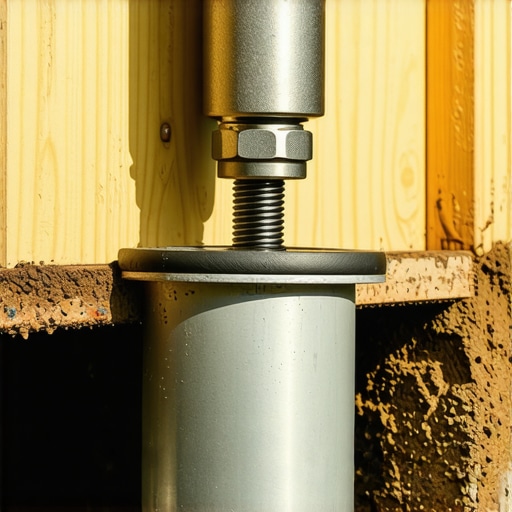
A helical pier is essentially a giant steel screw. We call them ‘piles’ in the trade, and they are driven into the ground using high-torque hydraulic heads. Unlike concrete underpinning, which requires massive excavation and waiting weeks for the concrete to reach its 28-day hydration strength, helical piers are ‘loaded’ immediately. We ‘butter’ the pier into the ground until we hit a specific torque measurement. This torque correlates directly to the soil’s load-bearing capacity. We aren’t guessing. We know exactly when that pier has reached a soil strata capable of supporting the weight of a stone porch. Once the piers are set, we attach a heavy-duty steel bracket under the existing footing. Using hydraulic jacks, we can often lift the porch back to its original level, closing those stair-step cracks before we ever start the brick column repair. It is the difference between a surgical strike and a sledgehammer approach.
Why Speed Matters: The Freeze-Thaw Factor
In northern climates, speed is everything. If you leave a settling porch through another winter, the freeze-thaw cycle will finish it off. Water enters the cracks, freezes, and expands by 9% in volume. This expansion exerts thousands of pounds of pressure per square inch, popping the faces off the bricks (spalling) and turning the mortar into sand. By installing helical piers, we stabilize the structure before the winter ‘heave’ can occur. Once the foundation is locked, we can then focus on the aesthetic masonry repair services. This includes mortar matching services to ensure the new ‘mud’ has the same lime-to-cement ratio as the original, preventing the ‘hard-mortar-on-soft-brick’ failure that plagues so many amateur repairs.
“Water penetration is the single greatest threat to masonry durability, and structural movement is the primary gateway for that water.” – BIA Technical Note 7: Water Resistance of Brick Masonry
Beyond the Foundation: The Full Masonry Ecosystem
Once the porch is stabilized by the piers, the forensic mason looks at the rest of the ‘envelope.’ A settling porch often hides other failures. For instance, chimney crown repair is frequently needed because the same soil movement that tilted the porch has also stressed the chimney stack. We check for ‘honeycombing’ in the concrete and ensure that any mortarless masonry systems used in the landscaping are properly keyed into the grade. If the porch has a retaining wall, we look for a retaining wall drainage upgrade. Without a way for water to escape (weep holes), the ‘hydrostatic head’ will push the wall over, regardless of how many helical piers you have. We also look at the ‘tooth’ of the stone. If the facade is dirty, a facade cleaning using low-pressure steam is necessary to see the true color of the brick for proper mortar matching. You can’t match the mud if you can’t see the brick. We use a ‘slicker’ or a jointer tool to strike the joints, ensuring they shed water properly, a process we call ‘repointing.’ This is a far cry from ‘lick-and-stick’ veneer work; this is about structural integrity and the long-term survival of the masonry.
When to Panic: Analyzing the Cracks
Not every crack requires a helical pier, but you need to know what to look for. A vertical crack that is wider at the top than the bottom is a sign of ‘rotational settlement’—the porch is falling away. This is a 911 call for a mason. A horizontal crack often indicates hydrostatic pressure or rusted ‘wall ties’—the steel bits that hold the brick to the frame. If you see a ‘soldier course’ (bricks standing on end) that is beginning to lean out, the wall is delaminating. In these cases, we might use a combination of helical piers and advanced masonry adhesives to tie the structure back together. Don’t be fooled by a ‘handyman special’ who offers to just ‘caulk’ the gap. Caulk is for bathtubs, not for structural masonry. You need a fix that reaches the bedrock, or at least the dense glacial till deep underground. That is the promise of the helical pier: it is the only way to do it once, so you don’t have to do it twice. After the piers are in, then we can talk about the beauty of the brick, the chimney crown repair, and the replacement of failing blocks. But until the foundation is pinned, everything else is just expensive paint on a sinking ship. “,”image”:{“imagePrompt”:”A professional masonry contractor installing a heavy-duty steel helical pier into the soil next to a distressed brick porch column. The pier has a screw-like blade at the bottom, and a hydraulic machine is visible. The brickwork shows stair-step cracks being monitored by a gauge.”,”imageTitle”:”Helical Pier Installation for Porch Stabilization”,”imageAlt”:”Steel helical pier being driven into the ground to repair a settling brick porch foundation.”},”categoryId”:15,”postTime”:”2023-10-27T10:00:00Z”}