
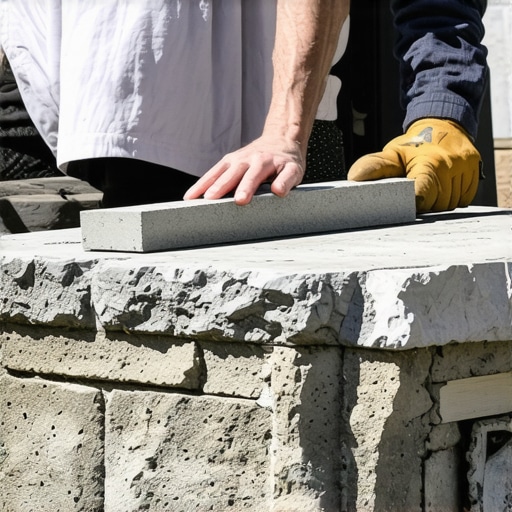
The homeowner thought it was just a hairline crack. But when I put my scope inside that parapet wall, I saw a nightmare: the structural steel was rusted to dust and the masonry was a saturated sponge waiting for the first hard freeze to explode. This is the reality of forensic masonry. People look at the top of a building and see a decorative finish; I look at a parapet and see the most aggressive battlefield in architecture. A parapet wall is exposed to the elements on three sides—the front, the back, and the top. If your stone coping isn’t installed with the precision of a surgical strike, the entire assembly is doomed to fail through the brutal mechanics of the freeze-thaw cycle.
The Physics of the Parapet: Why Most Installations Fail
In the North, where the mercury swings sixty degrees in a week, stone coping isn’t just a lid; it’s a structural shield. When water penetrates a parapet, it doesn’t just sit there. It undergoes a phase change. As we know from basic physics, water expands by approximately 9% when it turns to ice. In the confined space of a modular masonry construction, that 9% expansion exerts thousands of pounds of pressure per square inch against the brick and stone. This is how spalling happens. The face of the brick literally pops off because the water trapped behind it had nowhere to go. Most contractors fail because they treat stone coping like a tile job. They ‘butter’ the stone, slap it down on some ‘mud’ (mortar), and walk away. That is a recipe for a stone wall repair call-out in five years.
“Water penetration is the single greatest threat to masonry durability. Proper flashing and drainage are not optional; they are the lifeblood of a lasting structure.” – BIA Technical Note 7
The core issue often stems from a lack of understanding of thermal movement. Stone and brick have different coefficients of expansion. They ‘breathe’ and move at different rates. If you bond them together too rigidly with a high-strength Portland cement, the stronger material will eventually tear the weaker one apart. This is why mortar matching services are critical. We don’t just guess the mix; we analyze the existing substrate to ensure the new mortar is ‘sacrificial’—meaning it is slightly softer than the masonry units it holds, allowing for movement without cracking the stone itself.
The Forensic Breakdown: The Anatomy of a Proper Coping Install
If you want to do it right, you have to think like the water. You have to assume the water will get past the stone. The goal is to give it a clear path out. This starts with the sub-flashing. Before a single stone is lifted by self-leveling masonry lifts, a high-quality stainless steel or rubberized asphalt flashing must be installed across the top of the masonry wall. This flashing should be sloped toward the roof side and must include a ‘drip edge’ that extends at least an inch beyond the wall face.
The ‘Secret’ of the Drip Edge
Why a drip edge? Physics. Water has a property called surface tension. It likes to cling to surfaces and crawl backward. Without a proper drip groove cut into the underside of the stone coping, water will run off the edge, curl back under the stone, and soak directly into the bed joint. Once that joint is saturated, brick efflorescence removal becomes a losing battle as salts are continuously leached out of the mortar and deposited on the face of the building. A forensic inspector looks for those white, powdery stains—they are the ‘blood’ of a dying wall.
Setting the Stone: The Mud and the Bond
When we lay the stone, we aren’t just using any mortar. We are looking at Type N or even Type O for historic restorations, ensuring the ‘tooth’ of the mortar can grip the stone without creating a brittle failure point. We use re-pointing services techniques to ensure the head joints (the vertical joints between the stones) are not just filled with mortar, but are actually sealed with a high-grade backer rod and sealant. Why? Because the head joint is the primary failure point. Mortar in a horizontal head joint will eventually crack due to the expansion of the stone. A flexible sealant allows the stone to expand and contract without breaking the watertight seal.
Advanced Technology: Digital Twins and Commercial Realities
In modern commercial smokestack repair and high-rise maintenance, we are now utilizing digital twin masonry projects. We create a 3D digital replica of the structure to track moisture migration and thermal stress over time. This allows us to predict where a chimney rebuild services might be needed before the bricks actually start falling onto the sidewalk. For older buildings, we often see stone veneer over brick applications that were done poorly. The forensic reality is that these ‘lick-and-stick’ jobs trap moisture between the new veneer and the old structural brick, leading to hidden rot. Correcting this requires stripping the veneer, addressing the underlying moisture issues, and performing a proper stone wall repair that includes mechanical anchors and proper drainage planes.
“The mortar should always be weaker than the masonry units to ensure that any stress-induced cracking occurs in the mortar joints, which are easily repaired, rather than in the masonry units themselves.” – ASTM C270 Standard Specification
The Step-by-Step Restoration Reality
If you are facing a failing parapet, the process isn’t a quick fix. It’s a surgical procedure. First, we remove the existing coping stones. We often find that the ‘pro’ before us used a hard Type S mortar that has caused the top three courses of brick to crumble. After cleaning the substrate, we apply the flashing. Then comes the bedding. We ‘butter’ the stone carefully, ensuring 100% coverage to avoid ‘honeycombing’—those small air pockets where water can collect and freeze. Once set, we use a ‘slicker’ to tool the joints, ensuring they are concave to shed water efficiently. Finally, if there is existing damage, we perform brick efflorescence removal using gentle chemical cleaners—never high-pressure washing, which can blow out the soft ‘cream’ of the brick and leave it permanently porous.
The Final Word: Do It Once or Do It Twice
I’ve spent thirty years watching people try to save a few dollars on their masonry. They hire a handyman who doesn’t understand the ‘suction’ of a dry brick or the necessity of a cold joint. They end up paying me three times as much to come back, tear it all down, and do it right. Whether you are dealing with modular masonry construction or a 100-year-old historic landmark, the rules of physics do not change. Water wants in. Your job—and mine—is to make sure it has no place to stay. If you see a crack, don’t ignore it. That hairline fracture is a whisper; if you don’t listen, the wall will eventually scream when it collapses. Invest in proper re-pointing services and expert coping installation. It is the only way to ensure your building stands for another three generations.