
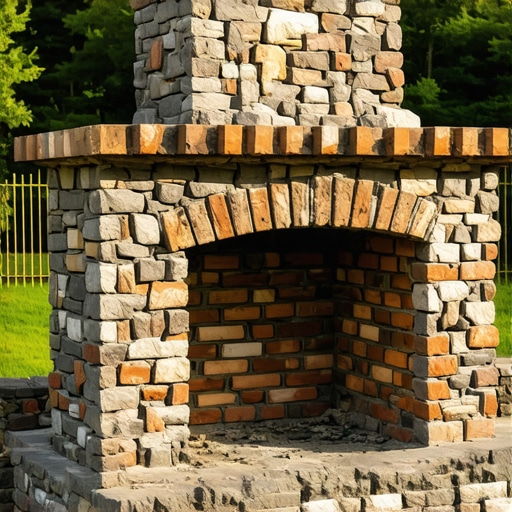
I remember a cold November morning standing before a soot-stained hearth in the backyards of a client who had spent a fortune on a fireplace that was now literally shedding its skin. My mentor, a man who had more lime in his lungs than blood in his veins, didn’t say a word at first. He just pulled out a small steel hammer and lightly tapped one of the bricks near the throat of the chimney. Instead of the sharp, crystalline ‘ping’ of a healthy, well-fired unit, it gave off a dull, hollow thud—the sound of a dead material. ‘Hear that?’ he asked, looking at the owner. ‘That’s the sound of a brick that’s been drowned from the inside out because your mason treated it like a bathroom tile.’ That moment stayed with me because it highlights the fundamental ignorance that kills most outdoor masonry projects: the failure to understand the physics of heat and water.
The Thermal War: Why Fireplaces Die
When we talk about outdoor fireplace rebuilds, we aren’t just talking about aesthetics; we are talking about managing a violent thermal event. Inside the firebox, temperatures can spike to 800°F or higher, while the exterior of the stack might be sitting in a sub-zero freeze-thaw cycle. This creates a massive thermal gradient. If you use a hard Portland-heavy ‘mud’ (mortar) on a soft brick, the brick will lose every single time.
“The expansion of masonry units due to thermal changes must be accommodated through the use of proper joints and material selection to prevent catastrophic failure.” – BIA Technical Note 19
Stone vs. Brick: The Density Debate
Choosing between stone and traditional brick isn’t just about the look of the ‘soldier course’ or the rustic appeal of fieldstone. It is about the coefficient of thermal expansion. Stone is a wild card. A dense granite will hold heat and expand differently than a porous limestone. If you are ‘buttering’ a stone veneer onto a concrete block core without considering the ‘tooth’ of the substrate, you are building a countdown clock. Brick, specifically high-quality firebrick for the interior, is engineered for this. Traditional brick offers a predictability that stone lacks. When performing a chimney structural repair, I often see stone fireplaces where the mortar has ‘burned’—it becomes brittle and loses its bond because the stone sucked the moisture out of the mix too fast during the build, a phenomenon we call ‘flash setting.’
The Science of the Base and Moisture
Most failures begin with poor chimney leak detection. Water is the universal solvent. In northern climates, water enters through a cracked chimney cap, migrates into the brickwork, and then expands by 9% when it freezes. This hydraulic pressure is enough to pop the face off a brick—a process known as spalling. This is why chimney cap replacement isn’t an ‘add-on’; it’s a structural necessity. When I’m looking at chimney interior parging, I’m checking to see if the previous mason used a smooth, breathable coat or if they just slapped on a concrete patch that’s now trapping moisture against the flue tiles. We use historic brick salvage for many rebuilds because those old, hand-pressed bricks often have a better pore structure for managing moisture than modern, extruded junk.
Micro-Zooming into the Mortar Joint
The mortar is the ‘sacrificial’ element of the wall. In a proper tuck pointing services application, the new mortar must be slightly softer than the masonry units themselves. If the mortar is too hard, the stress of the building’s movement will be forced into the brick, causing it to crack. We look for ‘suction’ when we lay. If a brick is too dry, it steals the water from the mud, and you get no bond. If it’s too wet, the brick ‘floats’ and the wall becomes a mess. This is the delicate dance of the trowel. For retaining wall reinforcement near a fireplace, we often have to address hydrostatic pressure by installing ‘weep holes’ and ensuring the structural brick ties replacement is done with stainless steel to prevent the ‘rust jacking’ that happens when cheap galvanized ties oxidize and expand, pushing the wall apart.
“Water penetration is the single greatest threat to masonry durability, and its management is the primary goal of any forensic repair.” – ASTM C1082 Standards
The Forensic Inspection Process
When I arrive for chimney repair services, I don’t start with a quote; I start with a ‘slicker’ and a flashlight. I’m looking for ‘honeycombing’ in the concrete patch work or ‘cold joints’ where one day’s pour didn’t bond to the next. If your fireplace stack is leaning, we don’t just ‘smear’ more mud on it. We look at the footings. An outdoor fireplace can weigh ten tons; if it’s sitting on a four-inch patio slab, it’s going to sink, and no amount of tuckpointing will save it. We look for the ‘ring’ of the brick. We look for the ‘breathability’ of the stone. This is the difference between a ‘handyman special’ and a master’s legacy. You do it once, or you do it twice—and doing it twice usually costs triple.