
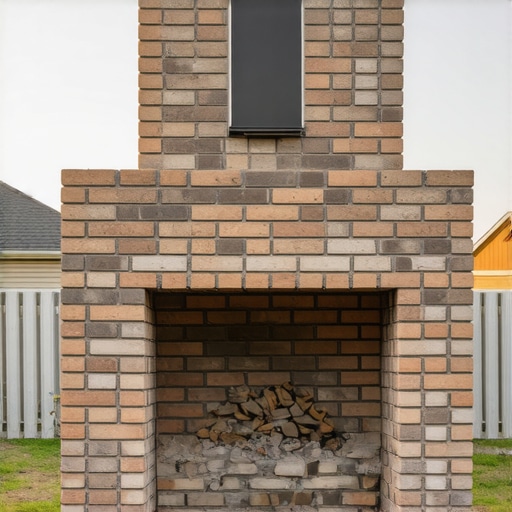
The first time I saw a firebox explode, I wasn’t surprised; I was annoyed. I was standing in a backyard where a homeowner had spent fifteen thousand dollars on a ‘custom’ outdoor fireplace that was now spitting shards of firebrick onto his expensive travertine patio. The contractor had used standard Type S mud for the firebox joints. In the world of high-heat masonry, that is a death sentence. My father always told me that a fireplace is a living lung—if it cannot breathe out the heat, it will eventually choke on its own ribs. He would run his hand over a finished joint, feeling for the ‘tooth’ of the sand, and if it wasn’t exactly right, we’d tear the whole soldier course down and start over. That is the difference between a handyman and a master mason. We aren’t just stacking blocks; we are managing the violent physics of thermal expansion.
The Molecular War: Why Standard Masonry Fails
Most outdoor fireplaces fail because the builder treats them like a garden wall. But a firebox isn’t a wall; it’s a furnace. When you light a heavy oak fire, the internal temperature of that hearth can spike from 70 degrees to 1,200 degrees in thirty minutes. This is where thermal shock takes over. Standard red clay bricks and Portland-based mortars have a specific coefficient of expansion. When they get hot, they grow. If they grow too fast, or if the mortar is too rigid to flex, the face of the brick will pop off in a process called spalling. This is why structural masonry inspection is the first step in any rebuild. We have to see if the core has been compromised by these heat cycles or if we’re dealing with masonry water damage repair issues from years of rain soaking into those heat cracks.
“The design of the masonry fireplace must provide for the differential movement between the fireplace and the surrounding structure to prevent cracking and structural failure.” – BIA Technical Note 19
In the South, we deal with the added nightmare of flash setting. If I’m buttering a brick in ninety-degree heat with high humidity, the moisture in my mud wants to vanish before the chemical bond even forms. I’ve seen ‘pros’ slapping dry bricks onto dry mortar. That brick will suck the life out of the mud instantly, leaving a ‘cold joint’ that has the structural integrity of a cracker. We soak our firebricks first. We want them ‘Saturated Surface Dry.’ This ensures the suction of the brick doesn’t rob the mortar of the water it needs for hydration.
The Anatomy of a High-Heat Rebuild
When we take on a project, we aren’t just patching. We are performing historic brickwork repointing techniques adapted for modern heat. We strip the firebox down to the smoke shelf. If the original builder didn’t install a proper chimney flue liner installation, that’s where we start. A flue isn’t just a straw for smoke; it’s a thermal barrier that protects the outer masonry from the internal inferno. We often find that chimney cap replacement is necessary because the original concrete wash has cracked, allowing water to migrate down into the brick quoin repair areas, freezing in the winter and expanding, which ruins the structural bond. [image_placeholder_1]
The Refractory Secret
We use refractory mortar, which is a calcium aluminate cement. Unlike the stuff you buy in bags at a big-box store, this mud creates a ceramic bond. It doesn’t just dry; it vitrifies. When we are tuckpointing curved walls inside a custom firebox, the precision has to be absolute. We use a slicker to compress the joints, forcing the aggregate together to eliminate air pockets. Air pockets are the enemy. In a high-heat environment, an air pocket is a tiny bomb waiting to expand and blow the ‘butter’ right out of the joint.
“Refractory mortar must meet ASTM C199 standards to withstand the thermal stresses of repeated heating and cooling cycles without losing its structural bond.” – ASTM C199
We also look at the exterior. If the fireplace is built into a slope, we often find failing retaining wall repair needs nearby. Hydrostatic pressure from a poorly drained hill can push against the back of a fireplace, causing it to lean. We perform retaining wall batter correction to ensure the earth is working with us, not against us. Without proper drainage, that fireplace is just a dam that’s going to break.
Precision Tooling: Tuckpointing and Finishing
The finish is where most guys get lazy. They slap the mud on and walk away. We use tuck pointing services to create a sacrificial joint on the exterior. The mortar should always be slightly softer than the brick itself. This is the ‘sacrificial principle.’ If the structure moves—and it will—you want the mortar to develop a hairline crack, not the brick. Replacing a joint is cheap; replacing a custom-cut stone quoin is an expensive nightmare. For those ‘lick-and-stick’ veneer jobs that are failing, we strip them and go back to a real brick quoin repair method, tied into the structural backup with stainless steel corrugated ties. It takes longer, it costs more, and it’s the only way it lasts a hundred years. If you want a fireplace that doesn’t just look good in a brochure but survives a thousand fires, you have to respect the chemistry of the mud and the physics of the flame.