
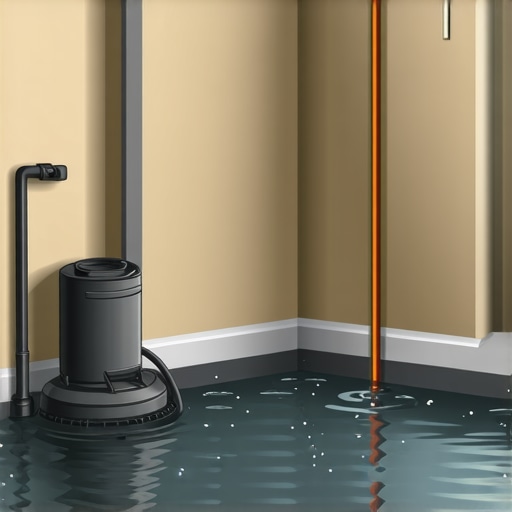
The Illusion of the Dry Basement
I’ve walked into thousands of basements where the homeowner stands proudly next to a high-end, cast-iron sump pump that’s humming away like a Swiss watch. They think they’ve won the war against the water table. But then I look at the walls. I see the efflorescence—that white, crusty salt deposit—climbing the mortar joints like a slow-moving fungus. I see the spalling, where the face of the concrete block is literally popping off in chunks. This is what I call the Forensic Scene. Recently, I was called to a property where the owner thought a hairline fracture was just ‘settling.’ I put my borescope into a weep hole and what I saw was a structural nightmare: the horizontal steel reinforcement had rusted to 300% of its original size, exfoliating like an old onion and splitting the wall from the inside out. A hundred sump pumps wouldn’t have saved that wall because the pump only handles the water that’s already won the battle. It does nothing to stop the hydrostatic pressure grinding against your foundation from the outside.
“Water penetration is the single greatest threat to masonry durability. Moisture is the primary factor in the weathering of masonry and the corrosion of embedded metals.” – BIA Technical Note 7
The Physics of the Bathtub Effect
To understand why your basement is leaking, you have to understand the ‘Bathtub Effect.’ When a house is built, the contractor digs a hole larger than the house. They pour the footings, lay the foundation, and then backfill the gap with loose soil. Even twenty years later, that backfilled soil is more porous than the undisturbed virgin earth around it. When it rains, your house is essentially sitting in a giant bowl of loose dirt that collects water. In the North, where the freeze-thaw cycle reigns supreme, this is a death sentence for masonry. As that water-saturated soil freezes, it expands by exactly 9%. That expansion exerts thousands of pounds of lateral pressure per square foot. If you’ve noticed a horizontal crack midway up your wall, that’s the soil pushing your house in. This is why a retaining wall drainage upgrade is often the only real solution—you have to move the water away before it ever touches the masonry. If the water stays, the pressure builds until the ‘suction’ of the brick or block draws moisture through the pores via capillary action.
Why Your Sump Pump is a Band-Aid, Not a Cure
A sump pump is a reactive tool. It sits in a pit and waits for the water table to rise high enough to enter your drain tile. But masonry is a sponge. By the time water reaches your pump, it has already traveled through your walls. In older homes, where we deal with historic pointing styles, the mortar is often a soft lime-based ‘mud.’ Lime is great because it’s ‘self-healing’ and breathable, but it’s no match for modern hydrostatic pressure caused by poor grading. When people try to fix these leaks from the inside with ‘waterproof’ paint, they are actually making it worse. They trap the moisture inside the brick. During a hard freeze, that trapped water turns to ice, expands, and you end up needing a massive brick wall restoration because the faces of your bricks have shattered. The ‘tooth’ of the mortar is lost, and the wall loses its structural integrity. You can’t butter over this problem with a fresh coat of cement; you have to address the geotechnical reality of the soil.
“The stability of any masonry structure depends entirely upon the management of moisture and the integrity of the bed joints.” – Vitruvius, De Architectura
The Forensic Breakdown of Spalling and Honeycombing
When I’m inspecting spalled concrete steps repair jobs, I usually find the same culprit: the lack of air-entrainment in the original pour or a cold joint where the contractor didn’t vibrate the mix properly. Honeycombing—those voids in the concrete that look like a beehive—occurs when the ‘mud’ is too stiff or the aggregate is too large to flow around the rebar. Water finds these voids, freezes, and pops the surface. The same thing happens in a stone balustrade restoration. If the stone is set without a proper ‘wash’ (a slight slope to shed water), the moisture sits in the joints. For an outdoor fireplace rebuild, I always insist on using sustainable masonry materials like reclaimed firebrick and natural hydraulic lime (NHL). These materials handle the thermal expansion of the fire without cracking, unlike the cheap ‘lick-and-stick’ veneers you see at the big-box stores.
Restoring the Exterior: Beyond the Basement Walls
The health of your foundation is linked to every other masonry element on your property. If your patio is sloping toward the house, you’re just funneling water into your basement. A patio stone realignment isn’t just about aesthetics; it’s about drainage. We pull up the pavers, rework the 4-to-8-inch gravel base to ensure proper compaction physics, and reset the stones with a 2% grade away from the foundation. Similarly, chimney interior parging is critical. If the parge coat inside your flue is cracked, moisture from combustion (and rain) seeps into the soldier course of bricks at the top, leading to vertical cracks that mirror the ones in your basement. I use a hawk and a slicker to apply a smooth, dense layer of mortar that seals those cracks, but again, it’s about managing the ‘mud’ so it doesn’t flash set in the wind and sun.
The Master Mason’s Final Word on Preservation
True masonry isn’t about hiding problems; it’s about physics. Whether it’s brick wall restoration using Type O mortar to match historic soft bricks or a complex retaining wall drainage upgrade using perforated pipe and clean 3/4-inch stone, the goal is always to keep the masonry dry. A sump pump is a fine secondary defense, but if you rely on it as your primary shield, you’re just watching your foundation slowly dissolve. Don’t be the homeowner who waits for the wall to bow before calling a professional. Look for the signs: the salt, the flakes, the damp smell. That’s the masonry telling you it’s tired of being wet. Fix the drainage, restore the joints with the right mortar, and your house will outlast you. Ignore the physics, and the earth will eventually take its space back.