
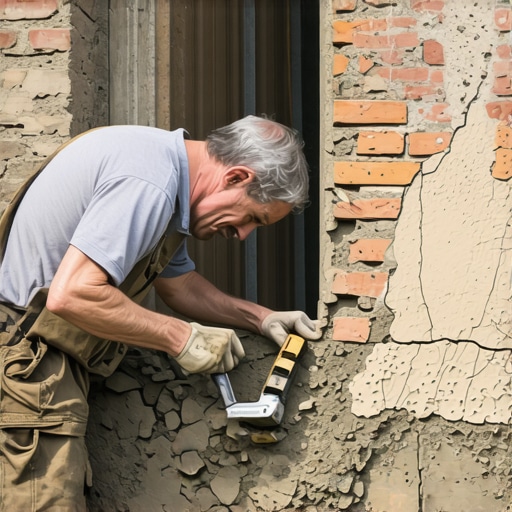
The Forensic Scene: Why Your Facade is Screaming
The homeowner thought it was just a hairline crack. But when I put my scope inside the cavity between the wythes, I saw the truth: the structural steel lintel was rusted to dust, expanding to three times its original thickness and heaving the masonry upward. This isn’t just a cosmetic blemish; it’s a symptom of a systemic failure in the building’s envelope. I’ve seen this a thousand times. A ‘handyman’ comes in, slaps some hardware store caulk or, worse, high-strength Portland cement into the gap, and calls it a day. Within two winters, the brick faces start popping off like bottle caps. This is what happens when you treat a breathing, moving organism like a static pile of rocks. To understand how to fix a cracked brick facade, you have to understand the chemistry of the mud and the physics of the wall.
“Water penetration is the single greatest threat to masonry durability. Proper drainage and mortar selection are the primary defenses against structural degradation.” – BIA Technical Note 7
The Physics of the ‘Sacrificial’ Joint
In historic brickwork repointing, the first thing you have to learn is the principle of the sacrificial lamb. In an old wall—pre-1940—the mortar is designed to be the weakest link. It is soft, porous, and lime-based. Why? Because the building moves. It expands in the summer sun and shrinks in the winter frost. If the mortar is softer than the brick, the stress of that movement is absorbed by the mortar joint. The joint cracks, you repoint it, and the building lives another fifty years. But when a modern ‘mason’ uses Type S Portland cement on historic clay, the mortar becomes harder than the brick. Now, when the wall moves, the brick has to give. The result is spalling—where the face of the historic brick salvage literally shatters because it has nowhere to go. This is the difference between tuckpointing (the aesthetic art) and structural repointing (the forensic necessity).
The Micro-Science of the Stitch
When we talk about ‘stitching’ a facade, we aren’t just talking about full repointing services. We are talking about mechanical reinforcement. If a wall has a vertical shear crack, you can’t just ‘butter’ the joint and expect it to hold. You need to perform a surgical intervention. We use stainless steel helical bars. We grind out the horizontal bed joints about 18 inches on either side of the crack, butter the groove with a high-performance thixotropic grout, and embed the steel. This ‘stitches’ the two sides of the fracture together, distributing the load across the masonry unit rather than letting it concentrate on the crack. This is critical for brick column repair where the load-bearing requirements are immense. You aren’t just filling a hole; you are restoring the tensile strength of a material that naturally has none.
“Mortar should always be weaker than the masonry units it binds, ensuring that stresses are relieved through the joints rather than the units themselves.” – ASTM C270 Logic
The Chemistry of Lime and Carbonation
Modern concrete dries through a chemical hydration process that happens in hours. Historic lime mortar? It ‘cures’ through carbonation. It literally breathes in CO2 from the atmosphere to turn back into limestone. This process can take weeks, even months. This is why you see us ‘misting’ a wall for days after we finish. If the mud dries too fast—a phenomenon called ‘flash setting’—it loses its tooth. It won’t bond to the historic brick salvage. It just sits there like a loose tooth in a gum, waiting to fall out. When we perform historic tuckpointing, we are matching the suction (the initial rate of absorption) of the old brick. If you put a high-suction brick against a low-water-retention mortar, the brick will suck the life out of the mortar before it can bond. You end up with a ‘dry joint’ that has no structural integrity.
Beyond the Brick: Stone and Retaining Walls
It’s not just about the clay. Stone wall repair and stone balustrade restoration require a completely different set of metrics. Stone is often denser, and the thermal mass is greater. But the biggest killer I see in the field is hydrostatic pressure. I recently inspected a stone wall repair project where the wall was bowing out by four inches. The culprit? Clogged weep holes. Water is heavy—62.4 pounds per cubic foot. When it gets trapped behind a wall, it’s like a slow-motion hydraulic ram. Regular retaining wall weep hole cleaning is the most ignored maintenance task in the industry. Without a way for that water to escape, the wall is doomed, no matter how much structural repointing you do. You have to respect the water. If you don’t give it a path, it will make its own, usually through the middle of your masonry.
The Tools of the Trade: The Hawk and the Slicker
You can tell a real mason by the way they handle their hawk and slicker. We don’t just ‘slap’ mud into a joint. We use a slicker (a narrow jointer tool) to pack the mortar in layers. If you try to fill a one-inch deep joint in one pass, you’ll get shrinkage cracks. You have to pack it, let it ‘thumb-print’ hard, and then apply the next lift. This ensures the mud is compressed against the ‘tooth’ of the stone or brick. For historic tuckpointing, we add a ‘bead’ of contrasting color—the ‘fillet’—to give the illusion of perfectly straight, narrow joints even if the bricks are irregular. It’s a trick of the light that requires a steady hand and a deep respect for the craftsmen who came before us.
The Bottom Line: Do It Once or Do It Twice
Whether it’s brick column repair or a massive stone balustrade restoration, the physics don’t lie. You cannot cheat the freeze-thaw cycle. You cannot ignore the elastic modulus of your materials. If you see ‘honeycombing’ in your concrete or a ‘cold joint’ where a new pour didn’t bond to an old one, you’re looking at a future failure point. I tell my clients: masonry is an investment in centuries. If you hire a ‘lick-and-stick’ contractor who uses a 4-inch grinder to chew up your brick edges while ‘cleaning’ the joints, you’re paying them to destroy your home’s value. True full repointing services involve hand-chiseling or using specialized oscillating blades that preserve the masonry unit. It’s slower. It’s more expensive. And it’s the only way to ensure that when you’re gone, the wall is still standing. Don’t let a ‘handyman special’ turn your historic treasure into a pile of historic brick salvage before its time.