
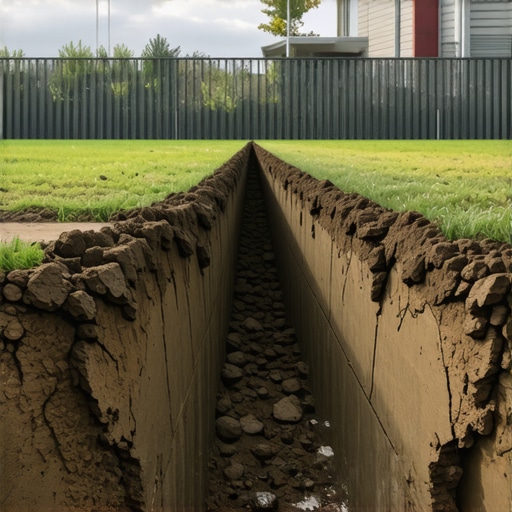
The Autopsy of a Fallen Wall
I stood looking at a $50,000 retaining wall that lay in a pile of rubble because the contractor forgot one thing: drainage. It wasn’t just a failure of stone; it was a failure of physics. The homeowner was staring at a heap of expensive modular retaining walls that had tilted, heaved, and finally surrendered to the weight of a rain-soaked hillside. You could smell the sour, anaerobic scent of stagnant water trapped behind the blocks—a clear sign that the ‘mud’ had won. Most people think a wall fails because the stone is weak. They’re wrong. A wall fails because the ground beneath it turns into a liquid, and the ‘pro’ you hired didn’t understand hydrostatic pressure.
“Water penetration is the single greatest threat to masonry durability, and in subterranean or earth-retaining structures, its mismanagement leads to structural catastrophe.” – BIA Technical Note 7
The Physics of the Base: Why Compaction is King
When we talk about modular retaining walls, we aren’t just stacking blocks like Legos. We are engineering a gravity-defying system. The most common sin I see in forensic inspections is a lack of ‘tooth’ in the base. If you’re building on raw clay without a proper 57-stone or 411-crushed-stone base, you’re essentially building on a sponge. In the North, where we deal with the brutal freeze-thaw cycle, that moisture is your executioner. Water expands 9% when it freezes. If that water is trapped in the soil behind your wall, it exerts thousands of pounds of pressure per square foot. Without a clear path for that water to exit—usually through weep holes or a perforated pipe wrapped in silt-blocking fabric—the wall will eventually ‘blow out’ at the bottom or ‘lean’ at the top.
Micro-zooming into the soil chemistry, we have to look at the angle of repose. Different soils have different shear strengths. Silt and clay hold water through capillary action, staying saturated long after the rain stops. When these particles become lubricated, they slide past one another. This is where self-leveling masonry lifts or concrete block foundation repair techniques often come into play during a rescue mission. If you don’t excavate deep enough to reach a stable subgrade and replace the ‘muck’ with compacted aggregate, the wall is doomed from the first course. I’ve seen walls where the contractor didn’t use a ‘hawk’ and a ‘slicker’ to properly finish the joints, but that’s cosmetic. The real crime is buried three feet underground in the lack of compaction.
The Silent Killer: Hydrostatic Pressure and Masonry Water Damage
Imagine the weight of a swimming pool pressing against the back of your wall. That is what happens during a heavy downpour when your drainage is clogged. This pressure is the primary cause of masonry water damage repair calls. It starts with a ‘stair-step’ crack. In a foundation, this might lead to foundation crack repair using epoxy injections, but in a retaining wall, it’s a death knell. The water forces its way through the porous structure of the stone. This is why porous stone sealers are not just an aesthetic choice; they are a defensive layer. Without them, the stone absorbs moisture, and when the temperature drops, the face of the stone ‘spalls’ or pops off, leaving the wall looking like it’s been through a war zone.
“The accumulation of water behind a masonry wall increases the lateral pressure significantly, often exceeding the design capacity of the masonry units themselves.” – ASTM C1552 Standards
We see a similar phenomenon in chimney rebuild services. A chimney is just a vertical retaining wall for heat and smoke. If the chimney flue liner installation was botched, moisture from the combustion process condenses inside the flue and seeps into the brickwork. It’s the same physics: moisture trapped in a rigid structure. Whether you’re looking at chimney sweep and repair or tuckpointing curved walls, the goal is always ‘breathability.’ You cannot trap water. You must give it a way out. In historic restoration, we use soft lime ‘mud’ because it acts as a wick, drawing moisture out of the brick. Modern Portland cement is too hard; it traps the water and destroys the brick from the inside out.
The Anatomy of a Proper Fix
So, your wall is leaning. Do you need a ‘Band-Aid’ or a ‘Cure’? A ‘Band-Aid’ is what the local handyman offers—slapping some ‘butter’ (mortar) into the cracks and calling it a day. A ‘Cure’ involves addressing the geotechnical reality. This might mean installing helical piers if the wall is part of a concrete block foundation repair, or it might mean a total teardown and rebuild using geogrid reinforcement. Geogrid is a high-tenacity polymer mesh that locks into the stone and the soil behind it, creating a unified mass that is much heavier and more stable than the stones alone. When I’m tuckpointing curved walls that are part of a tiered landscape, I’m looking for these structural anchors. If they aren’t there, I know I’m looking at a wall with a shelf-life of five years, tops.
Don’t be fooled by ‘lick-and-stick’ veneer or contractors who promise a cheap fix. Masonry is the art of managing gravity and water. If you ignore the ‘suction’ of the soil and the expansion of the water, the mud will always reclaim your investment. Whether you are investing in chimney sweep and repair to keep your flue safe or foundation crack repair to keep your basement dry, remember: the cheapest price is usually the most expensive in the long run. Do it once, do it right, and keep the mud where it belongs—under your boots, not over your wall.