
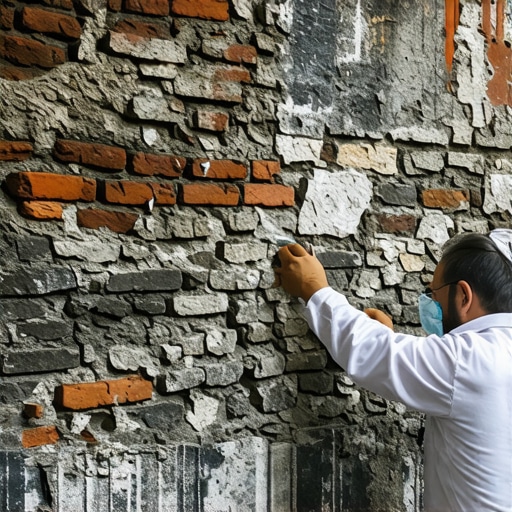
The Ghost in the Wall: Why Forensic Mortar Analysis is Your Building’s Only Hope
The homeowner thought it was just a hairline crack. But when I put my scope inside that 1920s facade, I saw the structural steel was rusted to dust, expanded to three times its original size, and was literally exploding the brickwork from the inside out. This wasn’t a ‘settling’ issue. This was a chemical execution. The building was being strangled by a previous ‘repair’ where a contractor used modern Type S Portland cement on top of soft, lime-based historic brick. I’ve spent thirty years in the mud, following in the footsteps of my father and grandfather, and if there is one thing I’ve learned, it’s that you can’t lie to physics. When you smear hard, non-breathable mud over a hundred-year-old wall, you aren’t fixing it—you’re signing its death warrant. This is why full repointing services must always begin with a forensic lab analysis of the existing materials. We aren’t just matching a color; we are matching a molecular signature.
The Physics of the Death Grip
In the world of historic masonry, the mortar is the sacrificial lamb. It is designed to be softer and more permeable than the surrounding brick or stone. This is intentional. Moisture is an inevitable guest in any wall system. It enters through capillary action and must have a way to exit. In a proper lime-mortar system, the moisture travels through the mortar joints and evaporates. However, when a ‘handyman’ comes in and performs commercial tuckpointing using high-strength Portland cement, the exit path is blocked. This creates a vapor-impermeable barrier. Now, the moisture is trapped. During a freeze-thaw cycle, that water expands by 9% in volume. Since it can’t push through the hard cement ‘slicker’ joint, it pushes through the face of the brick, leading to ‘spalling’—where the beautiful, hard-fired face of your historic masonry simply pops off, leaving a soft, crumbly interior exposed to the elements. This is the ‘death grip’ of modern materials on old bones.
“Water penetration is the single greatest threat to masonry durability, and the use of mortars with high cement content on historic buildings is a primary cause of masonry decay.” – BIA Technical Note 7
Micro-Zooming into the Chemistry: The Carbonation Cycle
To understand why sustainable tuckpointing mortars are different, we have to look at the chemistry of lime. Modern cement cures through a hydraulic reaction—add water, and it turns into a rock almost instantly. Historic lime mortar, specifically Type O or pure lime putty, cures through carbonation. As the ‘mud’ sits in the wall, it slowly absorbs carbon dioxide from the atmosphere, turning from calcium hydroxide back into calcium carbonate. This process can take months, even years, to fully complete. The result is a material that is ‘self-healing.’ If a tiny micro-crack forms due to building vibration or thermal expansion, the lime can actually re-crystallize and seal the crack. Modern cement can’t do that. Once it cracks, it’s a highway for water. When we perform a brick column repair, we are looking for that specific ‘tooth’ in the original aggregate. We perform a sieve analysis to see if the original mason used river sand or bank sand. If the grains are rounded, the mortar will have a different capillary profile than if the grains are sharp and angular. Shoving the wrong sand into a joint is like trying to put a Ferrari engine in a tractor—it just doesn’t mesh.
The Lintel and the Soldier Course: A Structural Nightmare
Often, the first sign of a mortar mismatch is seen in the brick lintel replacement cycle. The lintel is the horizontal structural member over a window or door. When the mortar around a lintel is too hard, it doesn’t allow for the thermal expansion of the steel. Steel expands at a different rate than masonry. If the mortar is flexible, it absorbs that movement. If it’s brittle, the pressure builds until the soldier course—those bricks standing vertically above the window—starts to ‘jack’ upward or ‘step-crack’ outward. I’ve seen brick column repair jobs where the entire core was ‘honeycombing’ because the exterior had been ‘buttered’ with a hard shell, while the interior was literally rotting away from trapped humidity. This is the same reason why stone veneer over brick is a recipe for disaster in historic contexts. You are essentially shrink-wrapping a living, breathing organism.
Efflorescence: The White Flag of Surrender
When I see a building covered in white, powdery stains, I don’t just see a cleaning job. Brick efflorescence removal is a diagnostic process. Those salts are being carried to the surface by moisture. If the salts are sitting on the surface, the wall is still breathing somewhat. but if those salts are trapped behind a hard repointing job, they crystallize inside the brick pores—a process called sub-florescence. The pressure of those crystals growing is enough to shatter the internal structure of the clay. This is why we don’t just ‘slick’ a joint and leave. We analyze the salt content. We look at the modular retaining walls nearby to see if ground salts are wicking up through the foundation. Even a simple patio stone realignment can be affected by the same hydrology. If the sub-base isn’t compacted with the right ‘fines,’ you get a cold joint between the earth and the stone, leading to the same salt-wicking issues we see in high-rise facades.
“The mortar should always be weaker than the masonry units so that any stress-induced cracking occurs in the mortar joints, which are easily repaired, rather than in the masonry units.” – ASTM C270 Standard Specification
The Forensic Lab Process: Science Over Guesswork
So, how do we fix it? We don’t guess. We take a sample of the existing ‘mud’ from deep within the wall—usually about two inches back where the sun and rain haven’t reached. We use acid digestion to dissolve the binder, leaving only the aggregate. We then weigh the remaining sand to find the exact binder-to-aggregate ratio. Was it 1:3? 1:2.5? We look at the sand under a microscope to find the mineralogy. If we’re doing green roofing masonry integration, we also have to account for the increased organic acids that will be leaching into the masonry from the soil above. This requires a custom-blended mortar that can withstand a lower pH environment without losing its structural integrity. It’s about ‘buttering’ the brick with a material that recognizes its neighbor. When we ‘strike’ the joint with a slicker or a jointer tool, we are compacting the face to create a weather-tight seal while maintaining the internal porosity. It’s a delicate dance of hawk and trowel that most modern ‘bucket-and-brush’ crews simply don’t understand. They want to move fast. They want to use ‘hot’ mixes that set up in an hour. But in restoration, speed is the enemy of longevity. You want a slow cure. You want a mix that stays ‘fatty’ on the hawk and ‘bites’ into the brick with the right amount of suction. If the brick is too dry, it sucks the water out of the mortar too fast, and the ‘mud’ burns, becoming a crumbly mess that will fail within five years. We pre-hydrate the wall, bringing it to a ‘saturated surface dry’ state before a single trowel of mortar is applied. That is the difference between a repair that lasts a lifetime and one that just lasts until the check clears. Do it once, or do it twice—the choice is always yours, but the building will eventually tell the truth.”