
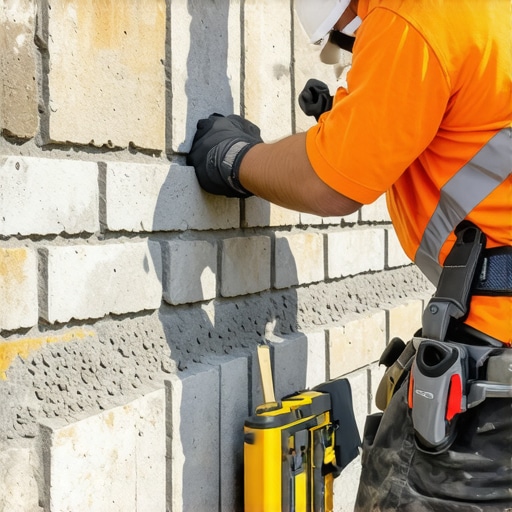
The Forensic Scene: When a Hairline Crack Becomes a Structural Grave
I was standing on a job site last November, looking at what the homeowner described as a ‘simple loose stone.’ It was a retaining wall cap, a heavy piece of bluestone that had wiggled free. But when I slid my borescope into the cavity beneath that stone, the story changed. The structural steel reinforcement was gone—not missing, but rusted into a red, powdery ghost of its former self. This is the reality of masonry neglect. That single broken cap had allowed decades of North-country rainwater to seep directly into the core of the wall. This isn’t just about aesthetics; it is about the physics of containment. When a cap fails, the wall’s ‘roof’ is gone, and the countdown to a total collapse begins.
The Physics of the Freeze-Thaw War
In regions where the mercury dips below thirty-two degrees, masonry isn’t a static object; it is a battlefield. Water is the only substance on Earth that expands by 9% when it freezes. When that moisture gets trapped behind a soldier course or beneath a poorly seated cap, it exerts thousands of pounds of pressure per square inch. This is what we call spalling. If your retaining wall doesn’t have a functional cap, that water infiltrates the honeycombing within the core. Eventually, the face of the brick or stone simply pops off, leaving the soft, porous interior exposed to the elements. This is why masonry water damage repair is never just about a bucket of mortar; it is about managing the hydration and dehydration cycles of the structure.
“Water penetration is the single greatest threat to masonry durability.” – BIA Technical Note 7
The Anatomy of a Smarter Repair: Fiber-Reinforced Mortars
Traditional ‘mud’—what we call standard mortar—is often too brittle for the high-stress environment of a retaining wall cap. When we talk about a smarter way to replace these units, we are looking at fiber-reinforced mortars. These aren’t your grandfather’s mixes. They contain microscopic synthetic fibers that act like a thousand tiny rebar rods, providing tensile strength that standard Portland cement lacks. This prevents the ‘cold joint’—that weak point where new mortar meets old—from becoming a fracture line. When buttering the stone, we ensure a 100% coverage rate. Any void is a reservoir for ice, and ice is a crowbar that will rip your hard work apart.
Advanced Masonry Adhesives: The Modern Bond
For some applications, the old ways aren’t the best ways. We are seeing a massive shift toward advanced masonry adhesives. These polyurethanes offer a level of flexibility that traditional mortar cannot match. A retaining wall is constantly moving, shifting with the hydrostatic pressure of the soil behind it. A rigid mortar bed will crack under this stress, but a high-performance adhesive can flex. However, you can’t just ‘lick-and-stick’ it. You have to prep the substrate. You have to grind out the old, ‘punky’ mortar until you hit solid stone with a good ‘tooth.’ If you don’t have a clean surface, your adhesive is just sticking to dust, and dust has zero shear strength.
The Grout Line Defense: Pointing and Tuckpointing
Once the cap is set, the defense isn’t finished. You have to look at the brickwork pointing styles. A flush joint might look clean, but a concave joint, struck with a slicker, actually compacts the mortar and sheds water more effectively. For older walls, we often employ historic tuckpointing. This isn’t just for looks. In a historic restoration context, we use a softer lime-based mortar. Why? Because the mortar must be the ‘sacrificial’ element. If the mortar is harder than the brick—which is often the case with modern Portland cement—the brick will be the thing that cracks when the wall shifts. We want the mortar to fail first because it’s cheaper and easier to replace than a hundred-year-old handmade brick.
“The mortar should always be weaker than the masonry units it binds, ensuring that stresses are relieved through the joints rather than the units themselves.” – ASTM C270 Standards
Structural Integrity: Brick Infill Panel Repair
Often, a broken cap is a symptom of a deeper problem, like a failing foundation or a shifting brick infill panel. When we perform brick infill panel repair, we are looking at how the wall breathes. If you’ve got a cavity wall, those ‘weep holes’ at the bottom are there for a reason. I’ve seen ‘handyman specials’ where some guy with a tub of caulk plugged up the weep holes, thinking he was ‘weatherproofing.’ All he did was create a vertical swimming pool inside the wall. The resulting emergency masonry repair bill was five times what the original maintenance would have cost. A smarter repair means understanding the flow of moisture from the cap all the way to the footing.
The Role of Fire-Rated Masonry in External Structures
While it sounds counterintuitive for an outdoor wall, fire-rated masonry installation techniques are becoming vital, especially near outdoor kitchens or fire pits. The thermal expansion near a heat source can blow a standard concrete cap to pieces. By using refractory materials and specialized mortars, we ensure the wall can handle the ‘flash setting’ and thermal shock without losing its structural bond. This is where full repointing services become a safety requirement, not just a cosmetic upgrade.
Conclusion: Do It Once, or Do It Twice
The ‘lick-and-stick’ method of the modern era is a cancer on the trade. Whether you are dealing with a simple cap replacement or a complex foundation stabilization, the physics remain the same. You need a mechanical bond, a chemical bond, and a clear path for water to exit the system. If you ignore the ‘suction’ of the stone or the ‘tooth’ of the mortar, you are just building a pile of rubble that hasn’t fallen down yet. Invest in full repointing services and high-quality fiber-reinforced mortars now, or prepare to replace the entire wall in five years. The choice is yours, but the stone never lies. “